HVAC Technician Resume Sample (USA): HVAC Service Technician Resume Example for 2026
Complete guide · 11 min read · Updated 2026
An HVAC résumé is read by a service manager deciding whether they can put you in a truck on your own. Before they read a bullet they are looking for four things: your EPA Section 608 certification type, the equipment you have worked on, whether you install, service or both, and some sign that your repairs stay fixed. Everything else on the page argues for those four.
Below is a complete HVAC technician résumé sample for a US residential and light-commercial service career, annotated section by section, plus what changes for a first job out of trade school, for a move into commercial work, and for the UK, Canada and Australia. The sample is a senior service technician with eight years in Phoenix, who came up through installation and now runs a territory and trains apprentices.
How does your HVAC technician resume score?
Upload your resume and get its ATS score out of 100, with each finding quoting the line it is about. Free, no account, and the file never leaves your browser — it is read locally and scanned on the results page.
Choosing your template
An HVAC résumé is a record of equipment, certifications and measured results, and a single-column layout is what keeps each of those attached to its context. It keeps the tonnage next to the rooftop unit, the certification type next to the date, and the callback rate next to the checklist that lowered it. A two-column design with a skills sidebar tends to lose that: an applicant tracking system can read the sidebar as a separate block, so "heat pumps, ductless mini-splits, ServiceTitan" arrives as a list of words with no job attached. Contractors and service companies increasingly post through the same tracking systems as everyone else, and a plain, single-column page is the one both the software and a busy service manager read in the right order.
Browse all 20 templates →Section-by-section: what to write
Header and title line
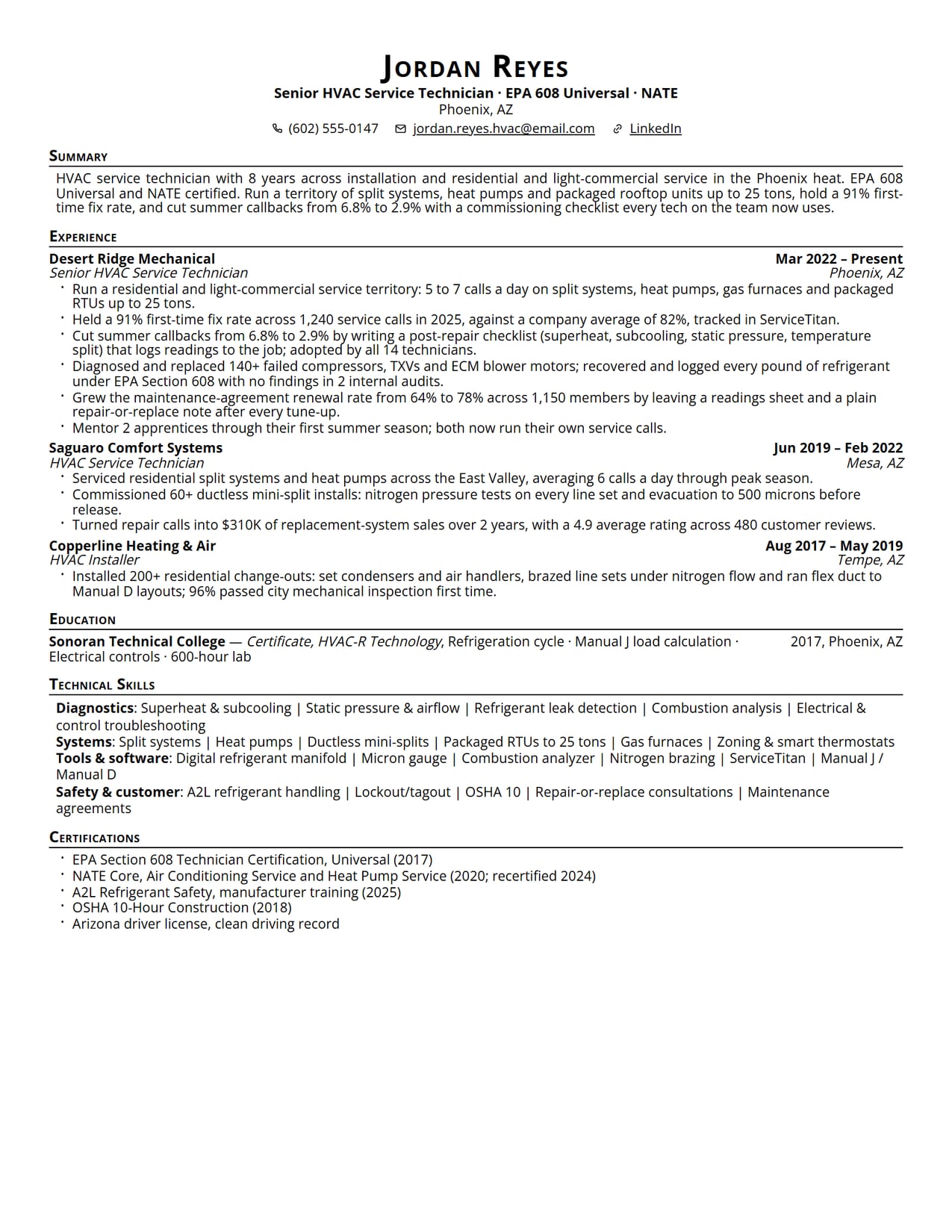
Put the role and your two strongest credentials in the title line: "Senior HVAC Service Technician · EPA 608 Universal · NATE". A service manager's first question is whether you can legally handle refrigerant on the systems they service, and the title line answers it before anything else. Add a phone number you actually answer during working hours, because trades hiring moves by phone.
Professional summary
Three lines and at least three numbers. Years in the trade, the split between installation and service, the equipment range, and one result a manager cares about: first-time fix rate, callback rate, or maintenance-agreement renewals. Skip "hard-working and reliable". Every applicant writes it, and a callback rate says the same thing in a form someone can check.
Experience: the current role
Open by sizing the work rather than listing duties: residential or commercial, calls per day, equipment types and the largest tonnage you service. Then give the numbers a service manager runs the business on: first-time fix rate against the company average, callbacks before and after, parts replaced, and agreement renewals. End with anything that shows you train people, because a technician who can bring on an apprentice is worth more than one who cannot.
The service technician years
Keep an earlier service job as its own entry with its own numbers. Commissioning detail is what separates a careful technician from a fast one, so write the procedure: nitrogen pressure tests, evacuation to a stated micron level, readings logged before release. If you sold replacement systems from repair calls, say so with a figure and a customer rating beside it, so it reads as trusted advice rather than pressure.
The installer years, kept short
One or two bullets. Installation experience explains where your hands-on fundamentals came from and dates the start of your career in the trade. Make the one bullet count: the number of change-outs, the work involved, and the first-time inspection pass rate, which is the installer metric a service manager respects most.
Education and training
Name the programme, the school and the year, and list what it covered in a few words: refrigeration cycle, load calculation, electrical controls, lab hours. If you trained through a union or employer apprenticeship instead, write that here with its length. If you have no formal training, leave this section out and let certifications and experience carry the page.
Skills, split four ways
Diagnostics, systems, tools and software, and safety and customer work. Four labelled groups let a manager confirm four different capabilities in one glance, and they stop you writing "HVAC systems" where the posting says heat pumps, ductless mini-splits or rooftop units by name. Name the dispatch or field-service software you have used, because many contractors screen for it.
Certifications
Every line gets its type and a date. For EPA Section 608, write the type (I, II, III or Universal), because the type decides which equipment you may service. Put NATE specialties, OSHA cards and manufacturer training on their own lines, and include a clean driving record if the role comes with a company vehicle, because for many service jobs it is a condition of hire.
HVAC Technician resume sample, annotated
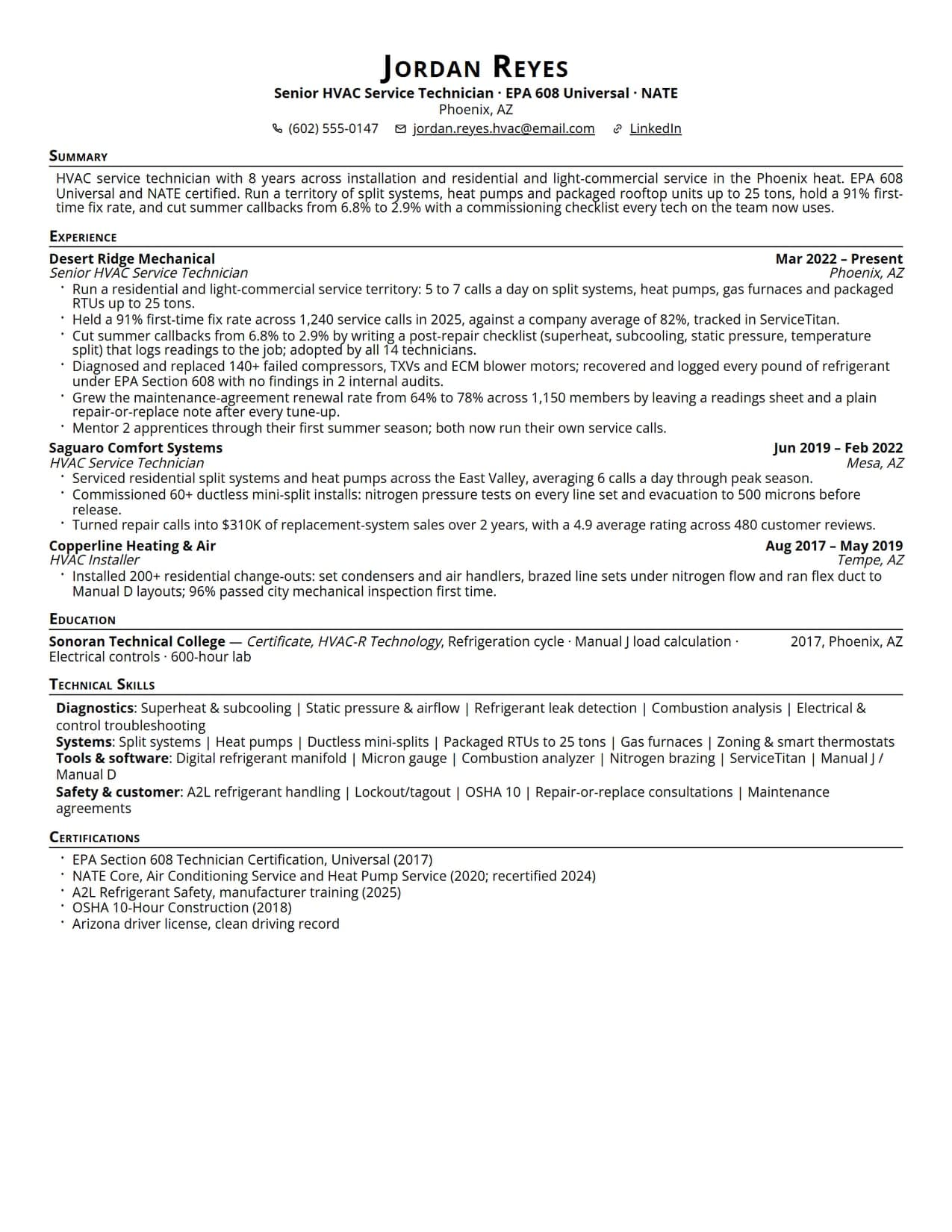
Jordan Reyes, a senior HVAC service technician in Phoenix with eight years across installation and residential and light-commercial service, holding EPA 608 Universal and NATE certification and a 91% first-time fix rate
Eight years, three employers, four labelled skill groups and five certification lines on one page. Read it as a structure to copy rather than wording to copy, and pay attention to where the annotations say it falls short, because a sample that only praises itself teaches nothing.
The annotations follow the page top to bottom, in the order a service manager reads it.
Header and title line
"Senior HVAC Service Technician · EPA 608 Universal · NATE" is the best decision on the page. Seniority, role and the two credentials a manager screens on arrive in one line. Most HVAC résumés put the certification at the very bottom and make the reader scroll to answer the first question they had.
Contact line
A local area code, a phone number and a LinkedIn profile, with no street address. That is right: trades hiring moves by phone, and the city in the title block is enough to show the commute works. The weakness is the lack of any licence or driving line near the top for a role that plainly involves a truck.
Professional summary
Three lines carrying eight years, the install-to-service path, the equipment range, a first-time fix rate and a callback reduction. The strongest phrase is "cut summer callbacks from 6.8% to 2.9%", because callbacks cost a contractor money and reputation at once. "In the Phoenix heat" is colour rather than evidence, though it does tell a reader these systems run hard.
First entry: the sizing bullet
"5 to 7 calls a day on split systems, heat pumps, gas furnaces and packaged RTUs up to 25 tons" answers the level question before any achievement lands. A commercial manager can see the ceiling, a residential one can see the volume. Compare it with "performed HVAC service and repair", which opens most résumés in this trade and would describe someone in their first week.
The first-time fix bullet
91% across 1,240 calls, against a company average of 82%, with the software named. The comparison is what makes it land: a percentage on its own could be good or ordinary, and the average beside it settles that. Naming ServiceTitan also tells a contractor using it that you need no training on dispatch.
The callback bullet
The strongest bullet on the page. It has a before and after, the mechanism (a checklist of superheat, subcooling, static pressure and temperature split logged to the job) and adoption across 14 technicians. That last clause turns a personal habit into a team result, which is what gets a technician considered for a lead role.
The refrigerant and audit bullet
140+ major component replacements, with recovery and recordkeeping under Section 608 and no findings in two audits. Refrigerant compliance is a real exposure for a contractor, and this line quietly says you are not one. The count is a little vague with its plus sign; an exact figure from the job history would be stronger.
The maintenance-agreement bullet
64% to 78% renewal across 1,150 members, with the reason attached: a readings sheet and a plain repair-or-replace note after every tune-up. Agreement renewals are recurring revenue, so this is the bullet an owner reads twice. The method is what makes it credible rather than a claim to have sold harder.
The apprentice bullet
Short and correctly placed last. Two apprentices through a first summer, both now running calls. It shows leadership without a title, and for a senior technician applying for a lead or field supervisor role it is the line that makes the jump plausible.
The service technician years
Commissioning detail, stated as procedure: nitrogen pressure tests and evacuation to 500 microns before release. A manager reads that and knows the installs were done properly. The $310K sales figure sits beside a 4.9 rating across 480 reviews, which stops the sales line reading as pressure selling.
The installer years, kept to one bullet
Correctly sized. 200+ change-outs, the work involved and a 96% first-time inspection pass rate. It dates the start of the career and explains where the hands-on fundamentals came from, then gets out of the way.
Education
A certificate programme with a year and four topics, including load calculation and lab hours. That is all a service manager needs. The line runs long on one row; splitting the topics into the detail line would read more cleanly.
Skills, split four ways
Diagnostics, systems, tools and software, and safety and customer work are the right four groups for this trade, and naming a digital manifold, micron gauge and combustion analyzer says more than any "proficient with HVAC tools" line. The weakness is "Zoning & smart thermostats", which is a little vague next to the specific items around it.
Certifications
Five lines, each with a date where one applies: EPA 608 with its type, NATE with its specialties and recertification year, A2L safety training, OSHA 10 and the driving record. The type on the 608 line is the detail most technicians leave out. The driving record belongs here, but it should also be in the header for a service role that comes with a vehicle.
The honest gap
There is no state or local licence line, no mention of on-call or after-hours work, and no commercial controls or building automation experience. For a light-commercial role the last one may be the first question. Bring those to the interview; the résumé's job is to get you on the ride-along.
What a service manager checks in the first few seconds
HVAC hiring is a capacity problem before it is a judgement problem. A contractor has more calls than trucks, especially in peak season, and the first pass through applications is a series of yes-or-no checks rather than a careful read. A gap at any one of them ends it.
Five questions, roughly in this order.
Turn HVAC duties into evidence: eight rewrites
Every line below is something HVAC technicians genuinely write. The rewrite keeps the same fact and adds the scale, the method or the result that makes it worth reading.
Instead ofPerformed HVAC service and repair.
WriteRan 5 to 7 residential and light-commercial service calls a day on split systems, heat pumps, gas furnaces and packaged RTUs up to 25 tons.
The first version describes the trade. The second tells a manager your volume, your equipment range and the largest system they can send you to.
Instead ofDiagnosed and repaired HVAC systems.
WriteHeld a 91% first-time fix rate across 1,240 service calls in 2025, against a company average of 82%.
Diagnosis is the job. A fix rate with the company average beside it proves you are good at it, in a number the manager already tracks.
Instead ofResponsible for quality workmanship.
WriteCut summer callbacks from 6.8% to 2.9% with a post-repair checklist of superheat, subcooling, static pressure and temperature split, adopted by all 14 technicians.
Quality is an adjective until you give it a callback rate. Naming the readings shows the method, and team adoption shows it worked for other people too.
Instead ofInstalled ductless systems.
WriteCommissioned 60+ ductless mini-split installs: nitrogen pressure test on every line set and evacuation to 500 microns before release.
Anyone can say they installed something. Stating the pressure test and the micron level tells a manager the systems were commissioned properly and will not come back.
Instead ofHandled refrigerant according to regulations.
WriteRecovered and logged refrigerant on 140+ compressor, TXV and ECM motor replacements under EPA Section 608, with no findings in 2 internal audits.
Compliance claims are cheap. A replacement count and an audit result make the claim specific and checkable.
Instead ofSold maintenance agreements.
WriteGrew the maintenance-agreement renewal rate from 64% to 78% across 1,150 members by leaving a readings sheet and a repair-or-replace note after every tune-up.
Agreements are recurring revenue. The before and after shows the effect and the method explains it, so it reads as good service rather than sales pressure.
Instead ofProvided excellent customer service.
WriteTurned repair calls into $310K of replacement-system sales over 2 years, with a 4.9 average rating across 480 customer reviews.
Every applicant claims excellent service. A sales figure next to a rating shows customers trusted the recommendations and were glad afterwards.
Instead ofTrained new employees.
WriteMentored 2 apprentices through their first summer season; both now run their own service calls.
Training is a duty. An outcome, apprentices now working alone, is what makes a manager picture you as a lead technician.
A first HVAC job: what actually counts
Almost every technician starts as an apprentice, helper or trade-school graduate, and service managers know it. A first application is judged on whether you can learn safely and quickly, so lead with things that prove it.
What to lead with, by kind of employer
The same experience should be arranged differently depending on where you send it. This is the edit most technicians never make.
| Where you are applying | Lead with | Do not bury |
|---|---|---|
| Residential service company | Calls per day, first-time fix rate, callbacks, customer ratings | Agreement renewals and replacement sales, which the owner reads twice |
| New construction installer | Change-out or install counts, inspection pass rate, duct and line-set work | Load calculation and duct design training |
| Light commercial | RTU tonnage, economisers, controls you have worked on, preventive maintenance routes | Any building automation exposure, however small |
| Commercial and industrial | Chillers, boilers, VRF, controls and building automation systems | EPA 608 Type III or Universal, stated plainly |
| Facilities and property management | Preventive maintenance programmes, work-order systems, multi-site coverage | Energy savings with a figure and a period |
| Refrigeration | Walk-ins, reach-ins, racks, ice machines, and the refrigerants you handle | Leak-rate records and recordkeeping |
Certifications, written so a manager can act on them
The certification block is short and it is the one HVAC applicants most often write carelessly. Three rules cover it.
First, write the type or specialty, not just the credential's name. The EPA describes Section 608 certification in four types: Type I for small appliances, Type II for high- and very high-pressure appliances except small appliances and MVACs, Type III for low-pressure appliances, and Universal for all types of equipment. "EPA certified" hides the only detail a manager needs.
Second, date each line. The EPA states that Section 608 credentials do not expire, so the year you certified is enough there. Other credentials have their own renewal rules, so write the year certified and, where it applies, the year last renewed, exactly as the issuing body shows it.
Third, keep training and credentials apart. A manufacturer course is worth listing, but label it as training so it is not mistaken for a certification with an exam behind it.
Outside the US: the same résumé, a different credential
The structure of this page travels well: size the work, name the equipment, quote the service numbers, date the credentials. What changes is the credential a hiring manager looks for first, and using the wrong country's name for it is the quickest way to look unqualified.
In the United Kingdom the document is a CV, and the refrigerant credential is F gas certification. GOV.UK's guidance on qualifications for working with F gas says a category 1 certificate covers all activities on stationary refrigeration, air conditioning and heat pump equipment, while a category 2 certificate covers installing, maintaining, servicing and recovering refrigerant from systems containing less than 3kg of F gas, or less than 6kg if hermetically sealed. Write the category. The same guidance notes that a UK F gas certificate is not valid for work in the EU.
In Australia the credential is a refrigerant handling licence under the ARCtick scheme. Its full RAC01 licence is described as allowing work on air conditioning and refrigeration equipment and handling refrigerant for any work other than the automotive industry, while other licence types are narrower, including one limited to split systems and heat pumps under 18kW. Write the licence type and number format as it appears on your card.
In Canada, Refrigeration and Air Conditioning Mechanic is a Red Seal trade, described as installing, maintaining, servicing and retrofitting residential, commercial, industrial and institutional heating, ventilation, air conditioning and refrigeration units and systems. Put the Red Seal endorsement and your provincial certificate on separate lines, because trade titles and requirements vary by province.
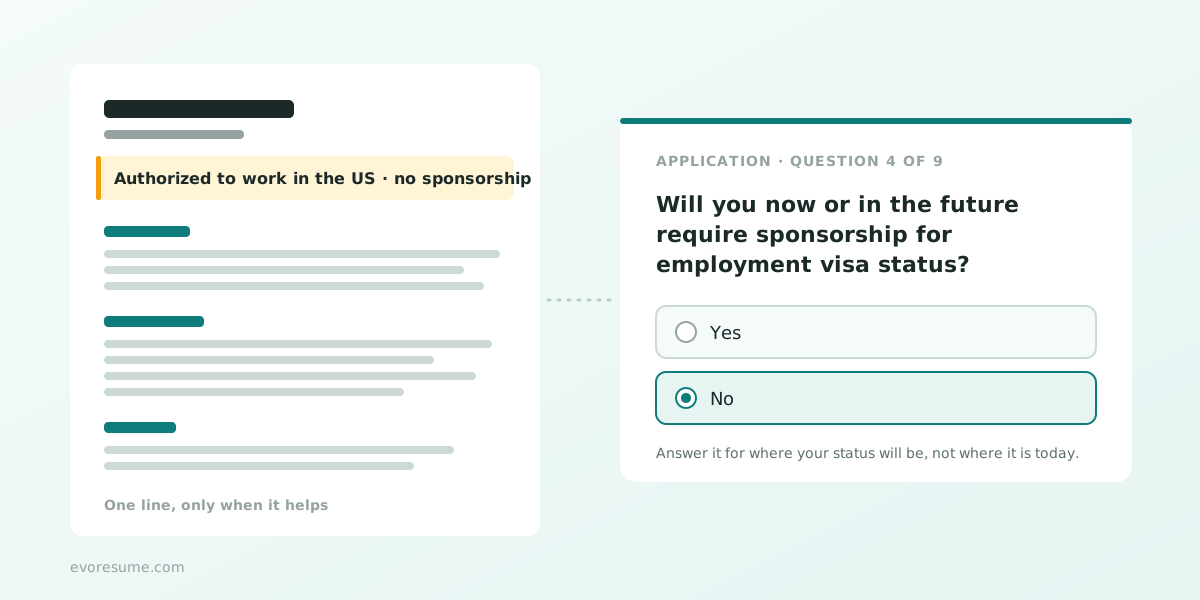
If you are moving country with the trade, one more line matters: your right to work. Our guide to work authorization on a résumé covers when to state it, the wording that works in each country, and how to answer the sponsorship question honestly.
Keywords ATS looks for
Weave these into your resume where they’re true to your experience, and always mirror the exact wording from the specific job post you’re applying to.
Common mistakes to avoid
HVAC Technician resume: FAQ
What should an HVAC technician put on a resume?
Your EPA Section 608 certification type, the equipment you have serviced or installed, whether you work residential or commercial, and three or four numbers a service manager can check: calls per day, first-time fix rate, callback rate, and maintenance-agreement renewals or replacement sales. Add NATE specialties, OSHA cards and a clean driving record where the role comes with a vehicle. Keep the page to one column so the equipment, certification and results stay attached to each other.
Which EPA 608 certification should I list on my resume?
The one you hold, with its type. The EPA's Section 608 certification requirements describe four types: Type I for servicing small appliances, Type II for servicing or disposing of high- or very high-pressure appliances except small appliances and MVACs, Type III for servicing or disposing of low-pressure appliances, and Universal for servicing all types of equipment. Write the type exactly, such as "EPA Section 608 Technician Certification, Universal (2017)", because it tells the reader which equipment you may legally work on.
Does EPA 608 certification expire?
No. The EPA states that Section 608 Technician Certification credentials do not expire. That is why the year you certified is enough on a résumé. Other credentials behave differently, so check each issuing body's rules before you write a date, and keep your 608 card or its certifying organisation's details handy, because employers commonly ask to see it.
How do I write an HVAC resume with no experience?
Lead with what can be checked. Your EPA 608 certification with its type, your trade school or apprenticeship programme with its hours, the systems you worked on in the lab, and any related work where you used tools, read wiring diagrams or dealt with customers. Name the instruments you have used, such as a manifold gauge or micron gauge. Skip an objective statement and use those lines for a short summary that names the certification and the programme instead.
Should I put my HVAC service numbers on my resume?
Yes, if you can stand behind them. First-time fix rate, callback rate, calls per day, agreement renewals and replacement sales are the numbers service managers use to run a business, and very few applicants write them down. Take them from your field-service software or your manager's reports, round down rather than up, and put the company average beside yours where you know it.
How long should an HVAC technician resume be?
One page for most technicians. The sample on this page fits eight years, three employers, four skill groups and five certifications on a single page without cutting anything a manager needs. Go to two pages only when commercial project lists, controls work or supervisory experience genuinely need the room.
What is the job outlook for HVAC technicians?
Good. The US Bureau of Labor Statistics puts May 2025 median pay for heating, air conditioning and refrigeration mechanics and installers at $61,010 a year, with 440,900 jobs in 2025 and employment projected to grow 11 percent from 2025 to 2035, which it describes as much faster than the average. It projects about 40,600 openings a year on average. Typical entry-level education is a postsecondary nondegree award, and the BLS notes that the EPA requires nearly all HVAC technicians to be certified in proper refrigerant handling.
Do HVAC technicians need a license?
It depends where you work. The BLS says some states and localities require HVAC technicians to be licensed, separately from EPA refrigerant certification, so check the rules for the state and city in the posting. On a résumé, write any state or local licence with its number format and expiry exactly as it appears on the card, and do not describe yourself as licensed where only the contractor you work for holds the licence.