Warehouse Resume Sample: Warehouse Associate Example for 2026
Complete guide · 14 min read · Updated 2026
Warehouse hiring moves faster than almost any other field. A site with forty open pick-pack roles is not reading resumes for style, it is scanning each one for four things: can you drive the trucks we run, have you worked our kind of operation, can you hit a rate, and is your safety record clean. Everything else gets read after those four.
Below is a complete warehouse associate resume sample, annotated section by section, plus what changes for order pickers, forklift operators, inventory clerks, shift leads and first-time applicants with no warehouse experience. The sample is a US associate with six years across three distribution centres — the profile most warehouse postings are written for. UK, Australian and New Zealand readers will see the same page under a different name, and the conventions that differ are set out further down.
Choosing your template
A warehouse resume is a short document carrying a lot of small verifiable facts: which forklift classes you are evaluated on, which warehouse management system you used, what rate you held, how many trailers you turned. A single-column layout keeps each of those next to the job it belongs to, in one reading order. The two-column warehouse templates that circulate as free downloads put certifications in a sidebar, which is where a parser most often detaches a forklift class from the employer that evaluated you. Staffing agencies and third-party logistics firms also run high-volume applicant tracking systems, so the layout has to survive being read by software before a human sees it.
Browse all 20 templates →Section-by-section: what to write
Header and job title
Name, then the job title you are applying for as a line directly under it — "Warehouse Associate", "Forklift Operator", "Order Selector". Applicant tracking systems match your title line against the posting's, so a header carrying only a name gives the software nothing to match. Then city and state (or town and county), phone and a plain email address. Skip the street address; warehouse recruiters only need to know you are within commuting distance of the site.
Professional summary
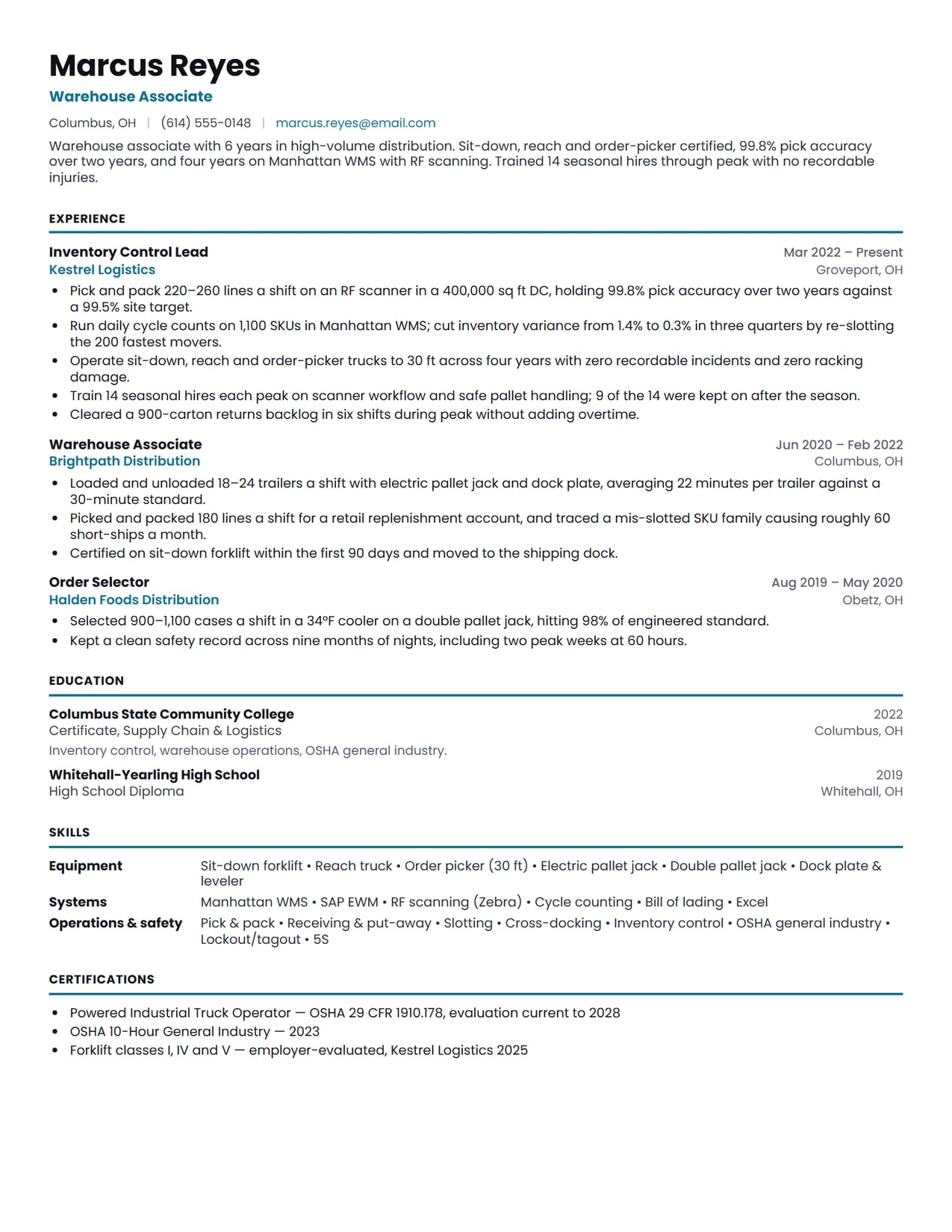
Three or four lines, and every one of them a fact. Years in warehousing, the equipment you are certified on, the rate or accuracy figure you can defend, and the WMS you worked in. "Warehouse associate with 6 years in high-volume distribution, sit-down and reach certified, 99.8% pick accuracy" tells a shift manager more in one line than a paragraph about being hard-working and reliable. Save the objective statement for a genuine first warehouse job.
Work experience
For each job: title, company, city and state, and dates by month. Then what the operation actually was and what you carried in it — site size, whether it was ambient, chilled or frozen, units or lines or cases per shift, the accuracy or rate you held, the trucks you drove. "Pick and pack 220 to 260 lines a shift on an RF scanner in a 400,000 sq ft DC at 99.8% accuracy" is the level of detail that gets a call. "Responsible for picking and packing" is the level that does not.
Earlier roles and progression
Warehouse careers move sideways and upwards in small visible steps: selector to associate, associate to lead, ambient to chilled, pallet jack to reach truck. Show them. Two roles at the same site with different titles and dates read as a promotion; one merged entry reads as six years of standing still. Keep earlier roles shorter than your current one, two bullets each, and use them to show the equipment and environments you have added.
Education and training
A high school diploma or GCSEs are enough for most warehouse roles and are worth stating plainly, because some application forms will not progress without them. Any logistics or supply chain certificate belongs here with the awarding college and the year. If you left school without formal qualifications, do not invent a line — put the training you have done instead, and let the certifications section carry the weight.
Skills, split by equipment and systems
Split them so a reader can scan: equipment, systems, then operations and safety. Name each truck type you can actually be evaluated on rather than writing "forklift" once — sit-down counterbalance, reach truck, order picker with the height you work at, electric and double pallet jack. Name the WMS: "Manhattan", "SAP EWM", "Blue Yonder", "Körber". Sites search for their own system literally, and "warehouse software" matches none of them.
Certifications and licences
Give this its own heading rather than folding it into skills. Powered industrial truck operator training under OSHA 29 CFR 1910.178 has to be re-evaluated at least every three years, so put the evaluation date on it. In the UK there is no fixed legal retraining interval, but the Health and Safety Executive suggests employers consider a gap of three to five years before a refresher, so date an RTITB or ITSSAR certificate too. Add OSHA 10 or 30, any manual handling or first aid training, and a food safety certificate if you have worked chilled or ambient food. A certification with no date reads as one nobody has checked.
Warehouse Associate resume sample, annotated
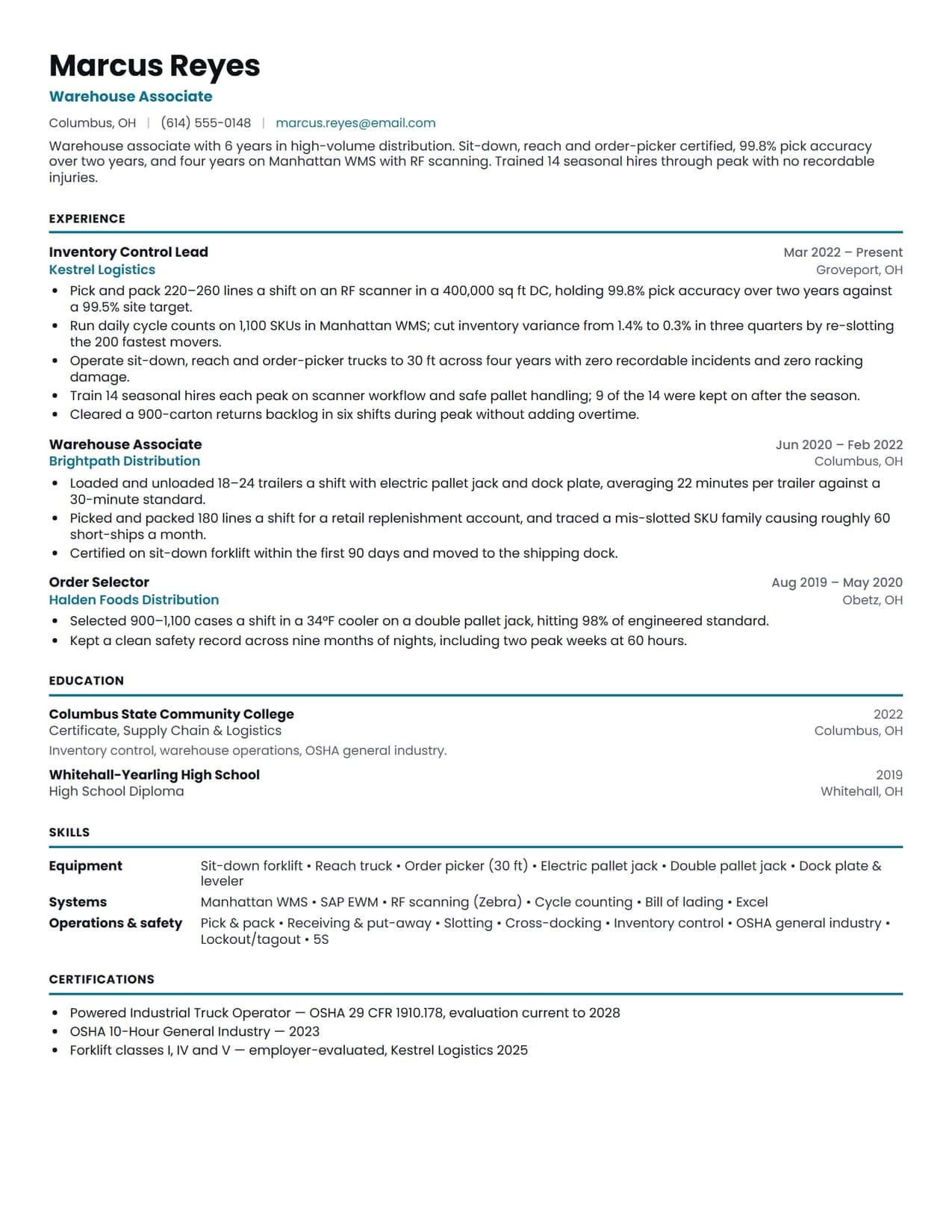
Marcus Reyes, a warehouse associate and inventory control lead in Columbus, Ohio with six years across three distribution centres
This is a complete warehouse associate resume for someone six years into the work, on one page, which is what this profile should look like. Read it as a structure to copy rather than wording to copy — the annotations below say where it is strong and where a real applicant should push harder.
They follow the page top to bottom, in the order a warehouse recruiter reads it.
Header and title line
Name, then "Warehouse Associate" as a title line, then city, phone and email on one row. The title line is doing real work: it is what an applicant tracking system compares against the posting, and it is the first thing a shift manager checks. If the posting says "Order Selector", change this line to match.
What this header does not need
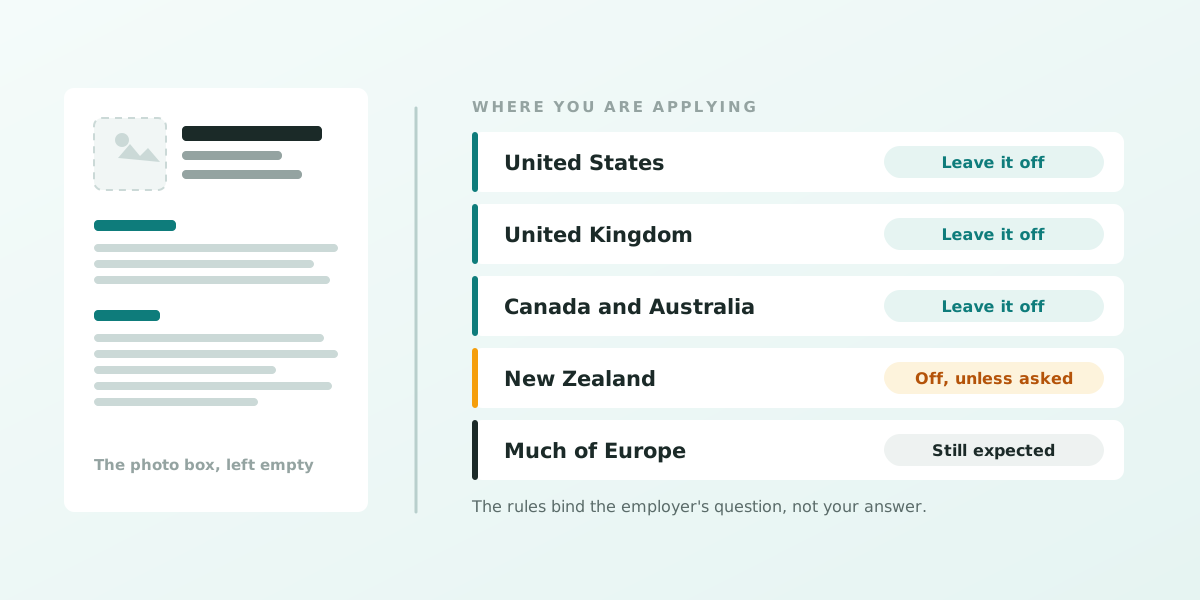
There is no street address, no photo and no date of birth, and that is correct on a US resume. UK and Australian readers can drop the same three. What is worth adding in the space you save is one line of availability — "Available nights and weekends" — because it answers a screening question before it is asked.
Professional summary
Four facts in three lines: six years, the truck classes, 99.8% pick accuracy over two years, and four years on Manhattan WMS. Every one of them is checkable and every one of them is a filter term. The last sentence carries the safety record and the training work, which is what separates an associate from a lead.
The first job's bullets
The strongest line is the first one, because it stacks four facts into a sentence: the throughput, the tool, the site size and the accuracy against a named target. The cycle-counting bullet is the second strongest, because variance from 1.4% to 0.3% has both ends of the number and names the action that moved it. Two ends of a number is the difference between a claim and evidence.
The safety line
"Zero recordable incidents and zero racking damage" across four years is placed inside the job rather than in a separate safety block, which is right — it belongs to the operation it happened in. Racking damage is a specific and expensive thing to a warehouse manager, so naming it lands harder than a general claim about safety awareness.
The training bullet
Fourteen seasonal hires trained, nine kept on. Retention is the number a site manager is measured on through peak, so this is the bullet that reads as leadership without the word appearing anywhere. If you have trained anyone, find the number.
Earlier roles
Three jobs in six years with visible progression: order selector in a cooler, then associate on a shipping dock, then inventory control lead. The earlier entries are deliberately shorter. The last bullet under Brightpath — certified on sit-down within 90 days, then moved to the dock — is doing a lot of quiet work, because it shows someone who picks up equipment quickly.
Education
A supply chain certificate above the high school diploma, both with locations and years. For six years of experience this sits correctly below the work history. Someone applying for their first warehouse job should move this block above experience and add any coursework that touched inventory, health and safety, or equipment.
Skills, in three labelled groups
Equipment, systems, then operations and safety. This is the section that survives a keyword filter, and it survives because everything is named specifically: the truck types separately rather than "forklift", Manhattan WMS and SAP EWM by name, the scanner brand. Trim anything here you could not answer a question about.
Certifications
Its own heading, with dates on every line, including the OSHA regulation the forklift training sits under. This is the block most warehouse resumes get wrong by burying under "Other" or leaving undated. A UK version of this page would name RTITB or ITSSAR here instead, and would add the manual handling certificate.
What a warehouse recruiter checks in the first ten seconds
Warehouse hiring is a volume exercise. A distribution centre staffing up for peak may be reading several hundred applications for the same role, which means the first pass is not a reading at all, it is a search for four answers.
Get all four onto the first third of the page and the rest of your resume actually gets read.
Turn warehouse duties into evidence: eight rewrites
Every warehouse worker picks, packs, loads and counts. Listing those verbs describes the role, not you. What distinguishes you is the volume you moved, the accuracy you held it at, the equipment you held tickets for, and anything that measurably improved because you were on the shift.
Instead ofResponsible for picking and packing customer orders.
WritePicked and packed 220 to 260 lines a shift on an RF scanner in a 400,000 sq ft DC, holding 99.8% accuracy against a 99.5% site target.
Throughput, tool, site size and accuracy against a named standard. "Responsible for" describes a job description; the rewrite describes a shift.
Instead ofOperated forklifts safely.
WriteOperated sit-down, reach and order-picker trucks to 30 ft across four years with zero recordable incidents and zero racking damage.
Three specific truck classes are three keyword matches. "Safely" is unfalsifiable; a four-year clean record with racking named is not.
Instead ofLoaded and unloaded trucks.
WriteTurned 18 to 24 trailers a shift with electric pallet jack and dock plate, averaging 22 minutes a trailer against a 30-minute standard.
Volume plus a rate beaten. A dock supervisor reads the second version and immediately knows whether you can hold their door.
Instead ofPerformed inventory counts.
WriteRan daily cycle counts on 1,100 SKUs in Manhattan WMS and cut variance from 1.4% to 0.3% in three quarters by re-slotting the 200 fastest movers.
The system is named, the scope is sized, the number has both ends, and the action that moved it is stated. That last part is what makes it yours.
Instead ofTrained new staff.
WriteTrained 14 seasonal hires each peak on scanner workflow and safe pallet handling; 9 of the 14 were kept on after the season.
Retention through peak is the metric warehouse managers are judged on. A training claim with a retention number attached is a hiring argument.
Instead ofFollowed all health and safety procedures.
WriteCompleted OSHA 10 general industry, ran lockout/tagout on the case sealer, and reported two near misses that led to a guard being refitted on the infeed.
Naming the training, the procedure and an actual near-miss outcome shows a safety culture rather than claiming one. A near miss you reported is a credit, not a mark against you.
Instead ofWorked well under pressure during busy periods.
WriteCleared a 900-carton returns backlog in six shifts during peak without adding overtime.
A backlog with a size, a time to clear it and a constraint you worked inside. "Under pressure" is what everyone writes and nothing anybody can check.
Instead ofUsed a scanner to process stock.
WriteProcessed goods-in on RF scanners against ASN, resolving short and over-shipments at the door rather than passing them to inventory control.
Naming the document you check against and the problem you solve at your own step tells a manager you understand where errors get expensive.
Warehouse resume with no experience: what actually counts
First warehouse jobs are one of the more open doors in the labour market, because sites train in-house and hire heavily for peak. The mistake is trying to disguise the lack of experience instead of leading with the things that genuinely transfer.
What to lead with, by warehouse role
The evidence that gets you an order-picking job is not the evidence that gets you an inventory or a shift-lead job. Leading with the wrong category is the clearest sign you have not read the posting.
| Role | Lead with | Also useful | Avoid leading with |
|---|---|---|---|
| First warehouse job | Availability, physical paced work, any stock handling | Manual handling or first aid training, willingness to train on trucks | Unrelated office experience |
| Order picker / selector | Lines or cases per shift, accuracy, environment (ambient, chilled, frozen) | Voice pick or RF experience, engineered standard hit | General "warehouse duties" |
| Forklift operator | Truck classes and evaluation date, racking type and pick heights | Load securement, damage record, VNA experience | "Forklift" as a single skill |
| Goods-in / receiving | Trailers turned, ASN and PO checking, discrepancy handling | Bill of lading, put-away accuracy, supplier claims | Picking figures |
| Inventory / stock control | Variance moved, SKU count, cycle count cadence, WMS by name | Slotting work, root-cause examples, Excel depth | Volume-only picking bullets |
| Shipping / dispatch | On-time dispatch rate, load planning, carrier paperwork | Load securement, hazmat handling, dock scheduling | Vague "logistics support" |
| Shift lead / supervisor | People supervised, rate and accuracy for the team, retention | Rota and holiday planning, toolbox talks, audit results | Your own individual pick rate |
| Cold storage | Hours in temperature, cases per shift at that temperature, kit used | Food safety certificate, cold-chain documentation | Ambient-only experience |
| Warehouse agency / temp | Every site type and system worked, immediate availability | Contracts grouped under the agency, induction speed | Short assignments listed as separate jobs |
Forklift certification, dates and what employers actually accept
This is the section most warehouse resumes get wrong, and the fix takes one line per certificate. What matters is the truck class, who assessed you, and when.
How warehouse applications actually get screened
High-volume warehouse recruitment runs through applicant tracking systems and agency databases, and warehouse resumes break them more often than most, because free warehouse templates lean heavily on sidebars, icons and tables.
The warehouse job market, and what it means for your resume
Two things are worth knowing before you decide which postings to chase and what to ask for.
The US Bureau of Labor Statistics puts the 2025 median pay for hand labourers and material movers at $38,220 a year, or $18.38 an hour, across an occupational group of about 6.9 million people, and projects it to grow 4% between 2025 and 2035, about as fast as the average across all occupations. Within that group the medians separate: $40,240 for labourers and freight, stock and material movers, and $37,330 for stockers and order fillers. It is a large and liquid market, which is why specific detail on your resume matters more than polish. There is no shortage of postings, only a shortage of applications that answer the four screening questions quickly.
Final checks before you apply
Keywords ATS looks for
Weave these into your resume where they’re true to your experience, and always mirror the exact wording from the specific job post you’re applying to.
Common mistakes to avoid
Warehouse Associate resume: FAQ
What should a warehouse resume include?
A title line matching the posting, a three-to-four-line summary with your years, certified truck types and a rate or accuracy figure, work experience with the site size and what you carried per shift, education, skills split into equipment, systems and safety, and a certifications section with dates. If you can work nights or weekends, say so — availability is a screening question in warehouse hiring in a way it is not in most fields.
How do I write a warehouse resume with no experience?
Lead with the things that transfer and are checkable: any job with a physical pace and a standard to hit (kitchen, retail stockroom, groundwork, delivery, farm work, military), any inventory or stock handling you have done, and your availability. State plainly that you hold no forklift certification yet and are willing to be trained — many distribution centres train in-house and would rather have that said than discover it at induction. Add any manual handling, first aid or food safety training you already hold.
How do I list forklift certification on a resume?
Name the truck classes and the date you were last evaluated: "Powered industrial truck operator — OSHA 29 CFR 1910.178, classes I, IV and V, evaluated 2025". US certification is employer-specific under OSHA and has to be re-evaluated at least every three years, so a new employer will re-evaluate you anyway; the date shows the training is current. In the UK, name the accrediting body — RTITB, ITSSAR or AITT — because employers ask for it by name.
How long should a warehouse resume be?
One page for almost everyone. Warehouse hiring is high volume and the screening question set is short, so a page with real numbers on it beats two pages of duties. Go to a second page only if you have supervisory experience, several sites, or a long certification list that genuinely will not fit.
What is the difference between a warehouse operative CV and a warehouse associate resume?
Mostly vocabulary and one page of convention. "Warehouse operative" is the UK, Irish and Australasian job title; "warehouse associate" or "warehouse worker" is American. A UK CV normally names the counterbalance and reach truck licence with its accrediting body, may run to two pages without penalty, and never carries a photo; a US resume keeps to one page and cites OSHA-based training. The content underneath — equipment, rate, accuracy, systems, safety record — is identical.
What skills do employers look for on a warehouse resume?
Truck types you are evaluated on, the warehouse management system you have used, RF or barcode scanning, picking and packing to a rate, receiving and put-away, cycle counting and stock accuracy, load securement and wrapping, and demonstrable safety practice such as lockout/tagout or manual handling training. Name the specific tools and systems rather than the general category — that is what both a shift manager and a keyword filter are reading for.
Should I put my pick rate on my resume?
Yes, if you know it and can defend it in an interview. Rate and accuracy are the two numbers warehouse managers manage against, so a candidate who quotes them is speaking the language of the job. Give the context with the number — units or lines or cases, per shift or per hour, and the target you were measured against — because a bare figure means nothing across different operations.
Do warehouse jobs use an ATS?
Large distribution operations and the staffing agencies that supply them almost always do, because the application volume makes manual reading impossible. Keep the layout single column, use standard headings, avoid tables for your job history, export a text-based PDF unless the form asks for Word, and mirror the posting's job title in your header. You can check how your resume parses and scores before you send it with the free ATS score check.