Chef Resume Sample: Executive Sous Chef Resume Example for 2026
Complete guide · 13 min read · Updated 2026
Chef resumes are usually written about food and read about money. The candidate lists cuisines, techniques and the famous kitchens they passed through; the chef-owner or GM doing the hiring reads for food cost, labor cost, covers, and whether the last kitchen fell apart when this person ran it. Both halves matter, but only one of them decides who gets the call, and it is not the tasting-menu half.
Below is a complete chef resume, annotated section by section, with guidance for line cooks moving up, sous and executive roles, banquets and hotels, and the jump into the first head-chef job. The sample is an executive sous chef eleven years in, running a 60-seat kitchen doing 300 covers a night.
Choosing your template
Kitchen careers are readable as a straight line — station to lead to sous to exec — and a clean single-column layout shows that climb without decoration. The numbers do the persuading: covers, food cost percentages, brigade sizes. Restaurant hiring also moves fast and often through a phone screen the same day, so a resume that scans in fifteen seconds fits how the industry actually hires.
Browse all 20 templates →Section-by-section: what to write
Header and title line
Name, then your real kitchen title: line cook, lead, sous, executive sous, chef de cuisine, executive chef. Kitchens run on brigade titles and the reader levels you off this line instantly, so use the title you held, not an aspirational one.
Summary: the GM's three questions
Years and the path (line cook up is worth saying), the scale you run now (seats, covers, brigade size), and one money number with its target: "food cost at 27–28% against a 30% target". A staffing claim lands here too — kitchens are hired partly on whether cooks stay for you.
Experience: the kitchen as a business
Restaurant, role, dates, then bullets that treat the kitchen as an operation: revenue or covers, cost percentages held, waste cut, systems built (par sheets, prep plans, waste logs), people promoted. One bullet on menu work with its margin effect is plenty — the reader assumes you can cook.
Education
Culinary school in one line if you went; nothing to apologise for if you did not. In kitchens the resume's education section is the career itself, and "line cook to executive sous in eleven years" reads better than any diploma.
Skills, split kitchen from office
Kitchen management (costing, ordering, scheduling, menu development), culinary (the styles and stations you genuinely run), compliance (ServSafe, HACCP, allergen protocols). The management group is the one that gets you the interview for any role above line.
Certifications
ServSafe Manager current, HACCP if you hold it, alcohol service where relevant. Food-safety cards are verified and health-inspection history follows you in any small market, so keep the dates honest and current.
Chef resume sample, annotated
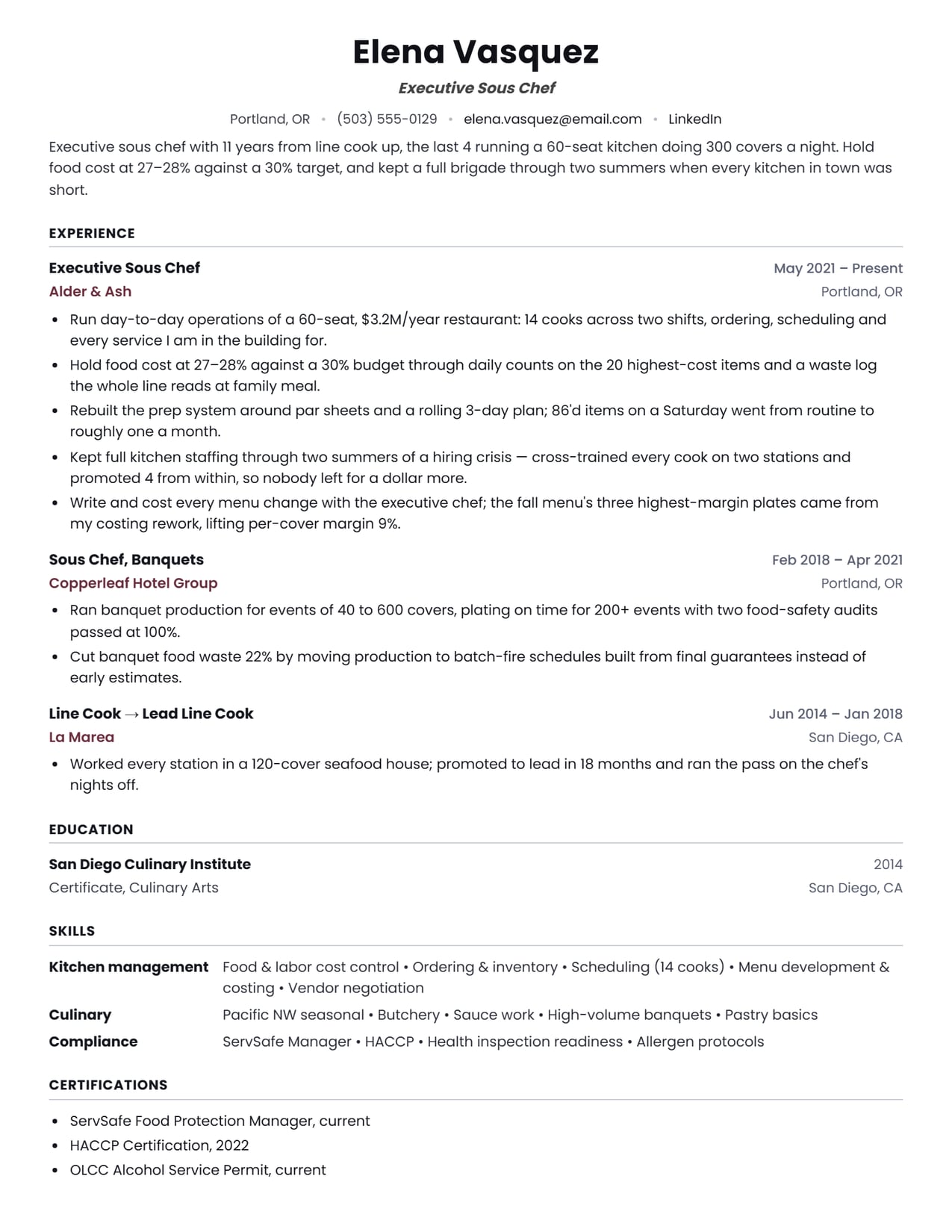
Elena Vasquez, an executive sous chef in Portland, eleven years from line cook to running a 60-seat kitchen
Eleven years on one page, line cook to executive sous, with the kitchen treated as a business in nearly every line: covers, revenue, cost percentages with their targets, waste, staffing held through a labor crisis. The cooking is present but it is never asked to carry the argument alone.
The annotations follow the page from the top.
Title and summary
"Executive Sous Chef" is the exact brigade title she holds, and the summary answers a GM's three questions in order: the path (line cook up), the scale (60 seats, 300 covers, 14 cooks), and a money number with its target.
The scope bullet
Revenue ($3.2M/year), brigade size, shifts, and "every service I am in the building for" — a plain sentence that tells the reader who actually runs this kitchen day to day.
The food-cost bullet
27–28% against a 30% budget, held by daily counts on the 20 highest-cost items and a waste log the line reads at family meal. The mechanism is the persuasive part: it is a system the reader can imagine installed in their own kitchen.
The 86 bullet
From routine Saturday 86's to roughly one a month, via par sheets and a rolling 3-day prep plan. Guests never see prep systems; they see items available. This bullet connects the system to the thing the business sells.
The staffing bullet
Full staffing through two summers of a hiring crisis, with the how: every cook cross-trained on two stations, four promoted from within. Every GM reading this has lost a summer to an empty line; this is the bullet they call about.
Menu work stated commercially
Costing rework that produced the fall menu's three highest-margin plates and lifted per-cover margin 9%. One line proves the creative work lands as money, which is the only way menu work persuades on paper.
The banquet years
40 to 600 covers, 200+ events plated on time, two audits at 100%, waste down 22% by scheduling production from final guarantees. Banquets argue scale and reliability, and every claim here is a number.
The climb, visible
Line cook to lead in 18 months, the pass run on the chef's nights off, then sous, then executive sous. The progression itself is the credential — this is what kitchens mean by paying dues, laid out in dates.
Skills split into three kitchens
Management first (costing, ordering, scheduling, menu development), culinary second, compliance third. The order mirrors what a GM is buying at this level: the food is assumed, the control is the product.
Certifications, current
ServSafe Manager, HACCP, alcohol service permit, each dated or marked current. Food-safety cards are the verifiable part of a chef resume, and inspection history is public — so the sample keeps this section boring and exact.
What a GM checks in the first fifteen seconds
Restaurant hiring is fast, personal and burned-before. The person reading your resume has usually watched a kitchen fail under someone who interviewed well.
Menus don't hire; margins do
The hardest habit for chefs writing resumes is leading with the food. The food is why you cook; it is not why you get hired above line level. The reader assumes competence at the stove the moment your title history is credible — what they cannot assume is that you can run the business end of a kitchen.
Turn kitchen duties into evidence: seven rewrites
Each rewrite takes a stock culinary-resume line and attaches the number or mechanism that makes a GM stop scrolling.
Instead ofManaged kitchen operations and supervised staff.
WriteRun day-to-day operations of a 60-seat, $3.2M/year restaurant: 14 cooks across two shifts, ordering, scheduling and every service.
Scope with numbers: seats, revenue, brigade, shifts. "Managed operations" could mean anything; this can only mean running the kitchen.
Instead ofControlled food costs and reduced waste.
WriteHold food cost at 27–28% against a 30% budget through daily counts on the 20 highest-cost items and a waste log the line reads at family meal.
Percentage, target and mechanism. The reader can install this system in their head while reading it.
Instead ofDeveloped new menu items seasonally.
WriteCosted and launched the fall menu with the executive chef; its three highest-margin plates came from my costing rework, lifting per-cover margin 9%.
Menu work stated as money. One line like this outperforms a paragraph of culinary influences.
Instead ofTrained and developed kitchen staff.
WriteKept full staffing through two summers of a hiring crisis — cross-trained every cook on two stations and promoted 4 from within.
Retention through the industry's worst labor market is the claim; cross-training and promotion are the believable how.
Instead ofPrepared food for banquets and large events.
WriteRan banquet production for 40 to 600 covers, plating on time across 200+ events with two food-safety audits passed at 100%.
Scale, reliability and a public-record-checkable audit result. Banquet work argues in exactly these three currencies.
Instead ofReduced kitchen waste through better planning.
WriteCut banquet food waste 22% by scheduling production from final guarantees instead of early estimates.
The percentage plus the specific planning change. Anyone who has run banquets recognises this fix as real.
Instead ofWorked all stations on the line.
WriteWorked every station in a 120-cover seafood house; promoted to lead in 18 months and ran the pass on the chef's nights off.
Station range, volume, speed of promotion, and trust (the pass) — the four things a sous hire is screened on, in one line.
Line, sous, exec, banquets: what each rung must prove
The brigade ladder is explicit, and each rung's resume answers a different doubt.
| Role | Lead with | Also useful | Avoid leading with |
|---|---|---|---|
| Line cook | Stations held, covers on your busiest service, reliability | Cross-training, prep speed, who trusted you with what | Culinary philosophy |
| Lead / CDP | The pass run, cooks broken in, chef's nights covered | Ordering exposure, prep-list ownership | Only your own station |
| Sous chef | Systems owned: scheduling, ordering, costing exposure, service run solo | Waste and 86 numbers moved, training record | Deference — the resume must show command |
| Executive sous / CDC | The kitchen as business: revenue, cost held vs target, brigade retention | Menu margin work, vendor negotiation, P&L exposure | Plating descriptions |
| Executive chef | P&L ownership, multi-outlet or concept scope, leaders developed | Openings, concept work, inspection record across years | Line-level detail |
| Banquets / hotel | Event scale, on-time plate-ups, audits, forecasting from guarantees | Union and brand-standard fluency, multi-kitchen coordination | À la carte nostalgia |
| First head-chef jump | Every ownership fragment: services run alone, budgets touched, people kept | A menu costed end to end, an owner who will vouch | Waiting to be asked — make the argument explicitly |
The stage, the tasting, and what the resume sets up
Above line level, chef hiring usually ends in a working interview: a stage, a tasting, or both. The resume's claims decide what you will be tested on.
How chef resumes get screened
Final checks before you apply
Keywords ATS looks for
Weave these into your resumewhere they’re true to your experience, and always mirror the exact wording from the specific job post you’re applying to.
Common mistakes to avoid
Chef resume: FAQ
What should a chef resume include?
Your brigade title, a summary with scale (seats, covers, crew) and one costed number, experience bullets that treat the kitchen as a business, culinary education in one line if any, skills split into management, culinary and compliance, and current food-safety certifications. One page for most careers; kitchens read fast.
How do I show food cost on a resume?
As a percentage held against a stated target, with the mechanism: "held food cost at 27–28% against a 30% budget through daily counts on the 20 highest-cost items and a posted waste log". The target makes it a claim about control rather than luck, and the mechanism makes it repeatable in the reader's kitchen.
What matters more on a chef resume: creativity or management?
Above line-cook level, management. The hiring GM is buying food cost held, a brigade that stays, services that run clean, and menus that hit margin. One bullet showing the creative work landing commercially — a menu change that lifted per-cover margin — covers creativity better than a list of influences.
How does a line cook write a resume to move up to sous?
Surface the sous-shaped work you already do: stations trained on others, the pass run on the chef's nights off, orders placed, prep lists written, new cooks broken in. "Promoted to lead in 18 months and ran the pass two nights a week" is the argument. Volume numbers — covers on your busiest service — carry weight at every level.
Do I need culinary school on a chef resume?
No. Kitchens are the most openly meritocratic hirers in this guide's catalogue: the career line is the credential. If you went, give it one line. If you did not, the years and titles answer the question, and drawing attention to the absence apologises for something the reader does not care about.
How do banquet and hotel chef resumes differ from restaurant ones?
Banquet resumes argue scale and reliability: event sizes, plate-up timing, audits passed, forecasting from guarantees. Restaurant resumes argue nightly consistency and cost control at speed. Hotels also weigh systems fluency — ordering platforms, forecasting, brand standards. Lead with whichever world the posting lives in, because each side suspects the other's habits.
Should a chef resume mention health inspection scores?
If they are good, yes: "two food-safety audits passed at 100%" or a clean multi-year inspection record is exactly the risk-reduction a GM wants stated. Inspection results are public in most markets, so the claim is checkable, which is what makes it valuable.
How long should a chef resume be?
One page. A kitchen career compresses well — titles, kitchens, covers, costs — and the reader is deciding whether to call you before tonight's service. Two pages is defensible only for exec careers spanning multiple properties with P&L history worth itemising.