Doctor & Medical CV Template with Examples (2026)
Complete guide · 16 min read · Updated 2026
Medical CVs run longer than other professions and lead with credentials rather than achievements. Your GMC number, royal college membership and training grade decide whether the rest of the document gets read at all.
Below is a worked medical CV sample, annotated section by section, written for a UK hospital doctor. This guide also covers the case where a CV is the wrong document: most NHS training posts recruit through Oriel application forms, and a CV does its work for consultant, trust grade, locum, private and international applications.

Recommended templates for doctors, nurses & healthcare
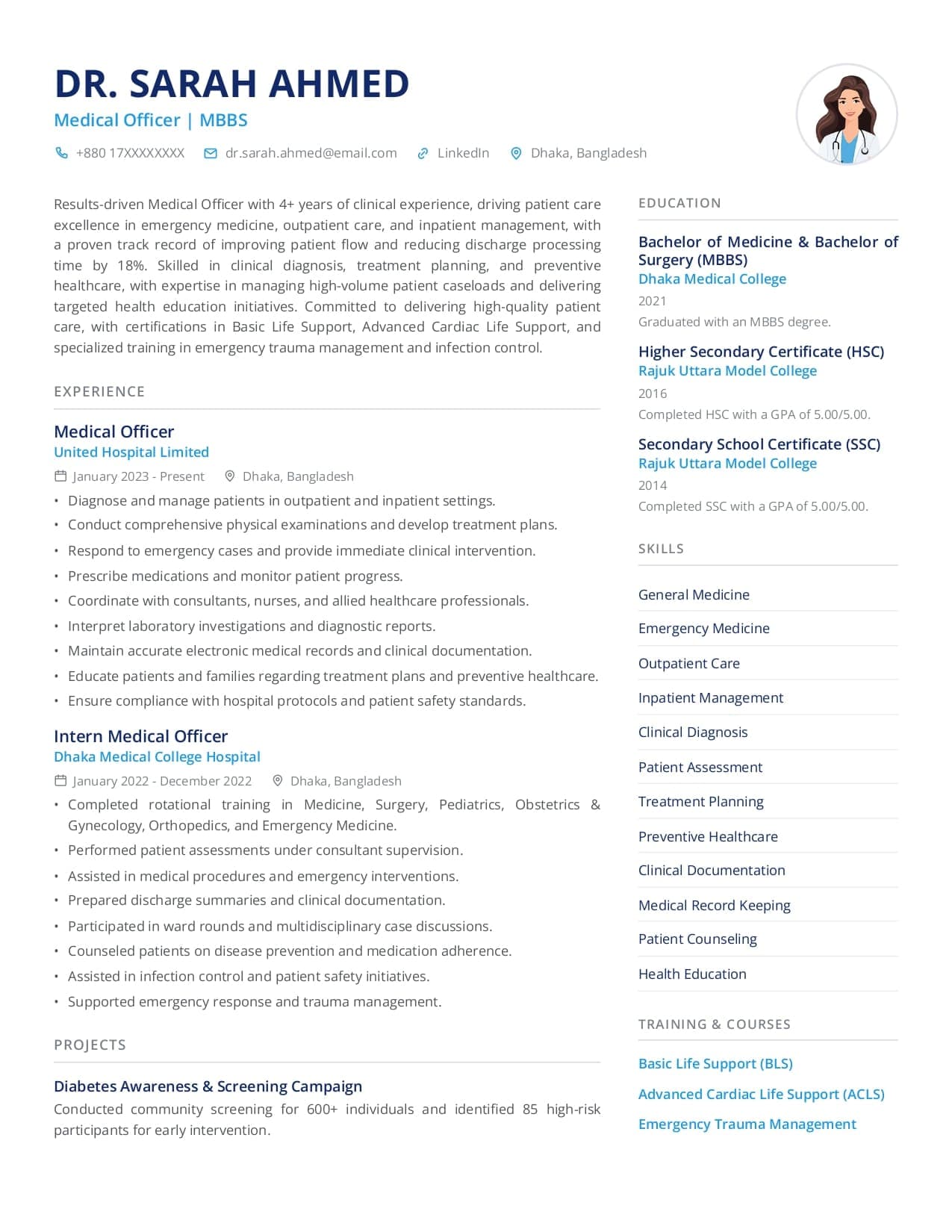
A medical CV carries more discrete verifiable facts than any other kind: registration numbers, exam sittings, rotations, audit cycles, publications, courses. A single-column layout keeps each of those next to its date in one reading order. Two-column medical templates routinely separate a qualification from the year it was awarded, and that pairing is the first thing a medical HR team checks.
 Pro
ProSection-by-section: what to write
Contact and registration
Title and name, GMC number (or NMC for nurses, HCPC for allied health), email, phone, city. Put the registration number in the header. UK medical HR verifies it before reading anything else, so burying it in a block at the end costs you time you cannot afford.
Professional profile
Three or four lines: your grade and specialty, years of post-qualification experience, the settings you have worked in, and one piece of evidence such as an audit outcome or a publication count. Name the grade precisely, for example "ST6 in acute internal medicine" rather than "senior doctor".
Qualifications and registration
Primary medical qualification, postgraduate exams, and registration status, each with awarding body and year. Write "MRCP(UK), Royal College of Physicians, 2021" rather than "MRCP". If you hold a licence to practise, say so, because registration without a licence means something different.
Clinical experience
For each post: grade, specialty, trust or hospital, dates. Then what you actually carried, such as take size, caseload, clinic numbers, procedures with counts, and who you supervised. "Led the acute medical take for a 1,100-bed centre, triaging 60 to 80 admissions per 24 hours" tells a reader more than a rotation list.
Audit and quality improvement
Give this its own section and state the full cycle: the problem, the intervention, the measured change, and whether you re-audited. Completed cycles carry far more weight than data collection, and this is where consultant panels look first.
Publications, presentations and teaching
Publications in Vancouver style with PMID where you have one. Presentations with the meeting name and whether it was oral or poster. Teaching with the audience and any formal training you hold, such as an educational supervisor course.
Courses and certifications
ALS, ATLS, APLS, Good Clinical Practice, and any specialty courses, each with the awarding body and year. Resuscitation certificates expire, so the year is what tells a reader whether yours is current.
What a medical CV has to prove
Medical recruitment checks facts before it forms an impression. Registration, exams and training grade are all verifiable against public registers, and the person reading your CV will verify them. That changes what the document is for: it is a structured evidence file, and the writing quality matters less than whether a reader can find each fact and confirm it.
A medical HR team or consultant panel works through four questions in order. Failing the first one ends the process regardless of what follows.
When a CV is the wrong document
Most UK doctors applying for training posts do not submit a CV. Foundation, core and specialty recruitment run through Oriel, which uses a structured application form, a scored self-assessment against published domains, and a portfolio you evidence at interview. There is no CV field, and time spent perfecting one is time not spent on the self-assessment scoring.
A CV is what you need for everything outside that pathway.
Registration and membership, stated correctly
This is the section where inaccuracy is caught fastest, because the GMC and NMC registers are public and searchable. State the awarding body, the status and the year, and use the postgraduate qualification's own naming.
Turn clinical duties into evidence: eight rewrites
Rotation lists tell a reader where you were, not what you carried. Every doctor at your grade rotated through the same specialties, so the rotation itself distinguishes nobody.
Instead ofWorked on the acute medical unit.
WriteLed the acute medical take for a 1,100-bed tertiary centre, triaging 60 to 80 admissions per 24-hour period.
Take size and hospital scale place your level immediately. A reader knows what that workload feels like.
Instead ofInvolved in a sepsis audit.
WriteRedesigned the sepsis pathway with ED and microbiology, cutting median door-to-antibiotic time from 94 to 41 minutes across 1,200 admissions, re-audited at 6 months.
Names the collaborators, the measured change and the re-audit. Closing the loop is what a panel asks about.
Instead ofCompetent in a range of practical procedures.
WriteIndependent in central venous access (60+), pleural aspiration and chest drain insertion (40+), ascitic drain (35+) and lumbar puncture (50+).
Numbers and independence level. "Competent in" is unassessable, and a supervisor signing your DOPS knows the difference.
Instead ofTaught junior doctors.
WriteDesigned and delivered a 6-session bedside teaching programme for 14 foundation doctors, rated 4.8 out of 5 across 28 responses.
Structure, audience size and feedback data. Teaching claims without evaluation carry little weight at consultant interview.
Instead ofPublished research during training.
WriteFour peer-reviewed publications, two as first author, including a retrospective cohort study of 840 admissions in Clinical Medicine (2024).
Authorship position and study size are what an academic reader is actually assessing.
Instead ofAttended departmental meetings.
WriteRepresented the medical registrar body on the trust deteriorating patient group, contributing to the revised NEWS2 escalation policy adopted across 4 sites.
Names the forum, the contribution and its reach. Committee attendance alone is not evidence.
Instead ofHelped improve patient safety.
WriteInvestigated 3 patient safety incidents under the trust's PSIRF framework, producing recommendations that reduced anticoagulation prescribing errors 38%.
Names the framework, the volume and the measured outcome. Safety work is assessed on whether anything changed.
Instead ofGood communication skills and works well in a team.
WriteChaired weekly MDT for a 22-patient ambulatory caseload, coordinating between respiratory, palliative care and community teams.
Soft-skill claims are worthless on a medical CV. Describe the forum you ran and who was in it.
Audit and quality improvement
Above foundation level, this section decides more interviews than clinical experience does, because clinical experience is broadly similar across candidates at the same grade. Almost every doctor has an audit on their CV, and most of them are data collection presented as an audit.
A completed cycle has four parts, and a reader checks for all four.
Which evidence to lead with, by role
What counts as strong evidence shifts sharply with grade and profession. Leading with the wrong category signals that you have not understood the post.
| Role | Lead with | Also useful | Avoid leading with |
|---|---|---|---|
| Foundation doctor | Completed audit cycle, procedure logs, teaching delivered | Taster weeks, QI projects, courses | Medical school prizes |
| Core or specialty trainee | Take size and caseload, audit outcomes, exam progress | Publications, presentations, supervision of juniors | Rotation lists |
| Consultant applicant | Publications, service development, management roles, teaching programmes | Regional and national roles, grant income | Procedure counts |
| GP and GP trainee | Clinic throughput, chronic disease management, complaints handling | Enhanced services, safeguarding lead roles | Hospital rotations in detail |
| Nurse | NMC registration and field, ward and caseload, specialist competencies | Preceptorship, link nurse roles, revalidation status | Shift patterns worked |
| Allied health professional | HCPC registration, caseload and setting, outcome measures used | Extended scope competencies, service redesign | Equipment familiarity |
| International medical graduate | GMC route and status, English test with date, UK grade equivalence | Home country experience quantified, UK clinical attachments | Untranslated grade titles |
Applying to the UK from overseas
International medical graduates make up a large share of UK medical recruitment, and the CVs that stall usually do so for the same reasons: a UK reader cannot map the grades, cannot confirm the registration route, and cannot tell whether the applicant can start.
Answer those three questions in the first half page and the rest of the CV gets read.
How medical CVs get screened
Outside Oriel, medical applications are handled by NHS Jobs and TRAC for trust posts, and by agency systems for locum work. These parse text the same way any other applicant tracking system does, and medical CVs break them more often than most because of how much people cram into tables.
Final checks before you send
Keywords ATS looks for
Weave these into your CVwhere they’re true to your experience, and always mirror the exact wording from the specific job post you’re applying to.
Common mistakes to avoid
Doctors, Nurses & Healthcare CV: FAQ
What should a doctor's CV include?
Contact details with your GMC number, a profile naming your grade and specialty, qualifications and registration with awarding bodies and years, clinical experience with caseload and procedure numbers, audit and quality improvement with measured outcomes, publications and presentations, teaching, and current courses such as ALS.
Where does my GMC number go?
In the header, next to your contact details. Medical HR checks registration before reading the CV, and the GMC register is public, so making the number easy to find speeds up your application rather than exposing anything.
How long should a medical CV be?
Two to four pages is normal, and consultant applications with a publication record run longer. Medical CVs are the clearest exception to the one-page rule, because audit cycles, publications, presentations and courses are all separately assessed.
Do I need a CV for NHS training posts?
Usually not. Foundation, core and specialty training recruit through Oriel using a structured application form and a scored portfolio, so there is no CV upload. A CV is what you need for consultant posts, trust grade and clinical fellow roles, locum agencies, private practice, and most international applications.
How should nurses and allied health professionals format a CV?
Same structure, different registration: NMC for nurses and midwives, HCPC for physiotherapists, radiographers, paramedics and others. Lead with the registration number and your qualification, then clinical experience by ward or department with caseload, then certifications such as ALS and any specialist competencies.
I qualified outside the UK. What changes?
Add a registration section stating your GMC route (PLAB, UKMLA, postgraduate qualification, or relevant European rights), your English test result with the date, and your visa or right-to-work status. Give UK equivalents for your grades, for example "equivalent to UK ST3", because a UK reader will not know your home system's ladder.