Pilot Resume Sample: Airline Pilot Resume Example for 2026
Complete guide · 15 min read · Updated 2026
A pilot resume is read differently from every other resume. The first pass is arithmetic: total time, pilot in command, turbine, and whether the certificates and medical are current. That takes a recruiter a few seconds, and most of a career is decided in them.
Below is a complete airline pilot resume, annotated section by section, with what changes for a flight instructor, a regional first officer, a corporate or charter pilot, a military transition and an overseas contract. The sample is a regional captain with 5,850 hours, type rated and line-check qualified, aiming at a major.
Choosing your template
A pilot resume is a table of verifiable numbers sitting above a short work history, and it is expected to be one page. That rules out anything decorative. A single-column layout keeps the flight time block, the certificates and the medical date in one reading order, which matters because the recruiter is checking them against minimums rather than reading them as prose. Airline application portals also parse what you upload, and a sidebar is the reliable way to detach a type rating from the certificate it belongs to.
Browse all 20 templates →Section-by-section: what to write
Header and certificate line
Name, then what you hold and fly as a line beneath it: "Airline Transport Pilot · CRJ-700/900 Captain". Then city, phone, professional email and LinkedIn. No photo, no date of birth, no full street address on a US application. Base city matters more than street address, because commuting is a real scheduling question and recruiters read it that way.
Flight time summary
The block a recruiter reads first, so put it high on the page. Total, PIC, SIC, turbine, turbine PIC, multi-engine, instrument and night at minimum. Give real numbers from your logbook, current as of a date you state, and never round upward. Every one of these is checked against your logbook and your records later, and the gap between what you wrote and what you can prove is the end of the application.
Certificates, ratings and medical
Certificate and level first (ATP, Commercial), then category and class, then type ratings by their designation: CL-65, B737, A320. Instructor certificates with their expiry. Then the medical: class, month and year issued, and whether it carries limitations. A medical without a date reads as one that has lapsed.
Flight experience
Employer, aircraft, seat and dates, newest first. Then the operation itself: the regulation you flew under, route structure, the environments you handled, and what you were trusted with beyond the line. Keep it to three or four lines a job. Aviation resumes are terse by convention, and a recruiter who wants the detail will ask in the interview.
Training, checking and safety roles
Line check airman, instructor, standards or training department work, safety committee and ASAP review, incident-free recurrent history. This is what separates two pilots with almost identical hours, and it is the strongest signal that an airline can put you in a left seat and later in a training role.
Education
Degree, school, year, and the aviation pathway if it applies. A four-year degree is preferred rather than required at most majors, and an approved aviation degree is worth naming because it lowers the restricted ATP threshold. If you do not have a degree, leave the section short rather than padding it.
Documents and work authorisation
Passport with expiry, work authorisation, FCC Restricted Radiotelephone Operator Permit, and any visa or right-to-work detail an overseas employer will ask for. These take one line each and remove a round of email. Never put your certificate or licence numbers on a document you send out.
Airline Pilot resume sample, annotated
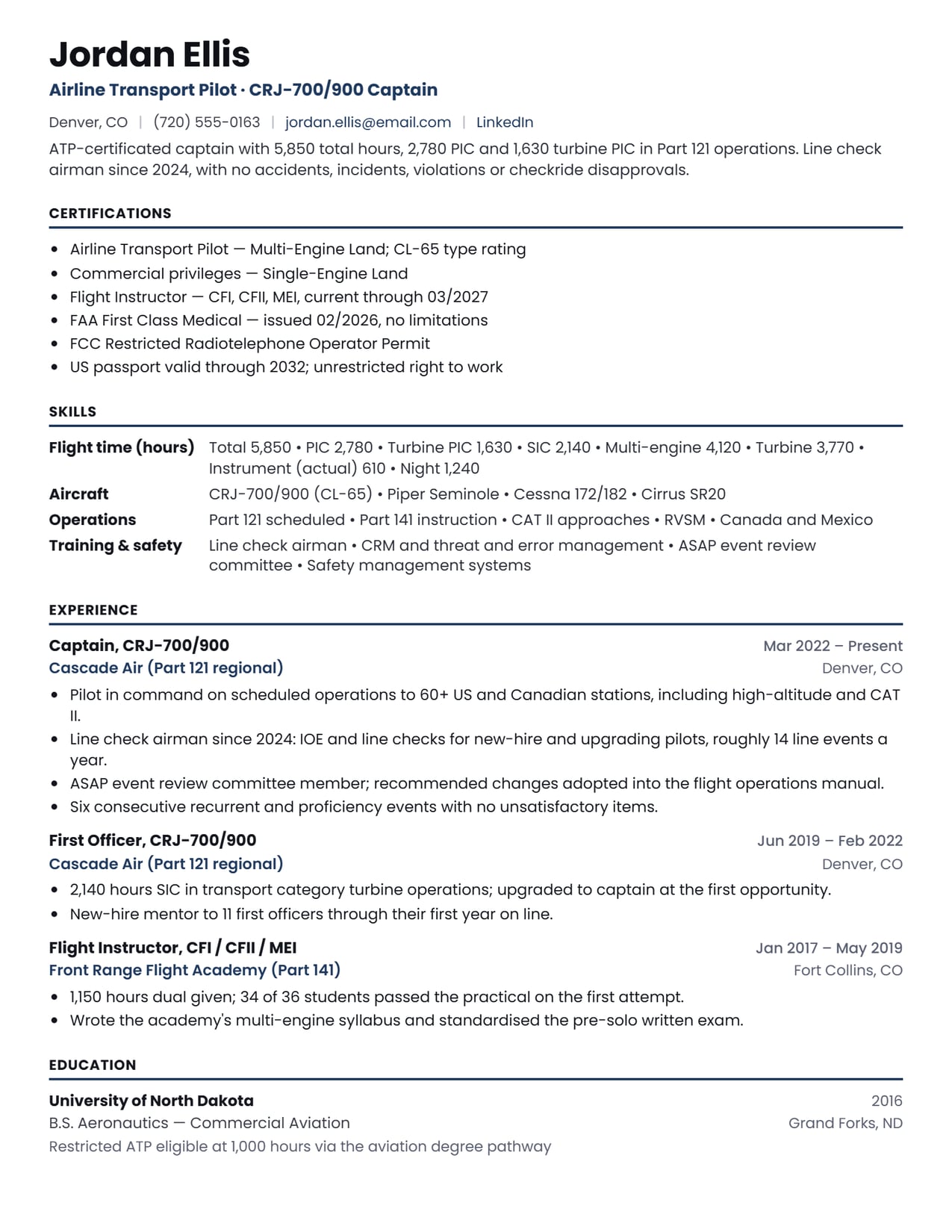
Jordan Ellis, a regional captain in Denver, 5,850 hours, type rated and line-check qualified
Nine years of flying on one page, in the order a pilot recruiter reads it: what you hold, what you have flown, then where. The certificates and the flight time block sit above the work history deliberately, which is the opposite of every other resume on this site and correct for this one.
The annotations follow the page from the top.
Certificate line under the name
"Airline Transport Pilot · CRJ-700/900 Captain" answers the two screening questions before the recruiter reaches anything else: the certificate level, and the seat and type. A pilot resume headed only with a name wastes the most valuable line on the page.
Summary
Two lines carrying the four numbers that matter and one clean-record statement. "No accidents, incidents, violations or checkride disapprovals" is worth stating outright when it is true, because the application will ask and the records will be pulled either way.
Certifications, placed second
Certificate and class, type rating by its designation (CL-65, not "CRJ type"), instructor certificates with an expiry, and the medical with its issue month. Every line carries a date or a designation, which is what makes the block checkable at a glance.
The medical line
"FAA First Class Medical — issued 02/2026, no limitations" gives the class, the currency and the absence of restrictions in nine words. An undated medical is read as lapsed, and a first-class medical is the thing that decides whether you can hold the certificate's privileges at all.
Flight time block
Total, PIC, turbine PIC, SIC, multi-engine, turbine, instrument and night, in a labelled row. Turbine PIC is the number a major screens on hardest, so it sits third rather than buried. A real applicant should add the date these are current as of, which this sample does not do.
Aircraft and operations rows
Type flown, then the operating environments: Part 121, CAT II, RVSM, Canada and Mexico. Naming the environment tells a recruiter what you can be dropped into. It also mirrors the language of the job posting, which is what the portal is matching against.
Experience, kept short
Three roles, ten bullets, no paragraphs. Aviation resumes are terse by convention and a recruiter reading fifty of them appreciates it. Note the seat and aircraft are in the job title, where they are found instantly.
The line check airman bullet
The strongest line in the experience section. It says the airline trusted this pilot to check other pilots, which is the clearest available proxy for judgment, and it is the sort of role a major expects to fill from its own new hires.
The recurrent training bullet
"Six consecutive recurrent and proficiency events with no unsatisfactory items" turns an absence of problems into evidence. Most pilots have this record and almost none of them say so.
Education and the ATP pathway
The restricted ATP note explains a career timeline before anyone has to ask about it. A degree is preferred rather than required at most majors, so the section stays to three lines and does not pad.
What is missing from the page
No date on the flight times, and no line stating base or commuting flexibility. Both are one-line additions, and both answer questions a recruiter would otherwise have to raise by email.
What a pilot recruiter checks in the first four seconds
Pilot hiring starts as arithmetic. Before anyone forms a view about you, someone compares four numbers against a published minimum, and the rest of the page is only read if they clear.
The flight time block, and the discipline of writing it honestly
Every number in this block is verifiable against your logbook, your training records and, in the US, the FAA's Pilot Records Database. Airlines pull those records as a matter of course. The block is therefore not a place for optimism.
It is also the part of the resume that does the most work, so it deserves care rather than a bare total.
Turn flying duties into evidence: eight rewrites
Every airline pilot operates the aircraft safely and follows standard operating procedures. Saying so describes the certificate, not the holder. What distinguishes you is the operation you flew, the environments you handled, and what the company trusted you with beyond the line.
Instead ofOperated aircraft in accordance with company procedures and federal regulations.
WritePilot in command on Part 121 scheduled operations to 60+ US and Canadian stations, including high-altitude and CAT II environments.
Regulation, route structure and environment. The original describes the minimum standard for holding the job at all.
Instead ofResponsible for the safety of passengers and crew.
WriteCaptain on CRJ-700/900 with a crew of four, dispatching in de-icing and convective conditions across a winter mountain network.
Says what the responsibility actually consisted of. Every captain is responsible for safety; not every captain works that network.
Instead ofTrained new pilots.
WriteLine check airman since 2024: IOE and line checks for new-hire and upgrading pilots, roughly 14 line events a year.
Names the qualification and the volume. Line check airman is a company appointment, which is the point.
Instead ofParticipated in safety programs.
WriteASAP event review committee member; recommended changes adopted into the flight operations manual.
Committee membership plus an outcome that outlived the meeting.
Instead ofMaintained currency and completed required training.
WriteSix consecutive recurrent and proficiency events with no unsatisfactory items.
Turns an absence of problems into a record. Almost every pilot can say this and almost none do.
Instead ofFlight instructor at a flight school.
Write1,150 hours dual given; 34 of 36 students passed the practical on the first attempt.
First-time pass rate is the one instructor metric that means something to a hiring department.
Instead ofFamiliar with international operations.
WriteLine experience into Canada and Mexico, RVSM airspace, and CAT II approaches to minimums.
Names the specific authorisations and environments rather than claiming familiarity.
Instead ofStrong crew resource management skills.
WriteFacilitated CRM and threat and error management modules during recurrent ground school for 120+ pilots.
CRM is claimed on every pilot resume in existence. Teaching it is not.
Regional to major: what actually changes
The regional resume proves you can hold a seat. The major resume has to prove you can hold a left seat later, and probably train other people in it. The hours move up, but what really changes is which parts of the page carry the weight.
What to lead with, by pilot role
Aviation is not one job market, and the number that wins a charter job is not the one that wins a cargo job. Leading with the wrong category tells a recruiter you have not read the posting.
| Role | Lead with | Also useful | Avoid leading with |
|---|---|---|---|
| Student to commercial | Certificates held and in progress, honest total time, aircraft flown | Ground instructor certificates, degree, aviation employment of any kind | Non-aviation work history |
| Flight instructor | Dual given, first-time pass rate, aircraft and ratings taught | CFII and MEI, syllabus or standards work, complex and high-performance time | Total time alone |
| Regional first officer | Total and PIC against the posted minimum, instrument time, currency | Instructing record, multi-engine time, degree pathway for restricted ATP | Aspirational language about majors |
| Regional captain | Turbine PIC, type rating, upgrade timing | Line check airman, ASAP or standards work, mentoring | SIC hours |
| Part 135 charter | PIC turbine, single-pilot IFR, unimproved or remote field experience | 135 checkride currency, customer-facing work, dispatch judgment | Airline-style route language |
| Corporate / Part 91 | Type ratings, international and oceanic experience, single-pilot or two-crew | Passenger handling, trip planning, aircraft management, discretion | Hours without type context |
| Cargo | Turbine PIC, night and all-weather time, heavy or large aircraft experience | Loading and weight and balance depth, on-time record | Passenger service framing |
| Military transition | Total, PIC, turbine and jet time converted to civil categories | Type equivalence, instructor and evaluator roles, security clearance | Rank, unit names and acronyms a civilian panel will not decode |
| Returning after a break | Current medical, recent recurrent or refresher training, honest currency | What you did in the gap, stated plainly in one line | An unexplained date gap |
| Overseas contract | ICAO licence held and conversions in progress, type rating, English proficiency level | Passport, visa status, availability date, notice period | Country-specific jargon the reader will not know |
Certificates, the medical and the records behind them
This is the part of the application where nothing is taken on trust, and knowing that shapes how the resume should be written.
Flying abroad: ICAO licences and overseas contracts
Overseas carriers recruit on a CV rather than a resume, screen on type rating and licence conversion, and ask for personal details a US application must never carry.
How airline applications actually get screened
Final checks before you apply
Keywords ATS looks for
Weave these into your resumewhere they’re true to your experience, and always mirror the exact wording from the specific job post you’re applying to.
Common mistakes to avoid
Airline Pilot resume: FAQ
What should a pilot resume include?
A certificate line under your name, a flight time block with total, PIC, SIC, turbine and instrument hours, certificates and ratings with type designations, your medical class and date, flight experience newest first with the aircraft and seat, training and safety roles, education, and your passport and work authorisation. One page.
How long should a pilot resume be?
One page, at almost every stage of a career. Aviation holds this convention more firmly than any other profession, and recruiters at both regionals and majors expect it. If a 20,000-hour captain can fit on one page, so can you: the flight time block carries the weight that bullets carry elsewhere.
How do I list flight hours on a resume?
As a labelled block near the top: Total, PIC, SIC, Multi-engine, Turbine, Turbine PIC, Instrument, Night. Use the actual figures from your logbook and say what date they are current as of. Add cross-country and any category that matters for the job, such as float, tailwheel or night vision goggle time.
Do I put my certificate number on a pilot resume?
No. Certificate and medical numbers belong on the application, not on a document that gets forwarded around. Certificate level, category, class, type ratings and medical class with its date are what a recruiter needs to see.
How does a resume change from regional to major?
Turbine PIC becomes the number that matters most, and the interesting part of your history moves from hours flown to responsibility carried: line check airman, standards, safety committee, mentoring, any training role. Majors are hiring a future captain and a future instructor, and the resume should show both.
What goes on a low-time pilot resume?
Lead with certificates and ratings, then the flight time block with an honest total, then instructing, banner towing, pipeline patrol, skydive or traffic watch work with the hours each produced. Name the aircraft you are current in. A CFI applying at 900 hours is not competing on total time, so compete on pass rates, aircraft variety and reliability.
Do airlines run pilot resumes through an ATS?
The application portals parse them, and they collect the same numbers again in structured fields, which is exactly why the resume must agree with what you type. Keep it single column with standard headings, name type ratings by designation, and upload a text-based PDF.
How do I disclose a checkride failure?
Not on the resume, which has no field for it, but honestly and without hedging on the application and in the interview. Say what happened, what you did about it, and what changed since. Records confirm every disapproval, so the only real question a panel is asking is whether you own it.