Accountant Resume Sample: CPA Resume Example for 2026
Complete guide · 15 min read · Updated 2026
Accounting resumes are read by people who will verify most of what is on them. A controller wants to know what you close, what you reconcile, which system you close it in, and whether an auditor has ever had to correct you. Adjectives do not survive that reading; specifics do.
Below is a complete accountant resume, annotated section by section, with what changes for staff and senior roles, public accounting, industry, tax, audit, and for the ACA, ACCA and CIMA route outside the US. The sample is a licensed CPA six years in, who moved from audit into corporate accounting and now owns a month-end close.
Choosing your template
An accounting resume is a dense list of things somebody will check: licence type and state, exam status, entities closed, systems used, reporting standard applied. A single-column layout keeps each fact beside its date and its employer. Two-column designs with a certifications sidebar are the usual reason a licence expiry ends up detached from the licence, and finance recruiting runs on the same applicant tracking platforms as the rest of the corporate world, which read a document straight down the page.
Browse all 20 templates →Section-by-section: what to write
Header and credential line
Name with the credential attached, "Elena Marquez, CPA", then the job title you hold as a line beneath it. Then phone, professional email, city and state, and LinkedIn. If you are licensed, put the state and expiry near the top: a controller in Texas needs to know whether your licence is active in Texas this quarter, and hunting for it on page two is not a game they play.
Professional summary
Three or four lines: licence status, years and where they were spent, the size of what you close, and one number that moved. "Owns the month-end close for two entities totalling $180M in revenue, cut from nine days to five" tells a hiring controller more than a paragraph about being detail-oriented. Every accountant is detail-oriented; that is the job, not a differentiator.
Licences, exams and certifications
Give this its own heading rather than folding it into education. CPA with state and expiry, or exam progress stated precisely: "CPA exam, 3 of 4 sections passed, REG scheduled March 2026". Then CMA, CIA, EA, CFE or the ERP certifications you hold, each with the year. Part-qualified is worth stating exactly. Vagueness reads as evasion in a profession built on assertions you can support.
Experience
For each role: employer, title, dates, and the scale you worked at. Revenue, entity count, transaction volume, team size. Then what you owned and what changed. Close days, reconciliation backlog cleared, variance closed, audit adjustments avoided, systems implemented. An accountant who says what they own is rarer on paper than you would expect.
Education and the 150-hour rule
Degree, school, city and state, graduation year. In the US, say how you met the 150-hour requirement if you did it through a master's or a graduate certificate, because it answers a licensing question the recruiter would otherwise have to ask. Outside the US, put your professional body's qualification above the degree once you have it.
Skills, split properly
Separate accounting knowledge from systems. Knowledge: month-end close, consolidations, revenue recognition, lease accounting, fixed assets, accruals. Systems: NetSuite, SAP, Oracle, QuickBooks, Sage, Xero, BlackLine, Excel with the actual functions you use. Name the ERP. A company running NetSuite filters for the word NetSuite, and "ERP systems" matches nothing.
Audit, controls and the things nobody lists
External audit support, SOX documentation and testing, process improvements, system implementations, and any policy or procedure you wrote. This is what separates two accountants with the same close experience, and it is what a controller building a team is actually shopping for.
Accountant resume sample, annotated
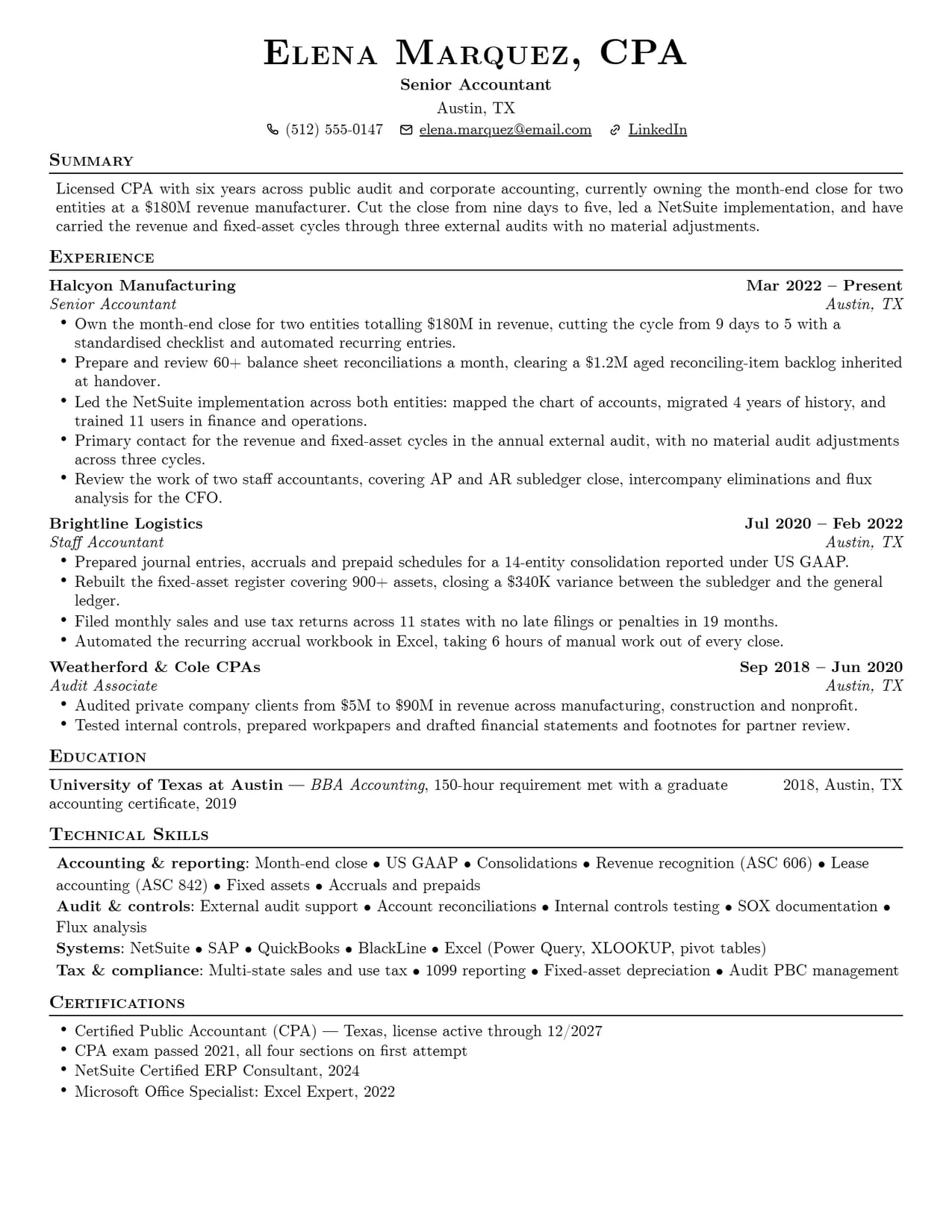
Elena Marquez, CPA, a senior accountant in Austin, six years in, two entities and a five-day close
Six years across public audit and industry, three roles, eleven bullets and a full systems list, held to one page by tightening the text rather than by dropping anything. A real applicant with this history could reasonably run to two pages and should not feel bad about it.
The annotations follow the page from the top, in the order a hiring controller reads it.
Name and credential
"Elena Marquez, CPA" puts the licence in the first three words. In accounting the credential is a filter before it is a qualification, and a header carrying only a name makes the reader hunt for the one fact that decides whether to keep reading.
Title line
"Senior Accountant" sits directly under the name. Applicant tracking systems match your current title against the posting's, and the gap between staff, senior and manager is the whole basis of the shortlist in this field.
What the header is missing
The licence state and expiry are down in the certifications block. They are correct there, but a line beside the location, "CPA - Texas, active through 12/2027", would put the two facts a recruiter screens on within an inch of each other.
Summary
Licence, six years, both sides of the profession, the scale of the close and one number that moved. Note what it does not say: nothing about being detail-oriented, deadline-driven or a team player, all of which describe every accountant who has ever been hired.
The close ownership bullet
Two entities, $180M in revenue, nine days to five, and the mechanism named. Close days are the single most comparable number in corporate accounting, which makes this the most useful line on the page. The mechanism matters because the interview question is always how.
The reconciliation bullet
Sixty reconciliations a month, and a $1.2M aged backlog cleared. Backlog inherited and cleared is a strong pattern: it shows what the role was like on arrival and what changed, without saying a word against the predecessor.
The NetSuite bullet
Named system, defined role, and a scope: chart of accounts, four years of history, eleven users trained. "Assisted with the ERP implementation" would have been worth almost nothing here, because every accountant in the building assisted with it.
Audit history
No material adjustments across three cycles is an unusual thing to put on a resume and a very good one. It is verifiable, it is the outcome auditors care about, and it says the work held up under review by someone paid to find problems.
Education and the 150-hour line
The graduate certificate answers the licensing question before it is asked. In the US this is the detail that decides whether a recruiter has to call to find out if you are eligible, and one clause removes the call.
Skills, split four ways
Knowledge, controls, systems and tax kept apart, with the standards cited by number (ASC 606, ASC 842) and Excel described by the functions actually used. Citing the standard is the accounting equivalent of naming the EMR on a nursing resume: it is what gets searched.
What is missing from the page
Nothing about the industries behind the numbers. Manufacturing, logistics and nonprofit are already on the page as employers, but a line in the summary naming them would help a recruiter placing for a manufacturer see the fit in the first four seconds.
What a hiring controller checks in the first four seconds
Accounting hiring narrows fast, because the qualifications are unusually binary. Either you hold the licence or you do not, either you have closed the books or you have supported someone who did.
Four questions, in this order. A gap at any one of them ends the review.
Own it or support it: the distinction the whole resume turns on
The most common weakness in an accounting resume is verb choice that hides your actual level. Prepared, assisted, participated and supported all describe real work, but they describe it from underneath. If you owned something, say so, and if you did not, describe the part you did own rather than reaching for a bigger word.
This matters more in accounting than in most fields because the hierarchy is legible. A controller knows exactly what a staff accountant does, what a senior does, and what a manager does, and a resume that blurs the line reads as either inexperienced or inflated.
Turn accounting duties into evidence: eight rewrites
Every accountant posts journal entries, reconciles accounts and helps with the audit. Listing those describes the profession. What distinguishes you is the scale you carried, what you owned, and what measurably changed while you had it.
Instead ofResponsible for month-end close activities.
WriteOwn the month-end close for two entities totalling $180M in revenue, cutting the cycle from 9 days to 5 with a standardised checklist and automated recurring entries.
Scale, ownership and a movement in the one metric every accounting team benchmarks against.
Instead ofPrepared account reconciliations.
WritePrepare and review 60+ balance sheet reconciliations a month, clearing a $1.2M aged reconciling-item backlog inherited at handover.
Volume, seniority (review, not just prepare), and a problem that existed and then did not.
Instead ofAssisted with the ERP implementation.
WriteLed the NetSuite implementation across two entities: mapped the chart of accounts, migrated 4 years of history, and trained 11 users in finance and operations.
Names the system, the role and the scope. "Assisted" was true of everyone in the department.
Instead ofSupported the annual audit.
WritePrimary contact for the revenue and fixed-asset cycles in the annual external audit, with no material audit adjustments across three cycles.
The cycles you owned and the outcome. An audit that produced no adjustments is the clearest possible evidence the work was right.
Instead ofHandled accounts payable and receivable.
WriteManaged AP and AR subledger close for a 14-entity consolidation, including intercompany eliminations and a 12-day average collection improvement.
Consolidation and intercompany are seniority signals, and the collection number is a result rather than a task.
Instead ofFiled sales tax returns.
WriteFiled monthly sales and use tax returns across 11 states with no late filings or penalties in 19 months.
Multi-state is materially harder than single-state, and a clean compliance record is exactly the risk a controller is trying to hire away.
Instead ofUsed Excel to analyse financial data.
WriteAutomated the recurring accrual workbook with Power Query, taking 6 hours of manual work out of every close.
Names the tool inside the tool and the hours returned. "Used Excel" is true of everyone who has ever worked in finance.
Instead ofImproved accounting processes.
WriteRebuilt the fixed-asset register covering 900+ assets, closing a $340K variance between the subledger and the general ledger.
Says which process, at what volume, and what was wrong before you touched it.
Public accounting to industry, and back
Most accounting careers cross this line at least once, and the resume has to be rewritten rather than relabelled when they do. The two sides value different evidence, and a Big Four associate applying to industry with an engagement list reads as someone who has not thought about the job.
What to lead with, by accounting role
Accounting is not one job market. The evidence that wins a staff accountant post is not what wins a tax or an audit post, and leading with the wrong category is how a qualified candidate ends up screened out.
| Role | Lead with | Also useful | Avoid leading with |
|---|---|---|---|
| Entry level / new graduate | Degree, 150-hour path, CPA exam progress, internships | Bookkeeping or AP/AR work, QuickBooks or Excel certificates, VITA | An objective statement about growth |
| Staff accountant | Cycles prepared, entity count, systems, close involvement | Reconciliation volume, audit support, process fixes | Duty lists with no scale attached |
| Senior accountant | What you own in the close, entity and revenue scale, review responsibility | System implementations, audit cycles owned, staff reviewed | Preparation-level verbs |
| Accounting manager / controller | Team size, close ownership, financial statements produced, audit relationship | Policy and process ownership, ERP projects, board or lender reporting | Individual reconciliation work |
| Public accounting (audit) | Client industries, engagement size, cycles audited, busy-season load | CPA progress, specialised testing, staff supervised | Generic "performed audit procedures" |
| Tax accountant | Return types and volume, entity structures, jurisdictions | EA or CPA, research and planning work, software (CCH, UltraTax) | Bookkeeping duties |
| Cost / manufacturing accountant | Standard costing, variance analysis, inventory and BOM work | ERP module depth, plant or operations partnering | General ledger work alone |
| Financial analyst crossover | Forecasting, budget ownership, variance and driver analysis | Modelling, BI tools, business partnering | Transaction processing |
| Bookkeeper / AP / AR | Transaction volume, systems, close support, clean audit history | Certifications, industry specifics, process automation | Aspirational CPA language |
| UK / international (ACA, ACCA, CIMA) | Qualification or part-qualified status with exam progress, IFRS | Statutory accounts, VAT, notice period, visa status where asked | US-only standards like ASC references |
Licences, exam progress and the 150-hour question
This is the part of an accounting resume where imprecision costs the most, because everything on it is checkable and a recruiter's first job is to work out whether you are eligible for the role at all.
Outside the US: ACA, ACCA, CIMA and the Gulf
The same resume does not travel. The document is called a CV, the qualification is different, the reporting standard is usually IFRS, and several markets expect information a US resume must never carry.
How finance teams screen accounting resumes
Final checks before you apply
Keywords ATS looks for
Weave these into your resumewhere they’re true to your experience, and always mirror the exact wording from the specific job post you’re applying to.
Common mistakes to avoid
Accountant resume: FAQ
What should an accountant resume include?
Name with your credential, a summary naming licence status and what you close, licences and exam progress with dates, experience showing entity count and revenue scale alongside what you owned, education including how you met the 150-hour requirement, and skills split between accounting knowledge and named systems. Two pages is normal past three or four years.
How do I put CPA on my resume if I am not licensed yet?
State exactly where you are: "CPA exam, 3 of 4 sections passed, REG scheduled March 2026" or "CPA eligible, 150 hours met". Do not put CPA after your name until you are licensed, because it is a protected designation and using it early is the kind of error a firm treats as disqualifying rather than careless.
Should an accountant resume be one page or two?
One page for a new graduate or someone under three years in. Two once you have multiple employers, a licence, systems experience and results worth listing. Accounting is a field where a hiring controller reads the second page, because that is often where the ERP work and the audit history sit.
What is the difference between a public accounting and an industry resume?
Public accounting is read on client portfolio, industries served, engagement size and the standards you applied. Industry is read on what you own in the close, entity and revenue scale, systems, and cross-functional work. Moving from public to industry means rewriting the bullets around ownership rather than around engagements.
Do I need to list every accounting system I have used?
List the ones you can be questioned about, and name them exactly as the posting does. The ERP is the highest-value term on an accounting resume because it decides how much ramp-up you need, and it is a literal search term. Excel is worth listing only if you say what you actually do in it.
How do I write an accounting resume with no experience?
Lead with education, the 150-hour path and CPA exam progress if it has started. Then internships with the work you actually did rather than the department you sat in, any bookkeeping, AP or AR work, and the systems you have touched, including in coursework. A VITA volunteer season and a QuickBooks certificate both count for more than a filler objective statement.
Do accounting resumes go through an ATS?
Nearly always, and finance teams tend to run the strictest keyword filters in a company because the qualifications are so specific. Single column, standard headings, spell out abbreviations once beside the short form, name every system, and send a text-based PDF unless the posting asks for Word.
What changes on a UK or Gulf accounting CV?
It is a CV, and the qualification line is ACA, ACCA or CIMA rather than CPA, with part-qualified status and exam progress stated. IFRS replaces US GAAP as the default reporting standard. Gulf postings often ask for VAT experience, notice period and visa status, and international employers may expect date of birth and nationality that a US resume must never carry.