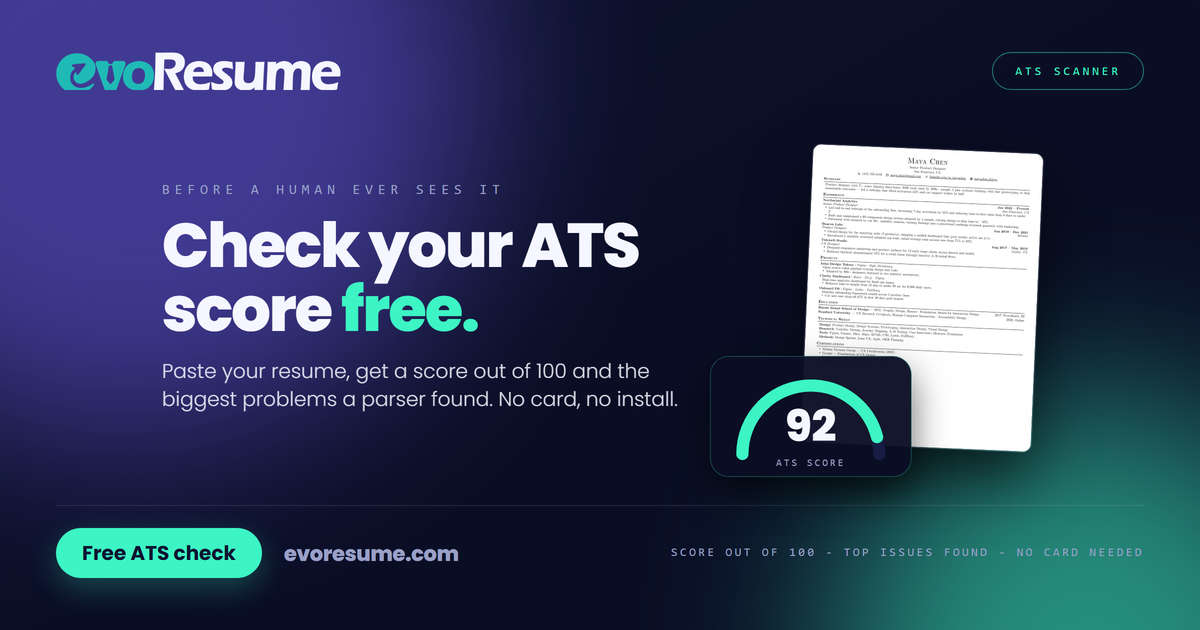
There's a version of your resume you've never seen. Not the one in your Downloads folder with the careful spacing and the section you moved four times. The other one: the flattened, re-ordered, occasionally mangled text file that comes out the far side of an applicant tracking system. That version is the one a recruiter searches. And before anyone reads it, software has already given it a number.
Most job seekers never see that number, which is strange, because it's the most actionable piece of feedback in the entire process. A rejection email tells you nothing. A score out of 100 with named problems tells you exactly what to do next. This post covers what an ATS score measures, what usually drags it down, and how to check yours in about ten seconds.
The six seconds that never happen
You've read that recruiters spend about six seconds on a resume. True enough - but it skips a step. For most postings at most mid-size and large employers, your file first passes through Workday, Greenhouse, Lever, Taleo or iCIMS, which parses it into structured fields: name, contact, employer, title, dates, skills. If that parse goes badly, the six seconds never happen. You aren't rejected on merit. You're rejected on legibility, or you simply never surface in the search the recruiter runs.
This is why the advice "just make it look professional" fails so many people. A two-column layout with a skills sidebar and icons looks extremely professional. It also interleaves your sidebar into the middle of your job history when a parser reads across the page. The document that impresses a human and the document that survives a machine are not always the same document - and the score is how you tell them apart.
What the score actually measures
A useful ATS score isn't a vibe. It's five specific checks, each of which maps to a thing that either works or doesn't inside a real parser.
- Contact info. Whether a parser can find your name, email and phone at all. Headers and footers are where these quietly go missing - the document looks complete to you and arrives with no way to reach you.
- Work experience. Whether each employer, title and date range stays attached to the right role instead of drifting apart. This is what breaks first in multi-column layouts.
- Quantified impact. How many of your bullets carry an actual number. This is the one most resumes fail, and it's the one that costs you interviews rather than parses.
- Skills and keywords. The terms a posting uses that your resume doesn't, weighted by how often the posting repeats them. Recruiters search this index; if the term isn't there, you aren't in the result set.
- Formatting. Columns, tables, text boxes, and whether the PDF contains real selectable text or a picture of text. A resume exported as an image scores zero on everything, because there is nothing to read.
What a low score usually means
In our own scans, low scores cluster around the same handful of causes, and almost none of them are about the quality of your experience.
- The template. A design downloaded from a graphics site, built on a table or a two-column grid. The single highest-impact fix available to most people, and it takes minutes.
- Duties instead of results. "Responsible for managing the social media calendar" describes a job description, not a person. It scores badly and reads worse.
- No numbers anywhere. If not one bullet contains a figure, a percentage or a volume, there is nothing for a reader to weigh.
- Creative section headings. "Where I've Made Magic" doesn't map to a field a parser expects. "Work Experience" does. Save the personality for the summary.
- Keyword mismatch. You wrote "client relations"; the posting says "account management" nine times. Same job, different index.
How to read your number honestly
A score is a diagnostic, not a verdict. Here's roughly how to interpret one, and what to do with it.
- Below 60. Something structural is wrong - usually the template or a missing contact block. Fix the container before you touch a single word of copy.
- 60 to 79. The document parses, but it's thin on evidence. This is almost always a quantification problem. Go find your numbers.
- 80 to 89. Solid. Now the gains are per-application: tailoring language to the specific posting rather than rewriting the resume.
- 90 and up. The machine is no longer your problem. Spend your effort on which jobs you apply to and who you know there.
One caution worth stating plainly: no third-party tool can see the exact scoring model inside a specific employer's Workday instance, and anyone claiming otherwise is selling something. What a good checker does is test your resume against the parsing behaviour and screening criteria these systems share - which is enough to catch the failures that actually sink applications.
The three fixes that move the number most
If you only do three things after seeing your score, do these.
1. Go single-column. Move everything into one reading order, contact details in the body rather than the header. Nothing else you do this week is worth as much.
2. Put a number in every bullet you can defend. Ask each line: how many, how much, how often? How many accounts, tickets, students, sites, releases? How much revenue, budget, time saved? Almost every job produces an honest figure under that questioning.
Responsible for improving the onboarding experience for new users.
Redesigned onboarding end to end, lifting 7-day activation 34% and cutting time-to-first-value from 9 days to under 2.
3. Mirror the posting's vocabulary. Not keyword stuffing - substitution. If the job says "account management" and you wrote "client relations", use theirs where it's honestly the same work.
Check yours in about ten seconds
- Open the ATS score checker and paste your resume text, or upload the file you already have.
- Read your score out of 100 and the biggest problems it found. This part is free and needs no card.
- Fix the structural issues first, then the quantification, then the keywords.
- Run it again. Watching the number move is the fastest way to learn what these systems reward.
If the fixes point at your template rather than your writing, the EvoResume builder shows a live ATS score as you type, so you're correcting the resume while you build it rather than after. There are 20 templates, every one checked against the five things that break a parser, and you can swap between them without retyping anything.
See your ATS score free
Score out of 100 and the biggest problems it found. No card, no install.
Frequently asked questions
Is the ATS score check really free?
The preview is free and needs no card: your score out of 100 and the biggest problems it found. The full report - category breakdown, searchability, skills coverage, phrasing notes and formatting detail - is part of a paid plan, starting at a one-time $4.99 for seven days that does not renew.
What is a good ATS score?
Above 80 is solid and above 90 means formatting is no longer what's holding you back. Below 60 usually points at something structural, most often a two-column template or contact details stranded in the header where parsers don't look.
Does a high ATS score guarantee an interview?
No. A high score means your resume parses cleanly, surfaces in recruiter searches and presents evidence rather than duties. It removes the failures that stop you being read. Whether you're the right fit for the role is a separate question, and no tool can answer it.
Can any tool know an employer's exact ATS scoring rules?
No, and be wary of anyone who claims to. Individual Workday, Greenhouse and Taleo instances are configured per employer. What a checker can test is the parsing behaviour and screening criteria these systems share, which is where nearly all avoidable rejections come from.
Do I need to rewrite my resume from scratch?
Usually not. Most low scores are a container problem, not a content problem. Importing your existing resume and having it rebuilt into a single-column, parser-safe layout keeps your real experience and fixes the structure it was trapped in.