Teacher CV Sample: Teaching CV Example for 2026
Complete guide · 14 min read · Updated 2026
Teaching applications are read by people who have worked through hundreds of them, and they read in a fixed order. Are you qualified to take this class, are you safe to appoint, and can you show that students learned something. A CV that leaves any of the three to be inferred gets put down.
Below is a complete secondary teacher CV, annotated section by section, with what changes for primary, SEND, early career teachers, supply, further education and international schools. The sample is a mathematics teacher with six years in UK comprehensives who has moved into a second in department post.
Choosing your template
A teaching CV carries a stack of facts somebody will check: QTS and the year it was awarded, induction, safeguarding training, DBS status, the key stages you have taught, exam results. A single-column layout keeps each of those next to its date in one reading order. Sidebar designs are the usual reason an award year ends up detached from the qualification it belongs to, and multi-academy trusts increasingly recruit through platforms that read a document straight down the page.
Browse all 20 templates →Section-by-section: what to write
Header and title line
Name, then the job you do as a title line directly beneath it: "Secondary Mathematics Teacher (QTS)". Then phone, professional email, town or city, and LinkedIn if you keep it current. Leave off the photo, date of birth, marital status and full street address. International schools are the common exception on photos, and they will ask.
Personal statement
Three or four lines: the phase and subject you teach, years in post, and one result you can put a number on. "Mathematics teacher with QTS and six years in 11-18 comprehensives, GCSE grade 5+ from 58% to 71% across three cohorts" does more work than a paragraph about a passion for learning. Save the longer argument for the supporting statement, which is the part schools actually weigh.
Qualifications and QTS
Give QTS its own line with the month and year it was awarded, and have your teacher reference number to hand for the application form. Then degrees newest first with institution, year and classification, plus the training route you took: PGCE, PGDE, School Direct, Teach First, assessment only. Teachers trained outside the country you are applying in should say what status they hold there and what they have applied for if it is pending.
Teaching experience
For each post: school, job title, dates, and the key stages and subjects you taught. Then what changed because you were there. Set levels and class sizes, results movement across cohorts, curriculum you wrote, interventions you ran, staff you mentored. "Rewrote the KS3 scheme of work now used department-wide" is something a head of department can picture. "Planned and delivered engaging lessons" is not.
Skills, curriculum and technology
Group them so a reader can scan: curriculum and assessment, pedagogy and inclusion, pastoral and leadership, technology. Name the exam boards you have taught and moderated for, the SEND provision you have run, and the systems you use by name. Schools search for SIMS, Arbor, Bromcom, Google Classroom and their own MIS the same way any employer searches for software.
Professional development and safeguarding
Safeguarding and child protection training with the date it was renewed, first aid, SEND or designated safeguarding lead training, exam board examining or moderating, and NPQs including any in progress. Say that you hold an enhanced DBS and whether it sits on the Update Service, because that detail can take weeks out of a start date.
References and employment history
Two referees, one of them your current headteacher or line manager. Schools following safer recruitment take references before interview and ask directly about your suitability to work with children, so tell your referees first. Account for every year since you left education, and give a one-line reason for any gap rather than leaving a hole someone has to ask about.
Teacher CV sample, annotated
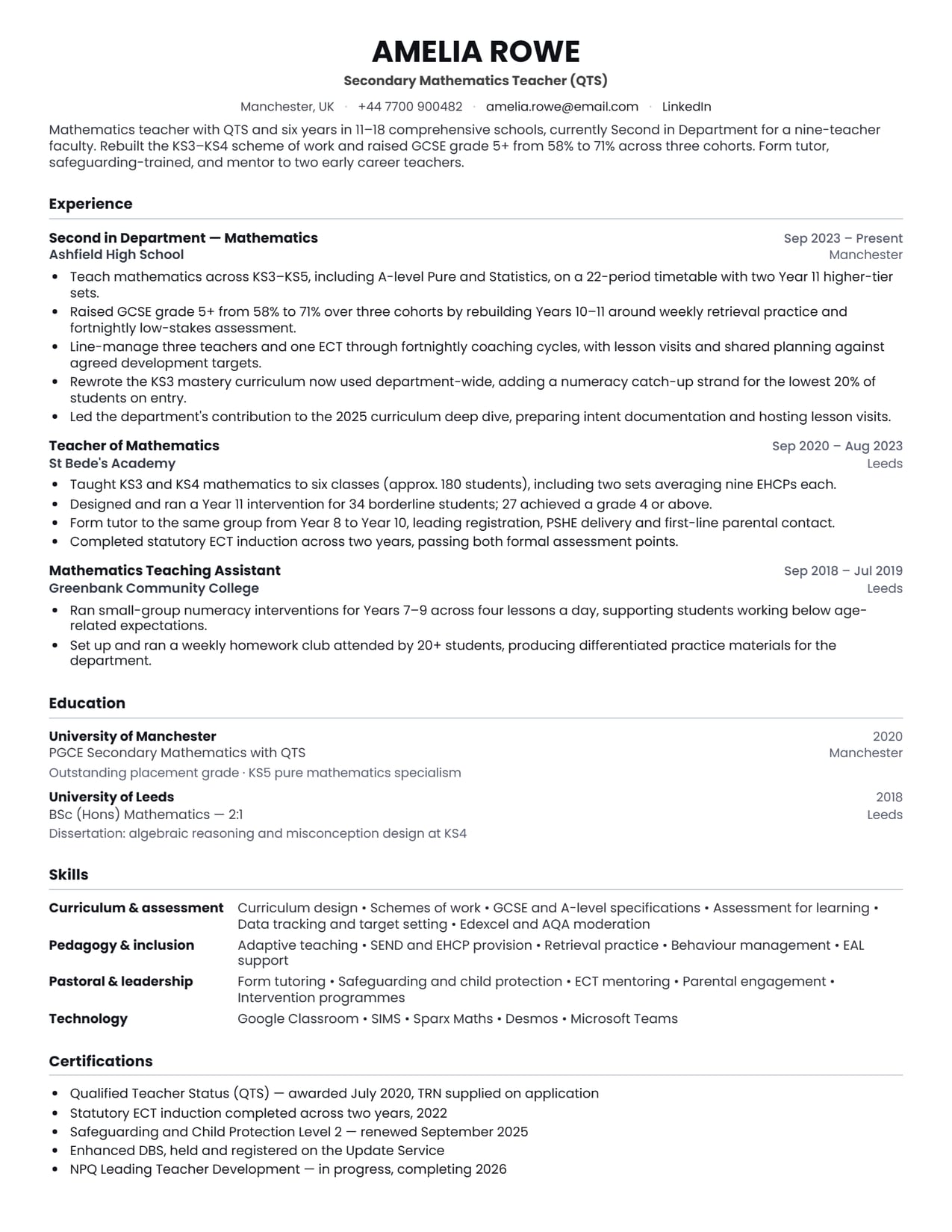
Amelia Rowe, a secondary mathematics teacher in Manchester, six years in, now second in department
This is six years of teaching on one page: three posts, both degrees, four skill groups and the full compliance block, held to a single side by tightening the text size rather than by cutting anything out. Read it as a structure to borrow rather than wording to copy, and note where the annotations say a real applicant should push harder.
The callouts follow the page from the top, in the order a head of department reads it.
Title line under the name
"Secondary Mathematics Teacher (QTS)" does two jobs in four words. It tells a human which pile the application belongs in, and it gives a parser something to match against the advertised title. A header carrying only a name gives neither.
Personal statement
Phase, subject, years, and the one number worth leading with, GCSE grade 5+ from 58% to 71%. The last clause, form tutor and safeguarding-trained and ECT mentor, signals that this candidate does the work outside the timetable that departments depend on.
What the statement leaves out
There is no line about the kind of school or intake. "In a 1,400-pupil comprehensive with 32% pupil premium" gives a head context for every result underneath it, and costs half a line.
Current post, first bullet
Key stages, A-level modules and set level in one line. A head of department reading this knows immediately whether you can take the Year 13 Pure group they need covering, which is often the whole reason the vacancy exists.
The results bullet
58% to 71% over three cohorts, with the mechanism named: rebuilt Years 10 to 11, weekly retrieval, fortnightly low-stakes assessment. Results without a mechanism read as luck or as somebody else's work. The mechanism is also the thing you will be asked to talk through at interview.
Line management
Three teachers and one ECT, with the coaching cycle described. This is the bullet that separates a teacher applying for a second in department post from one applying for a main scale post, and it belongs above the curriculum work for that reason.
Previous post
Six classes, roughly 180 students, two sets averaging nine EHCPs each. Naming the SEND load is honest evidence of adaptive teaching, and it is far stronger than listing "differentiation" as a skill. The intervention bullet does the same thing: 34 students in, 27 out with a grade 4.
The pre-PGCE assistant role
Nine months as a teaching assistant, kept on the page six years later. It is worth the three lines because it shows the classroom was a choice made before the training, and because small-group numeracy intervention is directly relevant work. Drop a role like this once it stops earning its space, not before.
Certifications block
QTS with its award date, induction, safeguarding with a renewal date, the DBS Update Service line, and an NPQ marked in progress with its completion year. This is the block a safer recruitment process checks first, and every entry carries a date, which is what makes it useful.
What is missing from the page
No referees and no line on employment history. Both are usually handled on the application form, so leaving them off a CV is defensible, but if this CV is going to an independent or international school, add "References available on request" and make sure your dates account for every year since your degree.
What a head of department checks in the first minute
Teaching recruitment is gated on suitability before it is gated on quality. A school cannot put you in front of a class without the qualification and the checks, so those get looked at before anyone forms a view about your teaching.
Four questions, in this order. A gap at any one of them ends the read.
The application form problem
Most maintained schools in the UK recruit on their own form, not on a CV. Safer recruitment guidance pushes them towards a standard set of declarations and a complete employment history from every candidate, which a free-form CV cannot guarantee. Some schools state that CVs will not be considered at all.
That does not make the CV wasted work. It is the source document you fill the form from, it is what agencies, independent schools and international schools want, and writing it first is how you find the results and dates you are going to need anyway.
Turn classroom duties into evidence: eight rewrites
Every teacher plans lessons, marks work and sees parents. Listing those describes the job, not the person doing it. What distinguishes you is the group you taught, what moved, and whether it held after you stopped pushing.
Instead ofPlanned and delivered engaging lessons to students of all abilities.
WriteTaught four KS3 sets and two KS4 higher-tier sets, including a nurture group of 12 working two years below age-related expectations.
Names the groups. "All abilities" could mean a top set and a second top set, and the reader has no way to tell.
Instead ofImproved student attainment in mathematics.
WriteRaised GCSE grade 5+ from 58% to 71% across three cohorts by rebuilding Years 10 and 11 around weekly retrieval and fortnightly low-stakes assessment.
The number matters less than the mechanism next to it. A panel will ask how you did it, and the bullet has already answered.
Instead ofUsed data to track student progress.
WriteRan half-termly gap analysis on question-level GCSE data, then rewrote the intervention timetable around the four topics costing the cohort the most marks.
Everyone tracks data. What counts is the decision the data changed, and that is what this version describes.
Instead ofSupported students with additional needs.
WriteAdapted resources and delivered provision for nine EHCP students across two sets, working with the SENDCo on termly reviews and exam access arrangements.
Names the volume, the paperwork and the person you worked with, which is what a SENDCo reading the application will look for.
Instead ofMentored new members of the department.
WriteMentored two ECTs through statutory induction with weekly coaching and fortnightly lesson visits; both passed both assessment points and stayed in post.
Retention is what schools are measured on and pay for. "Mentored" without an outcome could describe one conversation.
Instead ofContributed to the school's extracurricular programme.
WriteSet up and ran a weekly UKMT maths club of 30 students, entering 18 for the Intermediate Challenge, with 6 gold certificates in 2025.
Names the activity, the numbers and the result. Enrichment is a genuine differentiator in secondary hiring, but only when it is specific.
Instead ofWorked closely with parents and carers.
WriteIntroduced a fortnightly progress message for the Year 11 borderline group, lifting attendance at after-school sessions from 54% to above 90%.
Parental engagement claims are unfalsifiable. Describing what you set up and what shifted is not.
Instead ofInvolved in curriculum development.
WriteRewrote the KS3 mastery curriculum now used across the department, adding a numeracy catch-up strand for the lowest 20% on entry.
"Involved in" hides your actual role. Say what you wrote and whether anyone else uses it.
Early career teachers: what counts before you have a classroom of your own
Statutory induction in England runs across two years, and schools recruiting an ECT know they are taking on a mentoring commitment as well as a teacher. They are looking for evidence that you will be worth it.
Your placements are your teaching record. Give them the space a job would get.
What to lead with, by teaching role
The evidence that wins a primary post is not the evidence that wins a sixth form college post. Leading with the wrong category tells the panel you have not read the advert.
| Role | Lead with | Also useful | Avoid leading with |
|---|---|---|---|
| Early career teacher | Placement schools, key stages, timetable carried, QTS date | Subject knowledge enhancement, degree class, tutoring or TA work | Unrelated part-time jobs |
| Primary teacher | Year groups taught, phonics scheme, reading and maths progress, subject leadership | EYFS experience, moderation, parental engagement | Generic "all subjects" statements |
| Secondary subject teacher | Subject, key stages, exam boards, set levels, results movement | Enrichment, form tutoring, intervention outcomes | Duty lists with no cohort attached |
| Head of department | Team size, results across the department, curriculum ownership, budget | Line management and coaching, staff retention, NPQ progress | Your own classroom results alone |
| SEND teacher or SENDCo | Range of need supported, EHCP caseload, provision mapping, external agency work | NASENCO or the NPQ for SENCOs, access arrangements, TA deployment | Whole-class teaching detail |
| Teaching assistant | Phases and needs supported, interventions delivered, ratio worked | Level 2 or 3 qualification, safeguarding, behaviour training | Duties phrased as helping out |
| Supply teacher | Phases and subjects you can cover at no notice, schools and agencies worked | Behaviour management, DBS on the Update Service, safeguarding currency | Short placements listed as separate posts |
| Further education lecturer | Qualifications taught, awarding bodies, achievement and retention rates | Industry experience, assessor or IQA awards, apprenticeship standards | School-phase language like key stages |
| International school teacher | Curriculum taught (IB, British, American), phases, and years overseas | Safeguarding, EAL experience, pastoral or boarding duties | Locale-specific jargon the school will not know |
| University lecturer | Modules taught, student numbers, publications, funding | Supervision, programme design, external examining | School classroom detail in depth |
Safeguarding, DBS and the checks behind an offer
Schools in England recruit under Keeping Children Safe in Education, statutory guidance that is reissued most years. It shapes what a school asks for and the order it asks in, which is why the safeguarding line on your CV carries more weight than its length suggests.
Teaching abroad: what changes on an international CV
International schools recruit on CVs, often through agencies and recruitment fairs, and they screen on a different set of facts. The curriculum you have taught matters more than the country you taught it in.
How teaching applications get screened
Final checks before you apply
Keywords ATS looks for
Weave these into your CVwhere they’re true to your experience, and always mirror the exact wording from the specific job post you’re applying to.
Common mistakes to avoid
Teacher CV: FAQ
What should a teacher CV include?
A title line naming the phase and subject you teach, a short personal statement with one measurable result, QTS with the date it was awarded, degrees and training route, teaching experience with key stages and outcomes, grouped skills, safeguarding and CPD with dates, and two referees. Two pages is normal for a teacher with several years in post.
How long should a teaching CV be?
Two pages for a qualified teacher, one for a trainee or early career teacher with a single placement school. Academic and university teaching CVs run longer because publications, funding and supervision each need their own section. Do not compress a real work history to fit a one-page rule that nobody in teaching applies.
Do UK schools accept CVs?
Many maintained schools ask for their own application form and will not consider a CV on its own, because safer recruitment requires a consistent employment history and declarations from every candidate. Independent schools, international schools, supply agencies and most further and higher education posts do take CVs. Send the form when the form is asked for, and keep the CV for everything else.
What is the difference between a teacher CV and a supporting statement?
The CV is the record: what you are qualified in, where you have taught, what happened. The supporting statement is the argument for this specific post, written against the person specification point by point. Schools weigh the statement heavily, so it deserves more of your time than reformatting the CV does.
How do I write a teaching CV with no experience?
Lead with your training placements and treat them as posts: school, phase, key stages, class sizes, and what you taught. Give your final placement its own block with the timetable you carried by the end. Add tutoring, teaching assistant or youth work, subject knowledge enhancement, and your degree. Put education above experience while it is the strongest thing on the page.
Should I put my DBS on my CV?
Yes, as one line saying you hold an enhanced DBS and whether it is registered on the Update Service. Never put the certificate number on a document you send out. An Update Service registration means a new school can check it online in minutes rather than waiting on a fresh application.
Do teaching CVs go through an ATS?
Trust and college recruitment increasingly runs through applicant tracking platforms, and agency and international school applications almost always do. Keep it single column, use headings a system recognises, spell out abbreviations once alongside the short form, and send a text-based PDF unless the school asks for Word.
How is a teacher CV different in the US?
It is called a resume, it is one to two pages, and the qualification line is a state teaching license or certification with the state, subject endorsement and expiry rather than QTS. Praxis or edTPA results matter for early career applicants. The word CV in US education usually means a university teaching or research document.