Nurse Resume Sample (USA): RN Resume Example for 2026
Complete guide · 15 min read · Updated 2026
Nursing is one of the few fields where a recruiter can disqualify you in four seconds. They look for an active RN license in the state you are applying to, current BLS, and whether your unit experience matches the posting. Everything else on the page is read only after those three check out.
Below is a complete registered nurse resume sample for a US hospital job, annotated section by section, plus what changes for new grads, ICU and ED nurses, travel contracts, and LPNs. The sample is a med-surg RN with five years of experience — the most common profile in American nurse hiring.
Choosing your template
Nursing resumes carry a dense stack of verifiable facts: license type and state, certification expiry dates, units worked, ratios, EMR systems. A single-column layout keeps each fact next to its date in one reading order. Two-column nursing templates with a certification sidebar are the most common reason an ACLS date or a license state gets dropped during parsing, and hospital systems run big applicant tracking platforms — Workday, Taleo, iCIMS — that read strictly top to bottom.
Browse all 18 templates →Section-by-section: what to write
Header and credentials
Name with credentials in ANA order (Jessica Anderson, BSN, RN), then phone, professional email, city and state, and LinkedIn. Put your license line here too: "RN License — Illinois, active through 05/2027". Recruiters verify it on Nursys before they call you, so make it findable in the first inch of the page.
Professional summary
Three or four lines: your license and years of experience, the units you have worked, your typical patient load, and one measurable result. "Med-surg RN with 5 years on a 34-bed unit, 1:5 ratio, HCAHPS above departmental target" tells a nurse manager more than any adjective. Skip the objective statement unless you are a new grad changing fields.
Licenses and certifications
Give this its own heading — do not bury it under "Courses" or "Training". List license type, state, and expiration, then BLS, ACLS, PALS, NIHSS and any specialty certification (CCRN, CEN, RNC-OB, OCN) with the awarding body and expiry. An expired ACLS on a resume reads worse than none at all, because it says nobody checked.
Clinical experience
For each job: title, hospital, city and state, unit, and dates. Then what you actually carried — bed count, nurse-to-patient ratio, acuity, admissions per shift, procedures, and who you precepted. "Charge nurse for a 28-bed telemetry unit, 1:4 ratio, 8 to 10 admissions per shift" is the level of detail that gets you screened in.
Education
Degree, school, city and state, graduation year. ADN, BSN, MSN — list the highest first and keep the earlier one if you did an RN-to-BSN bridge, since the bridge itself signals ongoing progression. New grads should place education above experience and include the clinical rotation table.
Skills
Split clinical from technical. Clinical: patient assessment, medication administration, IV insertion and titration, wound care, telemetry interpretation, ventilator management, triage. Technical: Epic, Cerner, Meditech, Pyxis, barcode medication administration. Mirror the exact wording the posting uses, including the EMR — hospitals filter for their own system by name.
Achievements, committees and precepting
Unit council membership, shared governance, Magnet documentation work, preceptor and charge assignments, quality projects with a measured outcome, DAISY nominations. This is what separates two nurses with identical clinical histories, and it is what a Magnet hospital screens for specifically.
Nurse resume sample, annotated
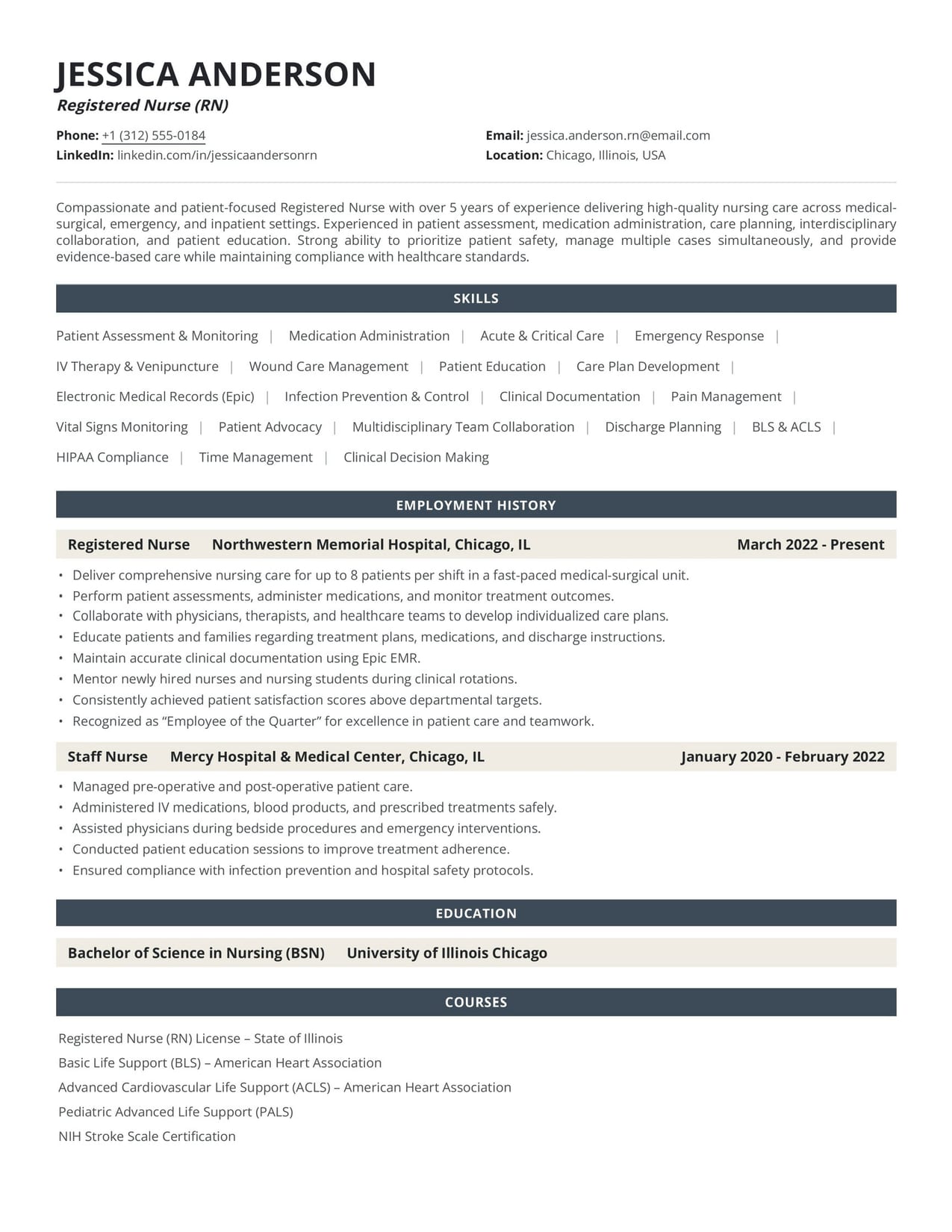
Jessica Anderson, BSN, RN, a med-surg registered nurse in Chicago with five years of hospital experience
This is a complete two-page-equivalent nurse resume compressed onto one page, which is what five years of experience usually looks like. Read it as a structure to copy, not wording to copy — the bullets below show where it is strong and where a real applicant should push further.
The annotations follow the page top to bottom, in the order a nurse recruiter reads it.
Header and title line
Name, then "Registered Nurse (RN)" as a title line directly under it, then contact details in two clean text columns. The title line matters: applicant tracking systems match your current title against the posting's, and a header that says only your name gives the parser nothing to match.
What this header is missing
There is no license line. Add "RN License — Illinois, active through 05/2027" beside the location. It is the single most valuable line on a US nursing resume and it costs one row of space.
Professional summary
Five years, the settings worked (medical-surgical, emergency, inpatient), and the core competencies. It reads well, but it names no numbers. Adding the unit size and ratio — "on a 34-bed medical-surgical unit at a 1:5 ratio" — turns a description into evidence a manager can size up instantly.
Skills band
Twenty-one skills across clinical, technical and compliance, including Epic by name and BLS/ACLS. Naming the EMR explicitly is the right call, because health systems search for "Epic" and "Cerner" literally rather than for "electronic health records". Trim any skill you could not answer a question about in an interview.
Employment history bullets
"Up to 8 patients per shift in a fast-paced medical-surgical unit" is the strongest line in the experience section, because it quantifies the load. The bullets around it — assessments, medication administration, documentation — describe what every med-surg RN does. Replace two of them with outcomes: an HCAHPS movement, a fall or CAUTI reduction, the number of new nurses you precepted.
Employee of the Quarter
Recognition belongs on a nursing resume, and it is placed correctly here as the last bullet under the job rather than in a separate awards block that would push the clinical detail down the page.
Education
BSN with the university, formatted as its own banded section. For a nurse with five years of experience, education sitting below employment is the correct order. A new grad would flip these two blocks.
The "Courses" section
This is where the sample loses the most ground. It holds the RN license, BLS, ACLS, PALS and NIH Stroke Scale — the compliance stack a recruiter is hunting for — under a heading nobody searches. Rename it "Licenses & Certifications" and add the awarding body and expiration date to each line. Same content, found in one second instead of ten.
What a nurse recruiter checks in the first four seconds
Nurse hiring runs on compliance before it runs on impression. A hospital cannot schedule you on a unit without an active license in that state and current life support certification, so those facts are checked before anyone forms a view about your experience.
Four questions, in this order. A gap at any one of them ends the review.
Credentials, in the order the ANA specifies
Nurses put credentials after their name on the resume, in email signatures, and on badges, and there is a defined order. Getting it wrong is a small signal that reads loudly to another nurse, which matters because the hiring manager is one.
The sequence is: highest permanent academic degree, licensure, state designations, national certifications, then awards and honors. Degrees come first because they cannot be taken away; licenses and certifications can lapse.
Turn nursing duties into evidence: eight rewrites
Every RN administers medication, documents assessments and educates patients. Listing those tasks describes the license, not the nurse. What distinguishes you is the load you carried, the acuity you handled, and anything that measurably changed on your unit.
Instead ofProvided nursing care to assigned patients.
WriteCarried a 1:5 assignment on a 34-bed medical-surgical unit, including post-op, telemetry step-down and isolation patients.
Ratio, unit size and case mix let a manager picture the shift. "Assigned patients" could mean four or twelve.
Instead ofAdministered medications and monitored patients.
WriteAdministered and titrated IV drips including heparin, insulin and vasoactive infusions under protocol, with zero medication errors across 5 years.
Names the drugs and the level of autonomy. Titration under protocol is a different skill level from scheduled med passes.
Instead ofDocumented in the electronic medical record.
WriteCharted in Epic (Rover, MAR, flowsheets) and served as unit super-user during the 2024 upgrade, training 22 nurses on the new workflow.
The EMR by name is a literal search term, and super-user status is a hiring signal for any system running the same platform.
Instead ofParticipated in quality improvement.
WriteCo-led a CAUTI reduction project that cut catheter days 31% over two quarters through daily necessity huddles, sustained at 12-month review.
Names the metric, the intervention and whether it held. Sustained change is what a Magnet facility asks about.
Instead ofTrained new nurses.
WritePrecepted 9 new graduate RNs through a 12-week orientation, with 8 of 9 remaining on the unit past their first year.
Retention data is what nurse managers care about most, because turnover is the expense they are measured on.
Instead ofResponded to emergencies.
WriteFirst responder on 40+ rapid responses and 15 codes as part of the unit response team, running the code cart and documenting per ACLS protocol.
Volume and defined role. "Responded to emergencies" does not say whether you led, assisted or watched.
Instead ofEducated patients about their conditions.
WriteDelivered discharge teaching for heart failure and new-onset diabetes patients using teach-back, contributing to a 9-point unit HCAHPS gain in the discharge information domain.
Names the method and the survey domain. HCAHPS scores are tied to reimbursement, so any movement is measurable and noticed.
Instead ofWorked well with the healthcare team.
WriteRan daily interdisciplinary rounds for a 34-bed unit, coordinating hospitalists, PT/OT, case management and pharmacy to move average length of stay from 5.1 to 4.6 days.
Teamwork claims are unfalsifiable. Describing the forum you ran and what it changed is not.
New grad nurse resume: what counts when you have no RN experience
New graduate hiring is competitive in metro areas and separately structured — residency programs recruit in cohorts with fixed application windows. The mistake most new grads make is treating clinical rotations as a line item rather than as the experience they are.
Your rotations are the only clinical evidence you have. Give them the space they deserve.
What to lead with, by nursing role
The evidence that wins a med-surg job is not the evidence that wins an ICU or an OR job. Leading with the wrong category tells the manager you have not read the posting.
| Role | Lead with | Also useful | Avoid leading with |
|---|---|---|---|
| New graduate RN | Clinical rotations with hours, capstone patient load, NCLEX status | CNA or tech experience, GPA, BLS | Unrelated retail or service jobs |
| Med-surg RN | Unit size, ratio, case mix, admissions per shift | Precepting, charge shifts, HCAHPS movement | General duty lists |
| ICU / critical care RN | Acuity, ratio, drips titrated, vents, CRRT, devices managed | CCRN, rapid response or code team role | Total years without acuity detail |
| Emergency RN | Annual ED volume, triage level, trauma designation, throughput | TNCC, CEN, ACLS/PALS, charge experience | "Fast-paced environment" |
| OR / perioperative RN | Service lines, circulating vs scrubbing, case volume | CNOR, robotics, call rotation | General med-surg experience |
| Labor & delivery RN | Deliveries per month, high-risk experience, OR circulating for C-sections | RNC-OB, NRP, fetal monitoring certification | Generic patient education bullets |
| Travel nurse | Every unit type and EMR worked, compact license status | Contracts grouped by agency, float experience | Short stints listed as separate jobs |
| Charge nurse / manager | Staff supervised, budget or schedule ownership, retention and quality metrics | Committee and shared governance roles, MSN progress | Bedside task lists |
| LPN / LVN | Scope actually practiced, setting, patient load | IV certification, long-term care or clinic specifics | Duties outside your state's scope |
| Nurse practitioner | Population focus, panel size, clinic volume, prescriptive authority | Board certification, DEA, collaborative practice detail | RN bedside experience in detail |
Licenses, compact states and certification dates
This is the section where errors are caught fastest, because every US nursing license is publicly verifiable through Nursys. State what you hold precisely, and state when it expires.
How hospital systems actually screen nursing resumes
Large health systems run the same applicant tracking platforms as any other large employer, and nursing resumes break them more often than most because of how much people cram into certification sidebars and tables.
The US nursing market, in numbers worth knowing
Two things are worth checking before you write a salary expectation or decide which postings to chase: what the role pays where you live, and how much leverage the current market gives you.
The Bureau of Labor Statistics puts the median annual wage for registered nurses at $93,600 as of May 2024, with employment projected to grow about 6% through 2034 — faster than the average across all occupations, and driven mostly by an aging population and by nurses leaving the bedside. State-level medians vary widely, from around $130,000 in California to the mid-$60,000s in the lowest-paying states, so the national figure is a starting point rather than a benchmark.
Final checks before you apply
Keywords ATS looks for
Weave these into your resumewhere they’re true to your experience, and always mirror the exact wording from the specific job post you’re applying to.
Common mistakes to avoid
Nurse resume: FAQ
What should a nurse resume include?
Header with your name and credentials in ANA order, license type, state and expiration, a three-to-four-line summary naming your specialty and patient load, licenses and certifications with expiry dates, clinical experience with unit size and nurse-to-patient ratios, education, split clinical and EMR skills, and any precepting, committee or quality work.
How long should a registered nurse resume be?
One page for a new grad, two pages once you have three or more years of clinical experience. Nursing is one of the fields where two pages is normal and expected, because licenses, certifications and unit histories are all separately verified. Do not compress a real work history to fit an imagined one-page rule.
Do you put your license number on a nursing resume?
It is optional. License type, state and expiration date are what recruiters need, and every US nursing license is publicly verifiable through Nursys by name anyway. Include the number if the posting asks for it; otherwise "RN License — Illinois, active through 05/2027" is enough.
How do I write credentials after my name?
The ANA order is highest permanent academic degree, then licensure, then state designations, then national certifications, then honors: "Jessica Anderson, BSN, RN" or "Maria Ortiz, MSN, RN, CCRN". Degrees are permanent, licenses can lapse, which is why the degree comes first.
What goes on a new grad nurse resume with no experience?
Clinical rotations with the hospital, unit and hours for each, your capstone or preceptorship with the patient load you carried, NCLEX status with your test date if you have not sat it yet, BLS certification, and any CNA, tech, EMT or unit secretary work. Rotations are experience — list them with the same detail you would a job.
Should a nurse resume have an objective or a summary?
A summary, in almost every case. Objectives describe what you want; summaries state your license, experience and patient load, which is what a nurse manager is screening for. The exception is a new grad or a nurse switching specialties, where two lines naming the target unit help explain the move.
Do hospital resumes go through an ATS?
Yes. Most large US health systems recruit through Workday, Taleo or iCIMS, and travel agencies use their own platforms. Keep the layout single-column, use standard headings, export a text-based PDF unless Word is requested, and name your EMR and certifications exactly as the posting does.
How do I write a resume for a travel nursing contract?
Recruiters and hospital clients want to see that you can be dropped onto a unit with minimal orientation. List every unit type and EMR you have worked, state your compact license status, group short contracts under one "Travel Nurse — [Agency]" heading with each facility and unit beneath, and keep every certification current since compliance packets are checked before submission.