Teacher & Academic CV Format (2026)
Teaching and academic hiring weighs three things in a fixed order: your qualifications, your classroom record, and, for higher education, your research. A CV that buries any of them loses to one that doesn't.
Below is a full teaching CV, section by section, ordered the way schools and universities read them.

Recommended templates for teaching & academic
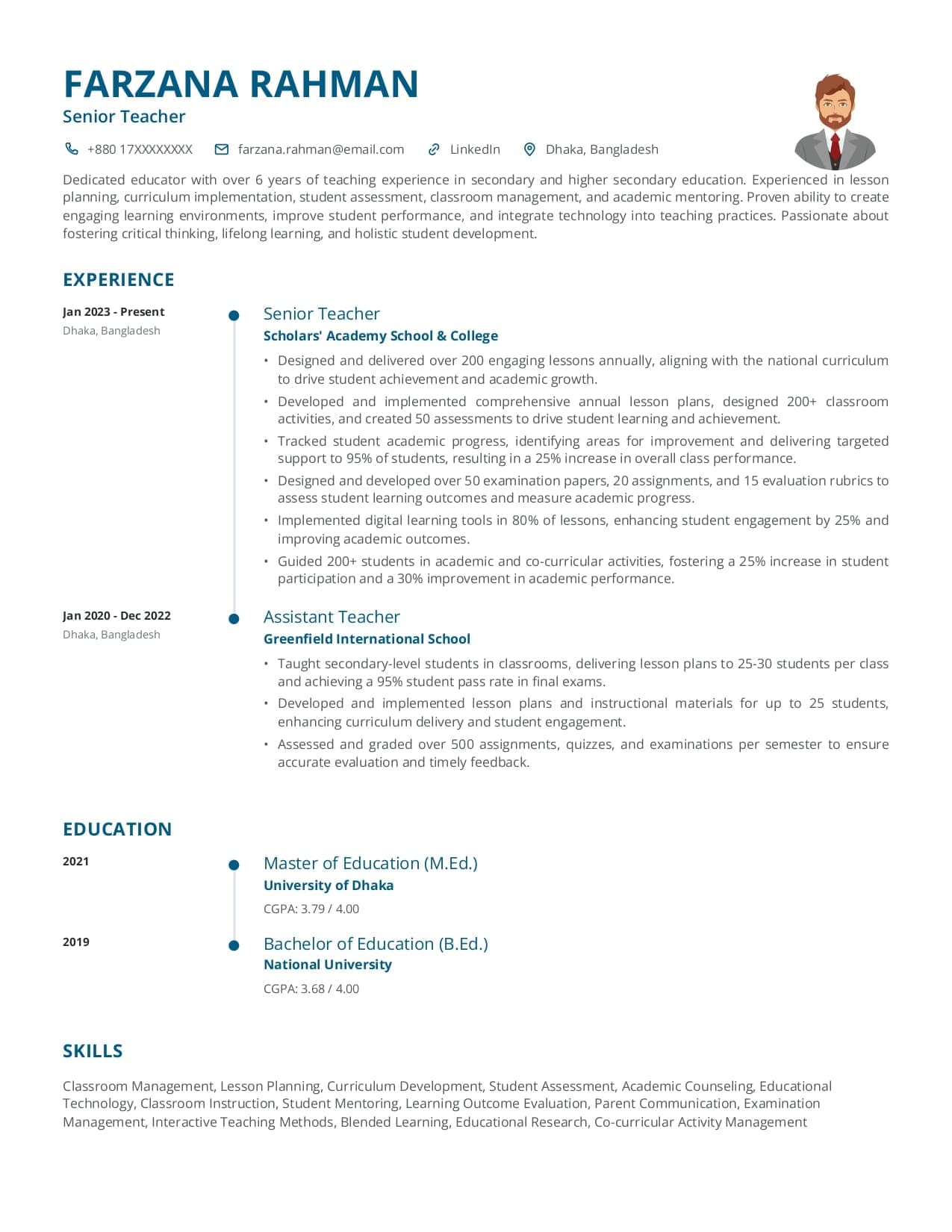
Teaching and academic CVs are credential-heavy, so they need a structured, single-column layout that keeps your qualifications, teaching experience, and research neatly organised — and fully ATS-parseable for the schools and universities that screen digitally.
 Pro
ProSection-by-section: what to write
Contact information
Name with academic title if applicable, professional email, phone number, and city. For university roles, add a link to Google Scholar or ResearchGate if you have publications.
Professional profile
Three to four lines: your teaching level (primary, secondary, college, university), subject specialism, years of experience, and a strength — e.g. "Mathematics teacher with 6 years at secondary level and a 95% board-exam pass rate."
Academic qualifications
List degrees in reverse order — PhD, MPhil, Master's, Bachelor's, plus B.Ed/M.Ed for school roles — with institution, year, and result. For academic posts this is the most scrutinised section, so keep it precise and complete.
Teaching experience
For each role: institution, position, dates, subjects and levels taught, and outcomes — exam results, curriculum developed, students mentored. "Raised average board results by 12% over three batches" shows real impact.
Research & publications
For college and university roles, list publications, conference papers, and research projects in a standard citation style. This section can be the deciding factor for academic appointments.
Skills, training & memberships
Subject expertise, teaching methods, classroom technology, languages, plus training, workshops, and professional memberships. Note any teaching-licence certification for school teaching roles.
Keywords ATS looks for
Weave these into your CVwhere they’re true to your experience, and always mirror the exact wording from the specific job post you’re applying to.
Common mistakes to avoid
Teaching & Academic CV: FAQ
What should a teacher CV include?
A professional profile, complete academic qualifications with institutions and results, teaching experience carrying measurable outcomes, research and publications for higher-education roles, and your teaching credentials. Keep the structure strict; this is a document people verify.
Do I need to list my teaching licence?
For school and college roles it is usually a hard requirement rather than a nice-to-have, so give it its own line rather than folding it into education. List it alongside your B.Ed, M.Ed or local equivalent.
How is a university CV different from a school teacher CV?
University CVs put far more weight on research, publications, and higher degrees (MPhil/PhD), and are often longer. School CVs emphasise teaching experience, exam results, classroom management, and a teaching licence/B.Ed credentials.
Should I include exam results I helped achieve?
Yes — quantified outcomes like board-exam pass rates, average score improvements, and students mentored are strong evidence of teaching impact and help you stand out from candidates who only list duties.