Human Resources Resume Sample: HR Manager Resume Example for 2026
Complete guide · 14 min read · Updated 2026
An HR resume is the only resume guaranteed to be read by someone who does your job. That cuts both ways. The reader knows exactly what "supported employee lifecycle initiatives" is hiding, and they also know precisely how hard a real number is to earn: attrition brought down, time-to-fill cut, an ER case file that survived legal review. Vague HR resumes fail faster in HR than anywhere else.
Below is a complete human resources resume, annotated section by section, with guidance for generalists, recruiters, HR managers and the specialist tracks, plus how to handle the confidentiality problem that flattens most HR writing. The sample is an HR manager eight years in, SHRM-CP, running a small team across three sites.
Choosing your template
HR resumes carry two things a layout can garble: metrics inside sentences (attrition percentages, days-to-fill, case counts) and a systems list that gets keyword-matched (Workday, BambooHR, Greenhouse, ADP). A single-column template keeps each bullet's number attached to its claim, and a grouped skills block keeps the systems findable. It also simply looks like what HR expects a clean resume to look like — this is the audience that wrote the norms.
Browse all 20 templates →Section-by-section: what to write
Header and title line
Name, title, city, phone, email, LinkedIn. Use the title of the ladder you are applying to — "HR Generalist", "HR Manager", "People Operations Manager" are screened as different strings, and HR screeners of all people match titles literally.
Professional summary
Three lines: years and the company sizes you have covered, the credential, and one number that proves scope. Company size matters more in HR than almost any field — HR for 90 people and HR for 600 are different jobs, and the reader wants to know which one you have done.
Experience: metrics with discretion
Employer, title, dates, then bullets that state outcomes as numbers without breaching anyone's privacy: attrition from 31% to 17%, time-to-fill from 41 to 23 days, 40+ ER cases a year with files that held up. Aggregates and process outcomes are always safe to state; names and details never are.
Education
Degree, school, year. An HR or business degree is worth a plain line; an unrelated degree is fine and common in HR, so give it one line and let the record carry the argument.
Skills, grouped by function
Split HR operations from recruiting from systems, and name the systems exactly: Workday, BambooHR, Greenhouse, ADP Workforce Now. "HRIS experience" fails the literal match that most HR software screens run. Spell out FMLA and ADA once — the acronyms are what get searched.
Certifications
SHRM-CP or PHR with years. In HR the certification is close to a hygiene factor for manager-level roles: it will not win the interview, but its absence is noticed by exactly this audience.
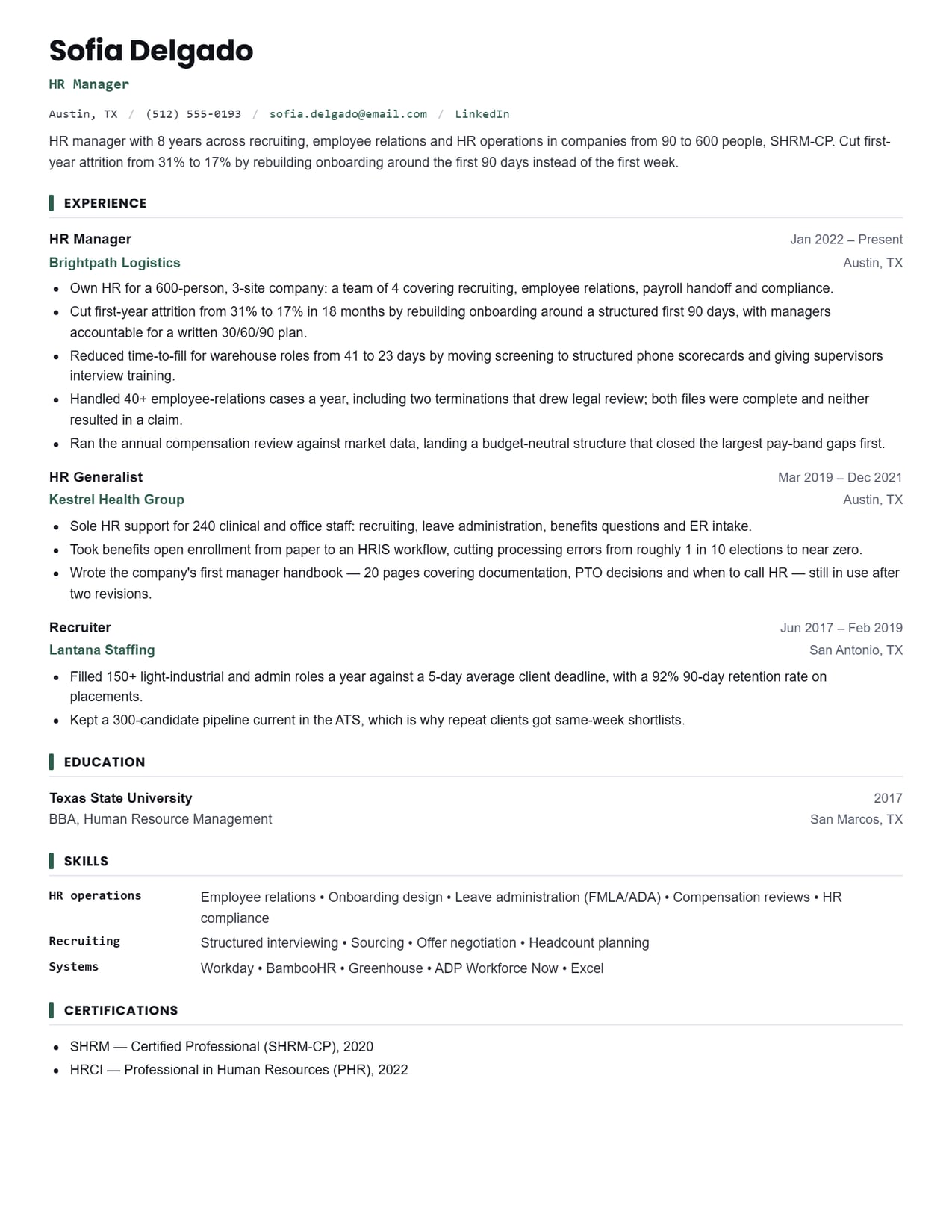
Human Resources resume sample, annotated
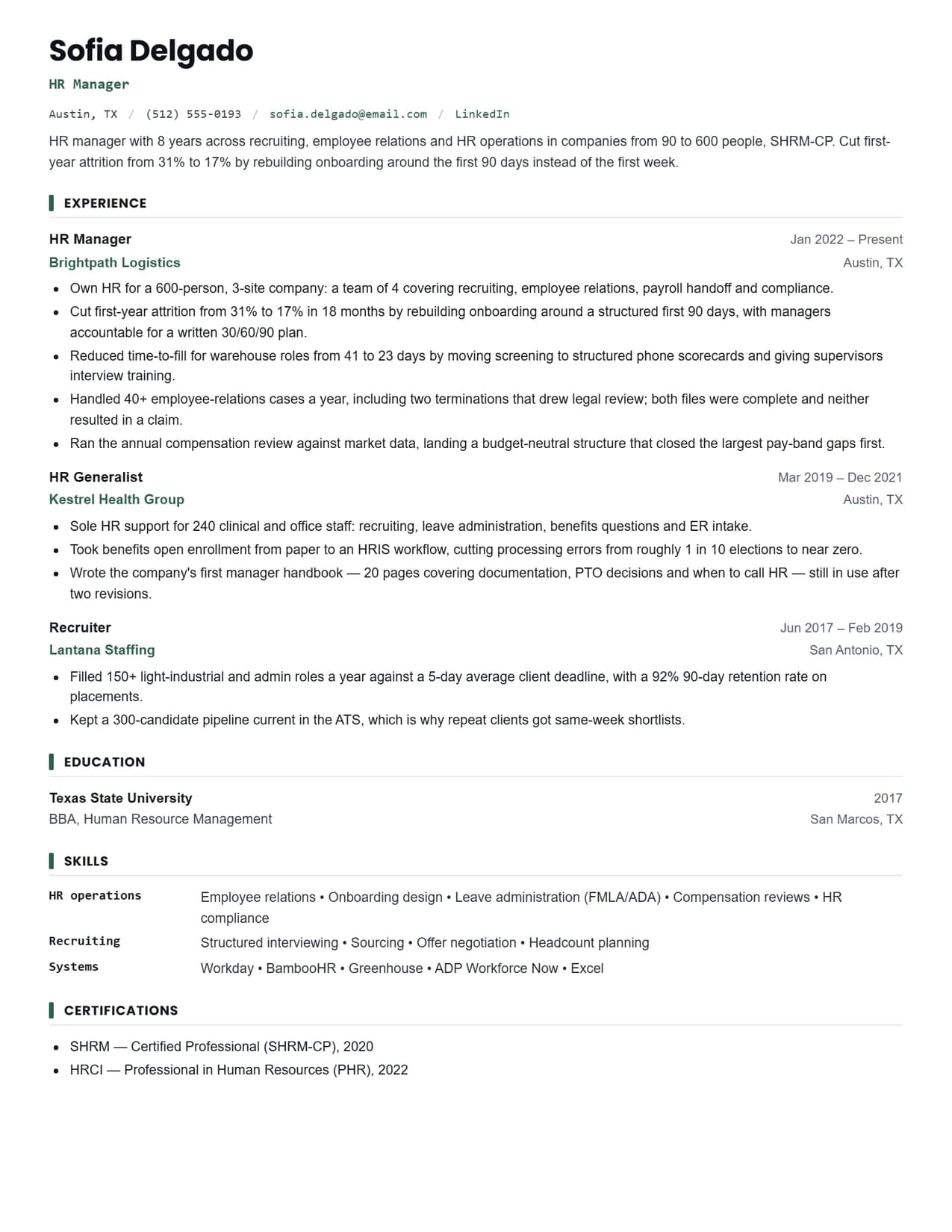
Sofia Delgado, an HR manager in Austin, eight years from agency recruiting to running HR for a 600-person company
Eight years and three employers on one page, agency to in-house to management, with a company size in every role. Read it the way an HR director would: scope first (600 people, 3 sites, team of 4), then the numbers, then whether the hard parts of the job — terminations, legal review, compliance — are present or politely missing.
The annotations follow the page from the top.
Summary
Years, the range of company sizes, the credential, and one program result. "Companies from 90 to 600 people" levels her instantly — the reader knows she has seen both the everything-yourself stage and the process stage.
Scope line at Brightpath
The first bullet is pure scope: 600 people, 3 sites, a team of 4, and the functions covered. HR readers level a candidate on this line before reading any achievement, so the sample spends its first bullet on it deliberately.
The attrition bullet
The strongest line: 31% to 17% in 18 months, with the mechanism (a structured first 90 days) and the enforcement (managers accountable for a written plan). Baseline, endpoint, method, governance — an HR director can interview against this line for ten minutes.
Time-to-fill with its lever
41 to 23 days, and how: structured phone scorecards and interview training for supervisors. Recruiting numbers earn trust when the lever is named, because the reader knows which levers actually move that metric.
The ER bullet
Volume (40+ cases a year), difficulty (two terminations with legal review), outcome (complete files, no claims) — and not one identifying detail. This is the template for writing employee relations without breaching anything.
The comp review line
"Budget-neutral structure that closed the largest pay-band gaps first" shows judgment under constraint, which is what comp work actually is. It also signals she has run a cycle end to end, not just pulled the market data.
Sole-HR years at Kestrel
"Sole HR support for 240 clinical and office staff" is a scope claim that explains everything after it. The enrollment bullet turns an administrative task into a quality number: errors from 1 in 10 to near zero.
The manager handbook
A 20-page artefact still in use after two revisions. Small, concrete, and it tells the reader she reduces future ER volume rather than just processing it — the difference between operating HR and improving it.
Agency years, kept honest
150+ fills a year against 5-day deadlines, with the number that matters attached: 92% of placements still there at 90 days. Volume recruiting without a quality stat reads as churn; this line pre-empts that read.
Systems named exactly
Workday, BambooHR, Greenhouse, ADP Workforce Now — four real systems, matchable by any filter, each defensible in an interview. Note what is absent: no padded list of every tool she has ever logged into.
What an HR director checks in the first four seconds
HR hiring managers screen resumes with the same eye they use on the hundreds that cross their desk for other roles. The scan is practiced and unforgiving.
The confidentiality trap
HR people underwrite their resumes out of a real virtue: they are trained not to talk about people's situations. But discretion about individuals gets misapplied as vagueness about outcomes, and the result is a resume of soft verbs that the reader — another HR professional — discounts on sight.
The line is simple: numbers about populations are yours to state; details about people are not.
Turn HR duties into evidence: eight rewrites
Every HR resume says it handled onboarding, employee relations and benefits. These rewrites attach the scope and the outcome that make the same work read as a track record.
Instead ofResponsible for full-cycle recruiting and onboarding.
WriteCut time-to-fill for warehouse roles from 41 to 23 days by moving screening to structured phone scorecards and training supervisors to interview.
The lever is named and the number has both ends. Full-cycle is a job description; 41-to-23 is a result.
Instead ofHandled employee relations issues as they arose.
WriteHandled 40+ ER cases a year, including two terminations that drew legal review; both files were complete and neither resulted in a claim.
Volume, difficulty and outcome, zero identifying detail — the exact template for ER on a resume.
Instead ofImproved the onboarding experience for new hires.
WriteCut first-year attrition from 31% to 17% in 18 months by rebuilding onboarding around a structured first 90 days, with managers accountable for a written 30/60/90 plan.
Experience improvements are claims about feelings; attrition movement is a claim about money, and it names the enforcement mechanism.
Instead ofAdministered benefits and annual open enrollment.
WriteTook open enrollment from paper to an HRIS workflow, cutting processing errors from roughly 1 in 10 elections to near zero.
The administrative task becomes a quality result with an honest, checkable error rate.
Instead ofSupported managers with performance management.
WriteWrote the company's first manager handbook — 20 pages covering documentation, PTO decisions and when to call HR — still in use after two revisions.
"Supported" becomes an artefact with a lifespan. Things still in use are the strongest small evidence a resume can carry.
Instead ofAssisted with compensation and salary benchmarking.
WriteRan the annual compensation review against market data, landing a budget-neutral structure that closed the largest pay-band gaps first.
Owning a cycle under a constraint is comp work; pulling benchmark data is a task inside it.
Instead ofMaintained HR records and ensured compliance.
WriteSole HR support for 240 clinical and office staff: recruiting, leave administration (FMLA/ADA), benefits and ER intake.
Compliance claims read strongest as scope honestly held. The acronyms sit inside a real sentence, where filters and humans both find them.
Instead ofPlaced candidates in temporary and permanent positions.
WriteFilled 150+ light-industrial and admin roles a year against a 5-day average client deadline, with 92% of placements still in seat at 90 days.
Volume with a quality denominator. Recruiting numbers without retention attached read as churn to any HR audience.
Generalist, recruiter, or specialist: pick the ladder
HR splits into tracks that screen on different evidence. One resume rarely serves two of them well.
| Role | Lead with | Also useful | Avoid leading with |
|---|---|---|---|
| HR coordinator / assistant | Process reliability, systems used, volumes handled without error | Event and onboarding logistics, HRIS data hygiene | Strategy language |
| HR generalist | Breadth honestly held: ER, benefits, compliance, recruiting, with headcount | One program result (attrition, enrollment quality) | Deep specialism claims |
| Recruiter / TA | Funnel numbers: reqs carried, time-to-fill, acceptance rate, 90-day retention | Sourcing depth, ATS fluency, hiring-manager management | Generalist breadth |
| HR manager | Team led, headcount covered, programs that moved a company metric | Comp cycles run, ER escalations owned, manager capability built | Task-level bullets |
| HRBP | Business units partnered, leaders advised, workforce plans delivered | Org design exposure, data fluency, change programs | Administrative volume |
| Specialist (comp, L&D, ER) | Depth in the specialism with its own metrics | The generalist base that got you there | Everything-else padding |
| Career changer | People-process work from your current field, plus SHRM-CP | Recruiting-adjacent or training-adjacent experience | An apology for the missing title |
The interview your resume sets up
HR interviews test the resume against scenarios, and the interviewer has usually lived every scenario they ask about.
How HR resumes get screened
Final checks before you apply
Keywords ATS looks for
Weave these into your resumewhere they’re true to your experience, and always mirror the exact wording from the specific job post you’re applying to.
Common mistakes to avoid
Human Resources resume: FAQ
What should a human resources resume include?
A title matching the ladder you are applying to, a summary with years, company sizes and credential, experience bullets that state outcomes as numbers, a skills block splitting HR operations from recruiting from systems, education, and SHRM or HRCI certification with dates. One page under ten years.
How do I quantify HR work on a resume?
Use the numbers HR already reports: attrition and retention rates, time-to-fill, offer-acceptance rate, ER case volume, headcount supported, error rates in payroll or enrollment. Every one is an aggregate, so none breaches confidentiality. If a program you ran moved one of those numbers, that is your bullet.
How do I write about employee relations without breaching confidentiality?
Count and characterise, never identify. "40+ ER cases a year, including two terminations that drew legal review; both files were complete and neither resulted in a claim" states volume, difficulty and outcome without a single identifying detail. What you must never do is describe a specific case in any way that could be matched to a person.
Is SHRM-CP or PHR better on a resume?
Either passes the check; both is a mild plus. SHRM-CP has become the more commonly requested string in postings, PHR signals the older HRCI body of knowledge. What matters is holding one of them by the time you apply for manager-level roles, and listing the year.
How is an HR generalist resume different from a recruiter resume?
A generalist resume argues breadth: ER, benefits, compliance, onboarding, with recruiting as one strand. A recruiter resume argues funnel: requisitions carried, time-to-fill, source mix, offer-acceptance, quality-of-hire proxies like 90-day retention. Sending the funnel resume to a generalist posting, or vice versa, reads as not knowing which job you want.
How do I get into HR with no HR experience?
Lead with the HR-shaped work your current job already contains: onboarding you ran, scheduling and coverage decisions, a complaint you escalated properly, training you delivered. Add the SHRM-CP, which does not require an HR title to sit. Coordinator and recruiting roles are the usual doors, and a resume that shows people-process work plus the credential gets those interviews.
Should HR resumes list systems like Workday or BambooHR?
Yes, by exact name, in their own group. Companies screen for their own HRIS literally, and admin-level experience in Workday or ADP is a hard requirement for some roles. Say which side you sat on — administrator, power user, or implementation — because the interview will establish it anyway.
How long should an HR resume be?
One page through senior generalist, two for HR managers with a decade or directors with program history. The reader processes resumes professionally and rewards density: company sizes, team sizes and numbers in every role, nothing padded.