Truck Driver Resume Sample: CDL-A Driver Resume Example for 2026
Complete guide · 12 min read · Updated 2026
Driver hiring runs on a handful of verifiable facts: CDL class, endorsements, years, miles, and the record — MVR, preventables, DOT history. Carriers pull those from databases whether you state them or not, so the resume's job is to state them first and state them clean. A driver who makes the recruiter dig for the CDL class has written the resume backwards.
Below is a complete CDL-A resume, annotated section by section, with guidance for OTR, regional, dedicated and local work, new CDL holders, and the move into trainer and fleet roles. The sample is a dedicated regional driver twelve years in, 1.3 million accident-free miles.
Choosing your template
Fleet recruiters screen high volumes fast, and much of it by phone with the resume open in front of them. A bold single-column layout with the class and endorsements in the title line, the record in the summary, and equipment and compliance grouped where a finger can find them matches exactly how that call goes. Nothing on a driver resume should take two looks to find.
Browse all 20 templates →Section-by-section: what to write
Header: class and title
Name, then "CDL-A Truck Driver" as the title, then city, phone, email. City matters more than in most fields — hiring radius is a real screen for dedicated and local work — so state it plainly and put the class where no one has to look for it.
Summary: the record in numbers
Three lines: years and miles, the lane types and trailer types you have run, and the record — clean MVR, zero preventables, on-time percentage if a customer scorecard backs it. These are the five facts every recruiter call opens with, in the order they ask them.
Experience: lanes, not just employers
Carrier, role, dates, then the lane described like a driver describes it: region, weekly miles, trailer type, stop count. Then the numbers that carry over: on-time rate, inspection history, load rejections, HOS record. Carriers know each other's accounts, so a precisely described lane is instantly credible.
Education and training
CDL school or the company program that licensed you, one line with the year. After your first driving job this section only has to exist; the record above it is the credential.
Skills: equipment and compliance
Group equipment (trailer types, transmissions, liftgate), compliance (ELD/HOS, pre-trips, load securement) and endorsements with your record summary. Name the ELD platforms — Samsara, Omnitracs — because fleets screen for their own systems, and a driver who logs clean needs no training week.
Licenses and certifications
CDL class, state and endorsements spelled out (H, N, T), TWIC if held, defensive-driving credentials. Endorsements are yes/no gates for whole categories of freight, so list every one you hold even if the posting does not ask.
Truck Driver resume sample, annotated
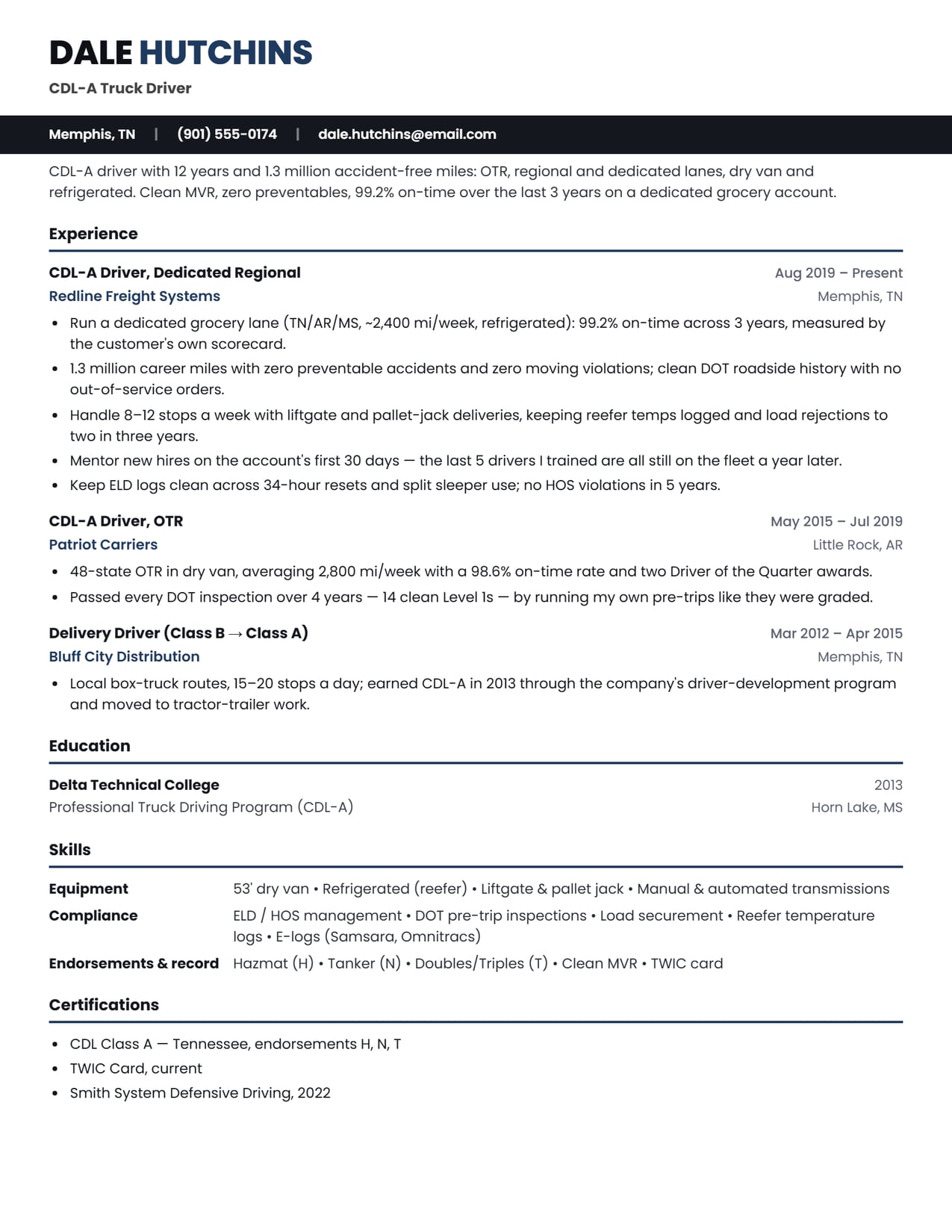
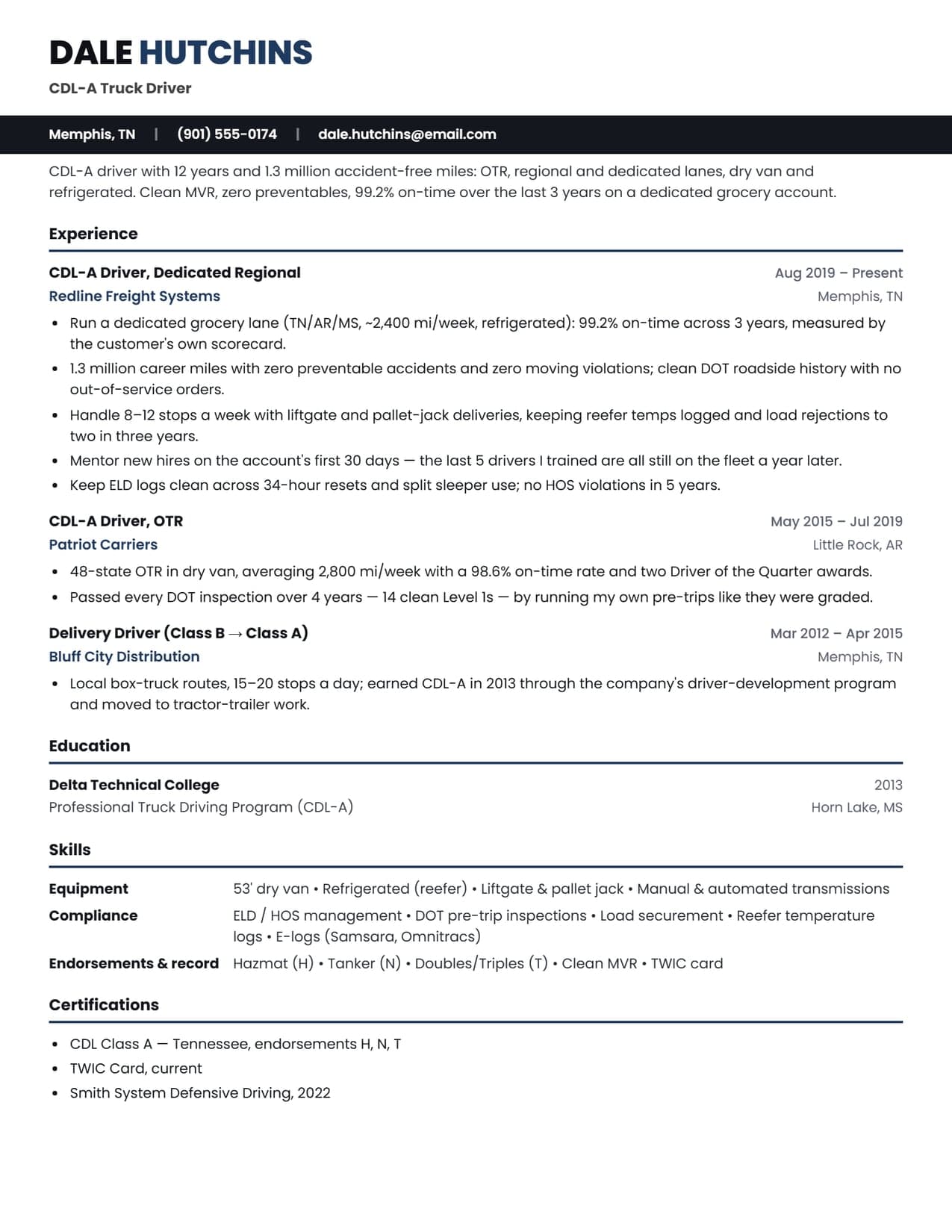
Dale Hutchins, a dedicated regional driver in Memphis, twelve years and 1.3 million accident-free miles
Twelve years on one page, box truck to OTR to a dedicated grocery lane, with the record doing the arguing: 1.3 million miles, zero preventables, 99.2% on-time on the customer's own scorecard. Notice how each lane is described the way drivers actually talk about them — region, weekly miles, trailer, stops.
The annotations follow the page from the top.
Title line and location
"CDL-A Truck Driver" beside the name answers the first screen without a search, and Memphis matters: dedicated and local hiring runs on radius, so the city is doing real work in the header.
Summary
Years, miles, lane types, trailer types, then the record: clean MVR, zero preventables, 99.2% on-time. These are the five questions a recruiter call opens with, answered in the order they get asked.
The lane description
"Dedicated grocery lane (TN/AR/MS, ~2,400 mi/week, refrigerated)" is instantly credible to anyone in freight — carriers know each other's accounts, and precision here reads as a driver who knows exactly what job he does.
The scorecard number
99.2% on-time across 3 years, "measured by the customer's own scorecard". The attribution is the strength: it names a verifiable source, which turns a percentage into a reference.
The record bullet
1.3 million miles, zero preventables, zero moving violations, no out-of-service orders. Every item here will be checked against MVR and PSP pulls — stating them exactly tells the carrier the check will come back clean.
The delivery detail
8–12 stops a week, liftgate and pallet jack, reefer temps logged, two rejections in three years. Grocery freight lives and dies on rejections, so that small count is the bullet a dedicated fleet manager reads twice.
The mentoring line
Five drivers trained, all still on the fleet a year later. In an industry with structural turnover, retention of trainees is fleet-level evidence — this is the line that opens trainer and lead-driver conversations.
The OTR years
48 states, 2,800 miles a week, 98.6% on-time, two Driver of the Quarter awards, and 14 clean Level 1 inspections credited to graded pre-trips. The inspection count is the kind of specific that separates a real record from a rounded one.
The first rung
Box-truck routes, then CDL-A through the company's driver-development program. Career-path evidence matters: it shows the license was earned working, and it explains the years before the class.
Endorsements listed in full
H, N and T, plus TWIC, plus the clean MVR restated in the skills band. Endorsements are yes/no gates for whole freight categories, so the sample lists every one — including the tanker endorsement no grocery lane needs, because the next lane might.
What a fleet recruiter checks in the first ten seconds
Driver recruiting is a volume operation working against verifiable databases. The resume is screened for the facts the databases will confirm.
The record is the resume
Every other field in this catalogue argues achievements; driving argues a record. Carriers price insurance, CSA exposure and customer risk directly off it, which makes a documented clean record the most valuable thing a driver can put on paper — and the thing most driver resumes strangely leave implicit.
Turn driving duties into evidence: seven rewrites
Each rewrite takes a line found on real driver resumes and attaches the miles, counts or record that carriers actually screen for.
Instead ofDrove tractor-trailer on assigned routes, delivering freight on schedule.
WriteRun a dedicated grocery lane (TN/AR/MS, ~2,400 mi/week, refrigerated): 99.2% on-time across 3 years on the customer's own scorecard.
The lane has a shape and the number has a source. Any fleet manager can picture this exact job.
Instead ofMaintained a safe driving record.
Write1.3 million career miles with zero preventable accidents and zero moving violations; clean DOT roadside history with no out-of-service orders.
The record in the units carriers verify. This bullet is the hire, stated as numbers.
Instead ofCompleted deliveries to customer locations.
WriteHandle 8–12 stops a week with liftgate and pallet-jack deliveries, keeping reefer temps logged and load rejections to two in three years.
Stops, equipment and the rejection count — the operational facts of the lane, with the number that matters in food freight.
Instead ofComplied with all DOT regulations and hours of service.
WriteKeep ELD logs clean across 34-hour resets and split sleeper use; no HOS violations in 5 years.
Names the actual HOS mechanics, which reads as fluency, and attaches the streak that audits confirm.
Instead ofPassed DOT inspections.
Write14 clean Level 1 inspections over 4 years — by running my own pre-trips like they were graded.
A counted streak plus the habit behind it. Inspections feed CSA scores, so this is money to a carrier.
Instead ofHelped train new drivers.
WriteMentor new hires through the account's first 30 days — the last 5 drivers I trained are all still on the fleet a year later.
Trainee retention is fleet-level evidence in a turnover industry, and it opens trainer-pay conversations.
Instead ofStarted as a local delivery driver.
WriteLocal box-truck routes at 15–20 stops a day; earned CDL-A in 2013 through the company's driver-development program and moved to tractor-trailer work.
The first rung written as a path: stop-count work ethic, then the license earned on the job.
OTR, regional, dedicated, local: match the resume to the seat
Recruiters staff specific seats. The same career reads differently depending on which seat you are asking for, so weight the evidence to the lane you want.
| Seat | Lead with | Also useful | Avoid leading with |
|---|---|---|---|
| OTR | Career miles, 48-state experience, self-sufficiency, trip planning | Equipment range, weather experience, clean logs across resets | Home-time complaints |
| Regional | Weekly miles, on-time rate, lane familiarity in the region | Customer-facing habits, recurring-stop relationships | Coast-to-coast war stories |
| Dedicated | The account's scorecard numbers, rejection counts, retention on the account | Reefer or account-specific equipment, mentoring on the account | Generic freight variety |
| Local / P&D | Stop counts, liftgate and dock work, city driving record | Route knowledge, customer service, physical reliability | Long-haul mileage as the headline |
| Tanker / hazmat | The endorsements, product-handling record, placard experience | TWIC, terminal access history, zero-incident loading record | Dry-van-only history unlabelled |
| Flatbed | Securement depth: chains, straps, tarps, oversize experience | Permit-load history, physical capability, zero load-shift record | No-touch-freight preferences |
| New CDL holder | License, school hours, equipment trained on, reliability from prior work | Clean personal record, willingness to train OTR first | Apologising for zero miles |
What gets verified, and how to be ready for it
Driver hiring runs more background machinery than almost any hourly field. The resume works best when it anticipates each check.
How driver resumes get screened
Final checks before you apply
Keywords ATS looks for
Weave these into your resumewhere they’re true to your experience, and always mirror the exact wording from the specific job post you’re applying to.
Common mistakes to avoid
Truck Driver resume: FAQ
What should a truck driver resume include?
CDL class in the title line, a summary with years, miles, lane and trailer types and your record, experience with lanes described precisely (region, weekly miles, equipment, stops), CDL school in one line, equipment and compliance skills, and every endorsement you hold with the state and class. One page.
How do I list my CDL and endorsements on a resume?
Title line: "CDL-A Truck Driver". Certifications: "CDL Class A — Tennessee, endorsements H, N, T", plus TWIC if held. Spell out what the letters are only if space allows; recruiters read the letters. List every endorsement even when the posting does not ask, because they qualify you for freight the carrier may also run.
What safety record numbers should go on a driver resume?
Career miles without a preventable, MVR status, moving violations if zero, DOT inspection history (clean Level 1s are worth counting), HOS record, and out-of-service history if clean. Carriers verify all of it through MVR and PSP pulls, which is exactly why stating it precisely works: you are showing them the check will come back clean.
How do I write a resume for my first CDL job?
Lead with the license and school: CDL-A, the program, hours behind the wheel, equipment trained on. Then make the previous work argue reliability — attendance, delivery or route work, anything with early hours and no supervision. New-driver hiring is a bet on reliability plus a clean record, so state both and apply to carriers with real training fleets.
OTR vs regional vs local — does the resume change?
The evidence changes weight. OTR argues miles, self-sufficiency and trip planning; regional and dedicated argue on-time percentage and customer-facing habits; local argues stop counts, liftgate work and city driving. Describe each past lane exactly and lead your summary with the type you want next, because recruiters staff specific lanes, not driving in general.
What does a dedicated-account driver resume need?
The account's shape: region, weekly miles, trailer type, stops, and the customer's own scorecard numbers if you have them. "99.2% on-time across 3 years, measured by the customer's scorecard" is the strongest line a dedicated driver can write, because dedicated hiring is entirely about not losing the account.
How do I move from driving into trainer or fleet roles?
Surface the evidence you already have: new hires mentored and whether they stayed, orientation help, clean-inspection streaks other drivers ask you about. "The last 5 drivers I trained are all still on the fleet a year later" is a trainer resume in one line. Fleet and dispatch moves also want the paperwork side — ELD fluency, logs clean at audit.
How long should a truck driver resume be?
One page. The facts that decide the hire — class, endorsements, miles, record, lanes — fit comfortably, and recruiters work at volume. Ten-plus-year careers can compress older carriers into single lines; the last two lanes carry the decision anyway.