Banking & Finance CV Template & Examples (2026)
Complete guide · 15 min read · Updated 2026
Banking and finance recruiters screen harder than almost any other sector. They look for accuracy, benchmarked numbers, and the right credentials before a human ever reads your file, and a CV that is vague or cluttered is filtered out before it reaches a hiring manager.
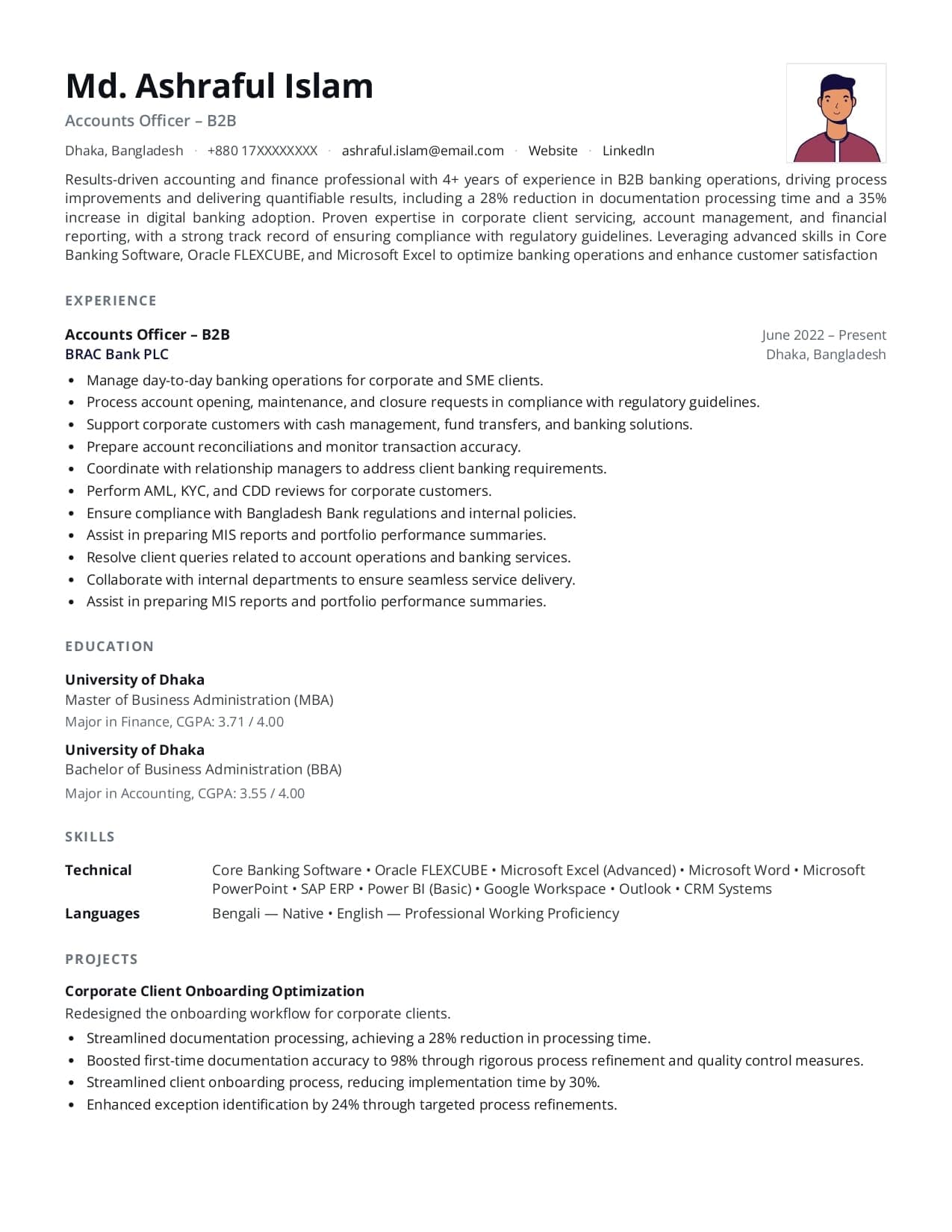
Below is a complete banking and finance CV sample, annotated section by section, covering corporate banking, credit risk, audit and accounting. Use it as a model for benchmarking your own numbers, then build your version in the EvoResume editor.

Recommended templates for banking & finance
Finance is a conservative field, and the CV should look it. A clean single-column layout signals the professionalism recruiters expect, and more practically it survives the parsing step: credit and audit roles attract high application volumes, so almost every file is read by an ATS before a person sees it. The templates below keep your quantified achievements, certifications and systems easy to scan for both.
 Pro
ProSection-by-section: what to write
Contact information
Name, professional email, phone number, city, and a complete LinkedIn URL. Banking is relationship-driven, so a polished LinkedIn profile matters.
Professional summary
Three to four lines stating your years of experience, specialism (retail banking, credit risk, audit, treasury, accounts), and one benchmarked headline metric, for example "managed a £310M portfolio at a 0.6% non-performing ratio against a 1.9% divisional average."
Work experience
Lead every bullet with a number: amounts handled, portfolio size, recovery rates, audit findings closed, cost savings, compliance scores. Finance hiring is evidence-driven, so "cut reconciliation errors 30%, from 61 to 43 per month" beats "responsible for reconciliation."
Education
List your BBA/MBA, major (finance, accounting), institution, and CGPA if strong. A finance employer reads this closely, so place it prominently if you're early-career.
Certifications & licences
CA, ACCA, CFA (any level), CMA, or in-progress study is a major differentiator, so give it its own section. Include Excel/financial-modelling certificates and any banking diploma.
Technical skills
Name the systems: Core Banking Software, Oracle FLEXCUBE, Tally, SAP FICO, advanced Excel (pivot tables, VLOOKUP, financial modelling), Power BI. Mirror the exact tools listed in the job posting.
Key achievements
A short highlights block covering awards, top-performer recognition, successful audits and process improvements, each with a number. This is the section a finance manager scans first.
What a banking or finance CV has to prove in 2026
Finance hiring is unusually structured. Large banks and audit firms run high-volume graduate and analyst pipelines with automated sifting, competency frameworks, and in many cases numerical testing before a human opens your file. Lateral hires are screened differently, but no less rigorously: the person reading your CV is usually the person who will have to defend hiring you to a credit or risk committee.
That produces a specific reading pattern. A finance hiring manager is checking four things, in roughly this order, and they will stop reading as soon as one of them fails.
Benchmark every number: eight rewrites
The most common weakness in finance CVs is not a missing number. It is a number with no reference point. Below are patterns from weak banking and finance CVs, with the rewrite alongside and the reason it lands.
Instead ofResponsible for a portfolio of corporate clients.
WriteManaged a £310M lending portfolio across 42 mid-market clients with turnover of £10M to £150M.
States book size, client count, and the segment. A reader can immediately place your seniority.
Instead ofMaintained a low level of bad debt.
WriteHeld non-performing loans at 0.6% against a 1.9% divisional average.
The benchmark is what makes it an achievement. Without it, 0.6% could be luck or a soft book.
Instead ofPrepared credit proposals for approval.
WriteAuthored 60+ credit papers to committee at a 91% first-pass approval rate, cutting turnaround from 12 working days to 7.
Volume, quality, and a process improvement. First-pass approval rate is the metric credit heads actually track.
Instead ofInvolved in restructuring distressed accounts.
WriteRestructured three distressed exposures totalling £18M, recovering 94% of principal against a modelled 61% under enforcement.
Recovery against the modelled alternative is the only honest way to show workout skill.
Instead ofImproved the team's financial models.
WriteBuilt a cash-flow stress-testing model in Excel and VBA adopted as the team standard, cutting build time from 4 hours to 40 minutes per file.
Names the tool, the adoption, and the time saved. Adoption by others is the proof it was good.
Instead ofAssisted with IFRS 9 compliance.
WriteLed an IFRS 9 staging review across a 220-account book, reclassifying 18 exposures and releasing £2.1M of over-provisioning.
'Assisted with' is invisible. Scope plus balance-sheet impact is not.
Instead ofHandled AML and KYC checks.
WriteCleared a 140-case AML and KYC remediation backlog in 11 weeks with zero findings at subsequent internal audit.
The audit outcome is the credibility. Anyone can process cases; passing the audit afterwards is the point.
Instead ofWorked on audits for various clients.
WriteDelivered statutory audits for 20+ owner-managed clients with turnover up to £80M, identifying a £640K revenue recognition misstatement.
Scope plus a specific finding. A named material finding is the single strongest line an auditor can write.
Which metrics to lead with, by finance function
Finance is not one job market. A credit analyst and a management accountant are assessed on entirely different evidence, and quoting the wrong metric signals you do not know the function you are applying to.
| Function | Lead with | Also useful | Avoid leading with |
|---|---|---|---|
| Corporate / commercial banking | Portfolio size, income growth, NPL ratio vs benchmark, new money originated | Cross-sell ratio, RoRWA, client retention | Number of meetings attended |
| Credit risk / underwriting | Approval volumes, first-pass approval rate, default rate, turnaround time | Model builds, policy contributions | Files 'reviewed' |
| Audit / assurance | Client count and turnover range, material findings, engagements led | Budget recovery, staff supervised | Hours worked |
| Accounting / financial control | Close time reduction, reconciliation error rate, audit adjustments | Systems implemented, headcount supported | Journals posted |
| FP&A | Forecast accuracy variance, budget size owned, cost savings identified | Model rebuilds, reporting automation | Reports produced |
| Treasury | Liquidity position managed, funding cost reduction, hedge effectiveness | Counterparty limits, cash pooling | Payments processed |
| Investment banking / M&A | Deal values, deals closed, sectors covered | Pitch conversion, models built | Pitchbooks produced |
Certifications and how to present them honestly
Finance is one of the few sectors where a qualification can be the difference between a screen-out and an interview, so this section carries more weight than it does elsewhere. It is also where candidates most often overstate, and where overstating is easiest to catch: professional bodies publish member directories.
The rule is simple. Say the awarding body, say the status, and say the date. If it is in progress, say which level and when you sit.
Regulatory language you should be naming
Compliance keywords do double duty: they are exactly what a keyword filter scores, and they are how a hiring manager judges whether you worked inside a framework or merely near it. Only claim what you can discuss for five minutes in an interview.
How an ATS reads a finance CV
Large banks and the Big Four run some of the highest application volumes of any sector, which means automated sifting is close to universal at graduate and analyst level. Most rejections blamed on the algorithm are parsing failures rather than judgement calls: the information was on the page, but the parser could not attach it to the right field.
Breaking into banking or finance without experience
Graduate finance recruitment is competitive but unusually transparent: the criteria are published, the process is structured, and the gatekeepers are consistent. That means an entry-level CV can be engineered against known requirements rather than guessed at.
'Banking and finance fresh graduate CV template' is one of the most searched phrasings in this space, and the honest answer is that the template matters far less than what you put in the education and projects sections.
UK, US and Gulf conventions
Finance is the sector where market conventions diverge most, and where getting them wrong is most visible. If you apply across markets, keep separate versions rather than one compromise document.
| UK | US | Gulf and Asia | |
|---|---|---|---|
| Document name | CV | Resume | CV |
| Length | 1 page graduate, 2 pages qualified | 1 page, strictly, in IB | 2 pages standard |
| Qualifications | ACA, ACCA, CIMA, CFA | CPA, CFA | ACCA, CFA, CA, local licences |
| Academics | Degree classification (2:1, First) | GPA out of 4.0 | CGPA and percentage both common |
| Photo | Optional, still uncommon at traditional firms | Omit, anti-bias policies count against it | Often expected |
| Personal details | City only | City and state only | Nationality and visa status expected |
| Spelling | Organised, analysed, programme | Organized, analyzed, program | UK spelling preferred |
Final checks before you send
Keywords ATS looks for
Weave these into your CVwhere they’re true to your experience, and always mirror the exact wording from the specific job post you’re applying to.
Common mistakes to avoid
Banking & Finance CV: FAQ
What should a banking or finance CV include?
A metric-led professional summary, quantified work experience (portfolio sizes, recovery rates, audit outcomes), your degree and CGPA, certifications (CA/ACCA/CFA/CMA), named technical systems, and a key-achievements block. A traditional template fits the industry.
How do I make a finance CV stand out?
Quantify everything. Replace responsibility statements with results that include currency amounts, percentages, and ratios. Add certifications and the specific software you've used, and mirror the job post's keywords so the ATS scores you highly.
Should I include my CGPA?
Yes if it's strong (3.0+ on a 4.0 scale), especially early in your career, because banks and audit firms weigh academic results heavily. If it's lower, lead with experience and certifications instead.
Which certifications matter most for finance jobs?
CFA, ACA, ACCA, CIMA and CMA carry the most weight, even at partial completion. Say the level and the sitting date for anything in progress, because 'CFA Level II candidate, sitting Aug 2026' is credible where 'studying CFA' is not.
How long should a banking or finance CV be?
One page for graduates and analysts, two pages from associate level upward. Two pages is normal and accepted in UK finance, unlike US investment banking where one page is enforced almost without exception.
Should I name my clients or borrowers?
No. Describe them by sector, size and structure instead: 'a £45M-turnover logistics group' rather than the company name. Naming counterparties suggests you would do the same with your next employer's book, and it can breach confidentiality terms.
Should a banking or finance CV include a photo?
It depends on the market. A photo is expected across much of the Gulf and Asia and is normal on modern European templates, but it is best omitted for US applications where anti-bias hiring policies mean it can count against you. Traditional UK banks and audit firms still lean towards no photo, so consider removing it for Big Four graduate schemes and older institutions. If you include one, keep it as a plain inline image rather than a shape fill, which some parsers cannot read past.