Project Manager Resume Sample: PMP Resume Example for 2026
Complete guide · 14 min read · Updated 2026
Project management resumes fail in a way that is easy to name and surprisingly hard to stop doing: they describe process instead of delivery. "Facilitated standups, managed stakeholders, tracked risks" is the job description of every PM alive. The question a hiring manager is actually asking is simpler and harsher: did your projects land, on what budget, against what baseline, and how do we know?
Below is a complete project manager resume, annotated section by section, with guidance for IT, construction, consulting and program-level roles, plus what changes when you are moving up from coordinator or across from another discipline. The sample is a senior PM nine years in, PMP-certified, running ERP and business-change programs.
Choosing your template
A PM resume has to carry numbers in almost every line: budget figures, team sizes, schedule variances. A single-column layout with a full-width skills band keeps those bullets long enough to state a baseline and a result without wrapping into fragments. Executive-styled templates work well here because PM hiring runs through sponsors and directors who read a resume the way they read a status report: title, headline numbers, then evidence.
Browse all 20 templates →Section-by-section: what to write
Header and title line
Name, then the title with the credential attached: "Senior Project Manager, PMP". The PMP is screened as a keyword and as a checkbox, so it belongs in the title line and the certifications section both. If you are not certified, state the title plainly and let the delivery record argue for you.
Professional summary
Three lines: years and the kind of programs, the largest budget you have owned, and one delivery the reader can verify further down. "Programs up to $6.5M" does more work than any adjective, because budget authority is the single fastest proxy for seniority in this field.
Skills, split by kind
Methods, tools, and program work, in that order. Name the methodology honestly (Waterfall, Scrum, hybrid) because the interviewer will probe it, and name the tools exactly: MS Project, Jira, Smartsheet and Power BI are searched literally. "Budget ownership to $6.5M" belongs in the skills band too — it is a searchable fact, not a boast.
Experience: delivery against baseline
Employer, title, dates, then bullets that each name a project, its size, and where it landed against plan. "Two weeks ahead of a 14-month baseline" is a claim with edges; "delivered on time" is not. Where a project went wrong, say what you did about it — recovered programs are stronger evidence than smooth ones.
Education
Degree, school, year, one line. PM hiring weighs the delivery record and the certification far above the degree, so this section earns exactly the space it needs and no more.
Certifications
PMP first, then anything genuinely held: PSM, PRINCE2, Prosci for change-heavy work. Dates matter because certifications lapse, and a lapsed PMP listed as current is exactly the kind of detail an interviewer checks. Three real credentials beat a wall of course completions.
Project Manager resume sample, annotated
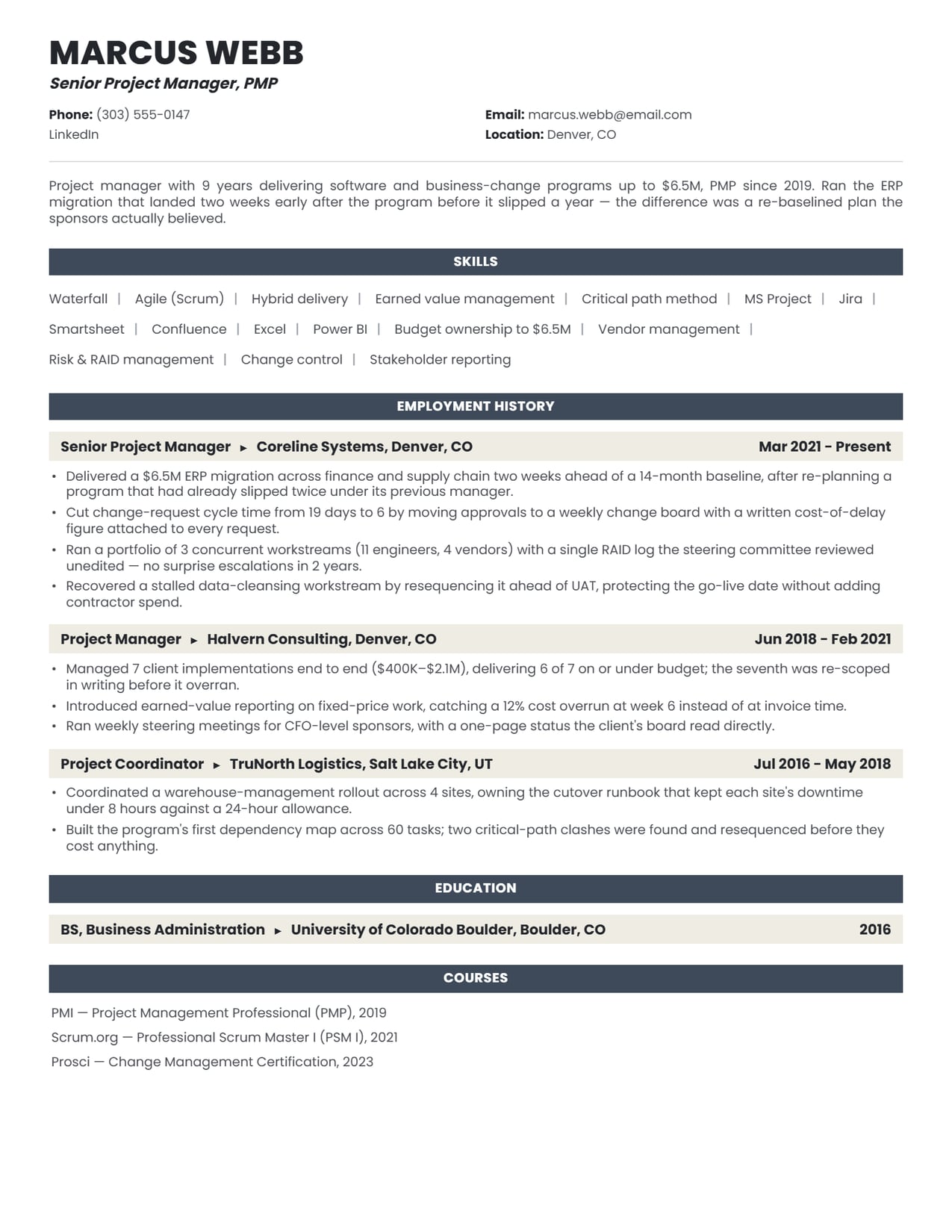
Marcus Webb, a senior project manager in Denver, nine years across software and business-change programs
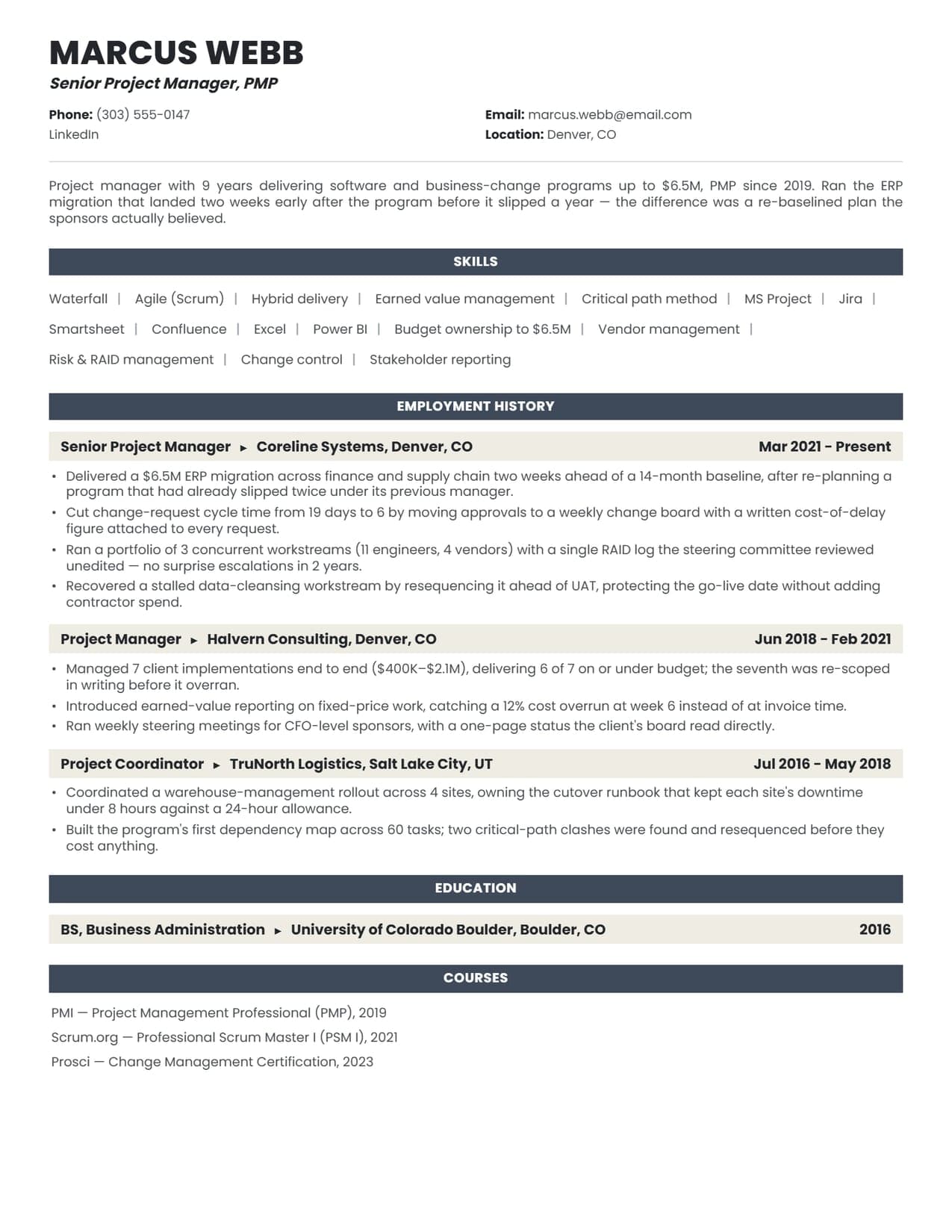
Nine years and three employers on one page, with the skills band above the work history so the methods and tools survive a partial read. Notice what almost every bullet has that most PM resumes lack: a baseline. Ahead of what plan, down from what cycle time, against what allowance.
The annotations follow the page from the top.
Title line
"Senior Project Manager, PMP" puts the credential where the keyword filter and the human reader both find it first. The summary then repeats the two facts that set his level: nine years, programs to $6.5M.
Summary's second sentence
One project, told with its context: the migration landed early after the program before it had slipped a year, and the difference was a plan the sponsors believed. That is a delivery story in one line, and it makes a reader want the detail below.
Skills band placement
This template puts skills above the work history, which suits PM hiring: a director skims methods and tools before deciding whether the history is worth reading. "Budget ownership to $6.5M" sits in the band as a searchable fact.
The ERP bullet
The strongest line on the page: dollar size, scope, the baseline, and the inherited mess. "After re-planning a program that had already slipped twice" claims recovery, which is rarer and more valuable than a clean green run.
The change-board bullet
Cycle time from 19 days to 6, with the mechanism named: a weekly board and a cost-of-delay figure on every request. Process bullets earn their place only when they end in a number, and this one does.
"No surprise escalations in 2 years"
An unusual metric, and a deliberate one. Sponsors dread surprises more than slippage. A RAID log the steering committee read unedited is governance evidence a director recognises instantly.
The consulting years
Seven implementations with the honest fraction: six of seven on or under budget, the seventh re-scoped in writing before it overran. The candor is the point — a 7-for-7 line would read worse to anyone who has run client work.
Earned value at week 6
Naming EVM matters for the keyword scan; catching a 12% overrun at week 6 instead of at invoice time matters for everyone else. The bullet serves both readers in one sentence.
The coordinator role
His first job is written as delivery, not admin: a cutover runbook that kept downtime under a third of the allowance, and two critical-path clashes caught early. This is how a coordinator resume argues its way up a level.
Certifications with years
PMP 2019, PSM 2021, Prosci 2023 — three credentials, dated, all reflected in the work above. The Prosci matters for change-heavy programs and quietly explains the adoption language in the bullets.
What a sponsor checks in the first four seconds
PM resumes are usually screened by the person who will sit across from you in a steering meeting. Their scan is fast and specific.
Process is not delivery
The central failure of PM resumes is writing about the machinery instead of what the machinery produced. Every PM runs meetings, tracks risks and manages stakeholders; putting those in bullets spends your strongest real estate proving you are ordinary.
The fix is mechanical. For each bullet, ask: does this end in something a sponsor would report upward? If not, either attach the outcome or cut the line.
Turn PM duties into evidence: eight rewrites
Each rewrite takes a line found on real PM resumes and attaches the size, baseline or consequence that makes it evidence.
Instead ofManaged multiple projects simultaneously in a fast-paced environment.
WriteRan a portfolio of 3 concurrent workstreams (11 engineers, 4 vendors) inside a $6.5M program, reporting to a single steering committee.
Counts and structure replace pace adjectives. "Fast-paced" is unverifiable; "3 workstreams, 11 engineers, 4 vendors" is not.
Instead ofDelivered projects on time and within budget.
WriteDelivered a $6.5M ERP migration two weeks ahead of a 14-month baseline, after re-planning a program that had slipped twice under its previous manager.
The baseline makes the claim checkable, and the inherited slippage makes it impressive.
Instead ofFacilitated daily standups, sprint planning and retrospectives.
WriteCut change-request cycle time from 19 days to 6 by moving approvals to a weekly change board with a cost-of-delay figure attached to every request.
Ceremonies are the job; the number the ceremony moved is the evidence.
Instead ofManaged project budget and tracked expenses.
WriteIntroduced earned-value reporting on fixed-price work, catching a 12% cost overrun at week 6 instead of at invoice time.
Names the method and what it caught. Budget bullets need a moment where the tracking mattered.
Instead ofCommunicated with stakeholders at all levels.
WriteRan weekly steering for CFO-level sponsors with a one-page status the client's board read directly.
Who, at what cadence, and the detail that proves the reporting was trusted: it went to the board unedited.
Instead ofIdentified and mitigated project risks.
WriteMaintained a single RAID log across 3 workstreams that the steering committee reviewed unedited — no surprise escalations in 2 years.
The outcome of good risk management is the absence of surprises, so state that absence as the result.
Instead ofCoordinated cross-functional teams to achieve project goals.
WriteOwned the cutover runbook for a 4-site warehouse rollout, keeping each site's downtime under 8 hours against a 24-hour allowance.
One artefact, one number, one allowance beaten. Coordination claims need a deliverable to point at.
Instead ofEnsured projects followed PMO standards and best practices.
WriteRe-scoped the one overrunning engagement of seven in writing before it overran, keeping the client and the margin.
Standards exist for the hard moment. Show the hard moment handled, not the manual followed.
Which PM job are you actually applying for?
Project management titles blur across industries, and a resume tuned for one reads as junior or misdirected for another. Decide the ladder first, then tune the evidence.
| Role | Lead with | Also useful | Avoid leading with |
|---|---|---|---|
| IT / software PM | Deliveries against baseline, budget size, vendor management, cutover and UAT | Agile fluency, Jira, technical vocabulary held honestly | Deep technical claims you cannot defend |
| Program manager | Multiple related workstreams, combined risk, benefits realisation | Steering-level reporting, dependency management across projects | Single-project mechanics |
| Construction PM | Contract values, schedule and trades coordination, safety record, change orders | RFIs and submittals, owner and GC relationships | Software methodology language |
| Consulting / client PM | Client deliveries with margins held, scope control in writing, multi-account juggling | Executive communication, commercial awareness | Internal-process bullets |
| PMO / governance | Standards adopted, reporting sponsors trusted, portfolio visibility built | Tooling rollouts, methodology coaching | Claiming other PMs' deliveries |
| Scrum master | Team throughput improved, impediments removed, cadence discipline | PSM/CSM, engineering-team credibility | Command-and-control phrasing |
| Coordinator moving up | Outcomes owned, however small: a runbook, a dependency map, a recovered slip | Tool depth, reliability, the explicit readiness argument in the summary | A responsibilities list |
The interview your resume sets up
Every strong claim on a PM resume becomes an interview thread. Write only what you can walk through under questioning, because PM interviews are built almost entirely from your own bullets.
How PM resumes get screened
Final checks before you apply
Keywords ATS looks for
Weave these into your resumewhere they’re true to your experience, and always mirror the exact wording from the specific job post you’re applying to.
Common mistakes to avoid
Project Manager resume: FAQ
What should a project manager resume include?
A title line with your credential, a three-line summary naming your largest budget, a skills band split into methods and tools, experience where every bullet states a project and where it landed against plan, education kept short, and certifications with dates. One page under ten years, two beyond.
Should I put PMP on my resume if I have it?
In three places: after your name or title, in the certifications section with the year, and in the summary if the posting names it. Many companies filter on the acronym literally, so write "PMP" and "Project Management Professional" at least once each.
How do I write project manager bullets that stand out?
Name the project, its size, and the outcome against a stated baseline. "Delivered a $6.5M ERP migration two weeks ahead of a 14-month baseline" survives every follow-up question. Then add one bullet per role about how you ran things — a change board, a RAID log the steering committee trusted — so the reader can see the machinery, not just the results.
What if my projects were late or over budget?
Say what happened and what you did. "Re-scoped in writing before it overran" and "caught a 12% overrun at week 6 instead of at invoice time" are senior bullets, because sponsors know most programs drift and are hiring for what you do when they do. A resume of only green projects reads as either luck or fiction.
Project manager vs program manager vs PMO — which title do I apply to?
Project managers own single deliveries; program managers own related workstreams and their combined risk; PMO roles own standards, reporting and governance across other people's projects. Apply to the ladder your evidence supports, and mirror the posting's title in your own title line, because these get screened as different keyword sets.
Do I need Agile certifications for project management jobs?
For software-adjacent roles, one recognised credential (PSM or CSM) answers the question and more adds little. What matters in the interview is whether you can describe how you actually ran delivery — cadence, backlog discipline, what you did when velocity dropped. A certification without those stories is screened past quickly.
How do I move from project coordinator to project manager?
Find the projects, however small, where you owned the outcome rather than the calendar, and write those as delivery bullets: a cutover runbook you owned, a dependency clash you caught. Then make the title argument explicit in your summary: coordination experience across N projects, ready to own delivery. Internal moves come faster than external ones at this step.
How long should a project manager resume be?
One page for the first eight to ten years, two after that or at program level. Sponsors read PM resumes fast and stop at the first vague bullet, so density of evidence matters more than completeness: every project you list should carry a size, a date and an outcome.