Here's a confession from a company that builds resume software: most resume advice on the internet, including some we've published, is opinion wearing the costume of fact. "Recruiters spend six seconds." "75% of resumes are rejected by robots before a human sees them." "Keywords are everything." These lines get repeated so often they feel like physics. But when you go looking for the study behind them, you frequently find… nothing. A blog quoting a blog quoting a press release from a company that no longer exists.
So we did the unglamorous thing. We analyzed 5,000 resumes and CVs built on thecvguy.net, our sister resume builder (it runs the same engine as EvoResume), to see where real resumes actually fall down — then, instead of trusting our own numbers alone, we cross-checked every pattern against the biggest public datasets on hiring outcomes we could find: Jobscan's analysis of roughly 2.5 million applications, Teal's data across 3.2 million users, CareerPlug's 2024 report covering more than 10 million applications, plus recruiter studies from Enhancv, EDLIGO, and a landmark Harvard Business School / Accenture report. This article is what the numbers actually say about getting an interview in 2026 — including the parts that contradict advice we used to give.
The brutal arithmetic: 180 apply, 5 get an interview
Start with the shape of the problem, because it explains everything that follows. According to CareerPlug's 2024 recruiting-metrics report — built from over 10 million applications across 60,000+ companies — the average corporate role now draws around 180 applicants. Of those, roughly five get an interview, and one to two get hired. That's an interview rate of about 3%.
The scary part is the trend line. Jobvite's benchmark reports put the interview rate at 15.3% back in 2016. In eight years it collapsed to 3%. Remote applications, one-click apply, and AI-assisted mass applying flooded the top of the funnel, so the same resume that comfortably earned a callback in 2018 can now vanish without a trace — not because it got worse, but because the line got five times longer.

Two things follow from this, and they frame the rest of this piece. First: at a 3% interview rate, small, unforced errors are fatal — you're not being compared to a low bar, you're being sorted against 179 other people. Second: because so many applicants now send the same generic resume everywhere (more on that below), the people who do a little deliberate work stand out disproportionately. The funnel is brutal, but it's also lopsided in favor of anyone paying attention.
Two "facts" that ruin resumes — and where they actually came from
Before we get to what works, we have to clear out two beliefs that cause real damage, because people over-optimize for them and under-optimize for what matters. Both are quoted constantly. Neither holds up.

Myth 1: "75% of resumes are rejected by bots before a human sees them"
This is the single most-cited resume statistic on earth, and it's essentially made up. Researchers who traced the citation chain found it originates from a 2012 marketing pitch by a company called Preptel — a firm that sold resume-optimization software and then shut down in 2013 without ever publishing a methodology. There is no study. It's a sales slide that escaped into the wild and has been laundered through a decade of blog posts.
What the actual recruiter data shows is close to the opposite. In a 2025 study of recruiters across 10+ ATS platforms (Enhancv), roughly 92% of applicant-tracking systems were not configured to auto-reject resumes at all — they parse, rank, and sort candidates for a human to review, rather than silently deleting them. (Fair caveat: that particular study is small, 25 recruiters, so treat the exact number as directional.) The ATS is a filing cabinet with a search function, not a bouncer throwing 75% of applicants in the trash.
Myth 2: "Recruiters spend exactly six seconds on your resume"
The famous "six seconds" comes from a 2012 TheLadders eye-tracking study with just 25 participants. A 2018 follow-up nudged it to about 7.4 seconds. But when recruiter Jan Tegze ran a larger replication (114 participants), initial review times landed anywhere from 17 to 46 seconds depending on the role. The honest takeaway isn't a magic number — it's that the first pass is fast and skim-based, and it happens at the top of your resume. Whether it's 7 seconds or 30, nobody is reading your third bullet under your second job on the first look.
The practical lesson survives even though the statistic doesn't: front-load everything that matters. Your level, your best quantified result, and the match to the role have to be visible in the top third, because that's what gets read first — and sometimes it's all that gets read.
So what actually moves the needle? Ranked by effect size
Here's where the data gets genuinely useful. When you line up the interventions that have measurable effects on interview rates, they are not equal — and the biggest lever is one most people skip. We ranked them by the size of the effect reported in the research, not by how often they're mentioned in advice columns.

1. Match the exact job title — the 10.6× lever
This is the finding that surprised us most. In Jobscan's State of the Job Search analysis of roughly 2.5 million applications, resumes that included the exact job title from the posting were associated with being 10.6× more likely to land an interview. Not 10%. Ten-fold.
It sounds almost too simple, and there's a subtlety: it's not about lying your way into a title you never held. It's about naming the target. If the posting is for a "Product Marketing Manager" and your last title was "Marketing Manager, Product," put a professional headline at the top that reads Product Marketing Manager — and make your history support it. Recruiters search their ATS by the title they're filling. If those exact words aren't on your resume, you're invisible to the search that matters most.
2. Tailor the resume to the posting — up to 6×
Teal, drawing on data across 3.2 million users, reports that tailoring your resume to a specific job can make you up to 6× more likely to get an interview, and Jobscan's data has long shown tailoring lifting callback rates by roughly 30–50%. Yet — and this is the lopsided funnel again — around 54% of candidates send the identical generic resume to every job (Resumly, 2025). Half the field isn't even trying to match the role. Tailoring isn't a nice-to-have; it's how you leapfrog the majority.
3. Quantify your achievements — the recruiter tiebreaker
When Jobscan surveyed 384 recruiters, 58.2% named measurable achievements as the thing they prioritize most on a resume — ahead of tailored content (55.3%) and cover letters (54%). Numbers do two jobs at once: they stop a skimming recruiter's eye in that fast first pass, and they feed the AI-generated summaries that increasingly sit between your resume and the human (we'll get to those). "Improved onboarding" is a claim. "Cut onboarding time 34%" is evidence.
4. Mirror the posting's real language (not a keyword dump)
Keywords still matter, but the reason has shifted. Many systems in 2026 do semantic matching (they understand that "client retention" and "customer success" are related), yet a meaningful share still can't reliably handle synonyms — EDLIGO and Jobscan put the figure around two-thirds of systems struggling with synonym understanding. The safe move is to use the posting's own terms for the skills you actually have, spell out acronyms once ("Search Engine Optimization (SEO)"), and prove each skill inside a bullet rather than parking it in a list. That covers you whether the parser is old-school literal or new-school semantic.
The format rules that keep you in the pile
Content wins interviews, but format can quietly lose them before content ever gets read — not because a bot rejects you, but because the parser mangles your resume into unsearchable garbage, so you never surface in the recruiter's ranked list. This is the part that's pure mechanics, and the data is refreshingly concrete.

EDLIGO's 2025 teardown of 1,000 rejected resumes across Workday, Taleo and Greenhouse found parsing failure rates of roughly 4% for a clean DOCX, about 18% for PDF, and a brutal 31% when a DOCX used tables for layout. Enhancv's recruiter data attributes about 23% of rejections to formatting failures — while a larger 57% come from genuine qualification gaps, a useful reality check that format is necessary but not sufficient. Translating the numbers into rules:
- One column, always. Two-column layouts are a top cause of scrambled parsing — the ATS reads across the columns and interleaves unrelated lines. The gorgeous two-column template is the single most common self-inflicted wound.
- No tables or text boxes for layout. That 31% failure rate is almost entirely tables. If you used a table to line up dates, rebuild it as plain text.
- Selectable text, never an image. If you can't highlight the words in your PDF with your cursor, the parser sees a blank page. Run the copy-paste test before every send.
- Contact details in the body, not the header/footer. Many parsers ignore header and footer regions, so an email hidden up there can simply vanish.
- Standard headings and fonts. "Work Experience," "Education," "Skills" — and Arial/Calibri/Georgia over anything exotic.
- PDF is fine if the text is selectable — but if a posting specifically asks for .docx, give it a clean, table-free .docx.
The 2026 twist: AI now reads your resume before the recruiter does
The biggest change this year isn't the parser — it's the layer above it. Recruiters increasingly see an AI-generated summary and a fit score for your resume before they read a word of it. That summary is assembled from your bullet points. Which means your vague bullets write a vague summary, and your specific, quantified bullets write a compelling one. You are, in a very real sense, drafting the recruiter's first impression on their behalf.
This also quietly kills the old keyword-stuffing playbook. A model that reads for meaning penalizes an obvious wall of padded terms, and some screening tools now flag resumes that read as unedited AI boilerplate. The winning move in 2026 is the honest one: use AI to draft and tighten, then edit every line so it's specific, true, and human. Fluent prose is now the baseline — everyone has it. Verifiable, quantified specifics are the differentiator.
It's worth remembering who this hurts when it goes wrong. A Harvard Business School and Accenture study ("Hidden Workers," surveying 2,250 employers) found that 88% of employers admit qualified candidates get screened out because their resume doesn't exactly match the automated criteria — an estimated 27 million "hidden workers" in the US alone. The system isn't malicious; it's literal. Your job is to stop being a false negative.
The before → after the data predicts will win
Everything above collapses into one habit: turn duties into quantified results, and mirror the target role. Here's the same experience, rewritten the way the numbers reward — a strong verb, a real metric, and language a recruiter is actually searching for.
Responsible for managing social media accounts.
Grew Instagram from 12K to 68K followers in 11 months, driving a 4.2× increase in inbound demo requests.
Marketing Manager (applying for a Product Marketing Manager role).
Headline reads "Product Marketing Manager" with launch, positioning and enablement bullets promoted to the top — matching the exact title the recruiter searches for.
Helped improve the checkout process.
Cut checkout abandonment 18% by A/B-testing a 3-step flow, adding ~$240K in annualized revenue.
Your data-backed pre-send checklist
Everything above, distilled into the things the evidence says actually change your odds. Run this before you hit apply:
- Exact job title from the posting appears as your headline (the 10.6× lever).
- Tailored to this role: mirrored language, relevant bullets promoted to the top (up to 6×).
- Every important bullet carries a number — the #1 thing 58% of recruiters look for.
- One column, no tables or text boxes, selectable text (passed the copy-paste test).
- Contact details in the body, standard headings, standard fonts.
- Top third is undeniable: level plus best quantified result, visible in a 7-second skim.
- AI-assisted but human-edited — no boilerplate, no invented metrics.
- Read it aloud once. Typos survive spellcheck; they don't survive your own voice.
How EvoResume turns this data into your resume
We build a resume tool, so of course this is where we tell you about it — but notice that everything below maps directly to a finding above, not to a feature we invented to sound clever. The point of analyzing 5,000 resumes and reading the public data was to build the checklist into the editor so you don't have to hold it all in your head.
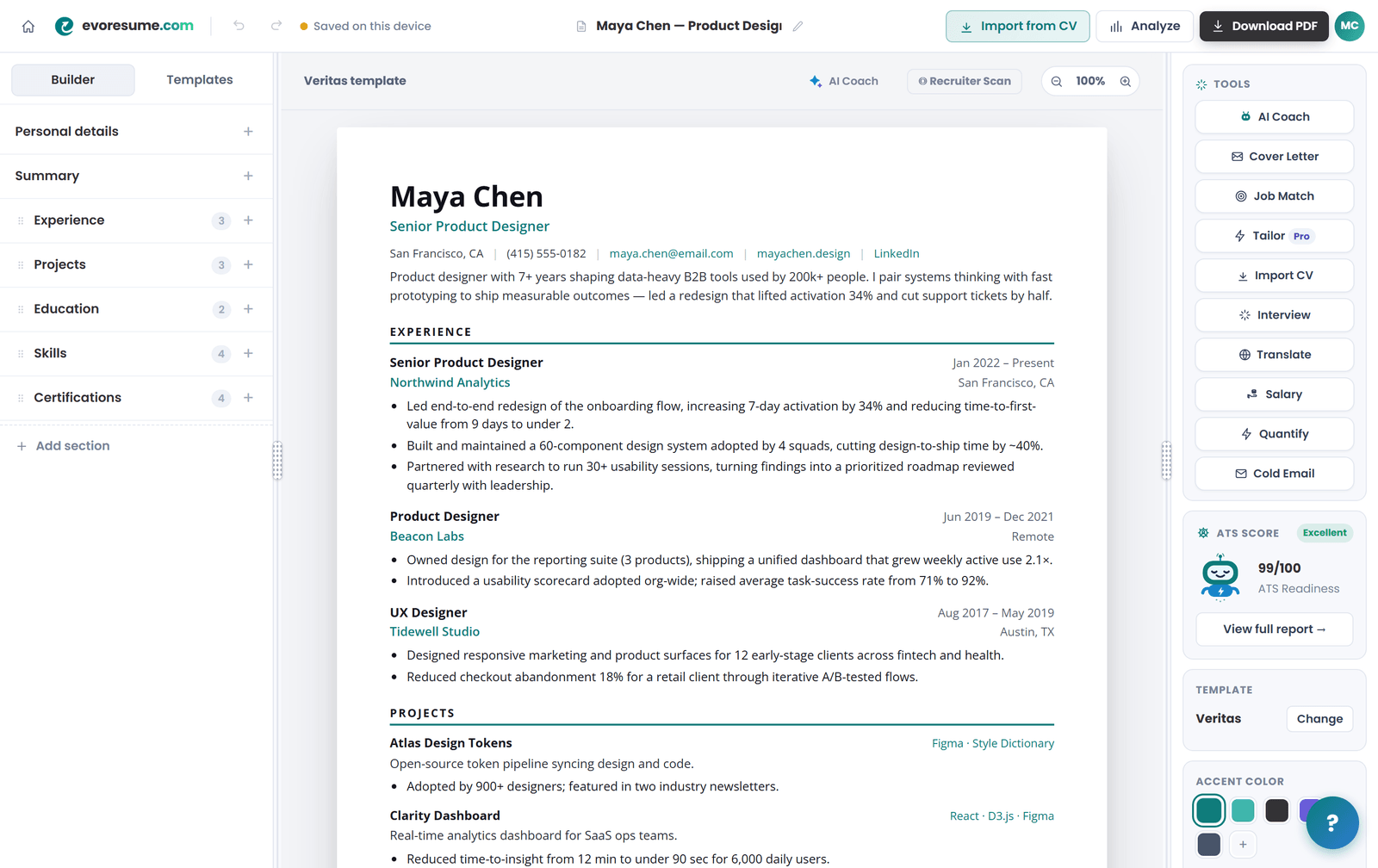
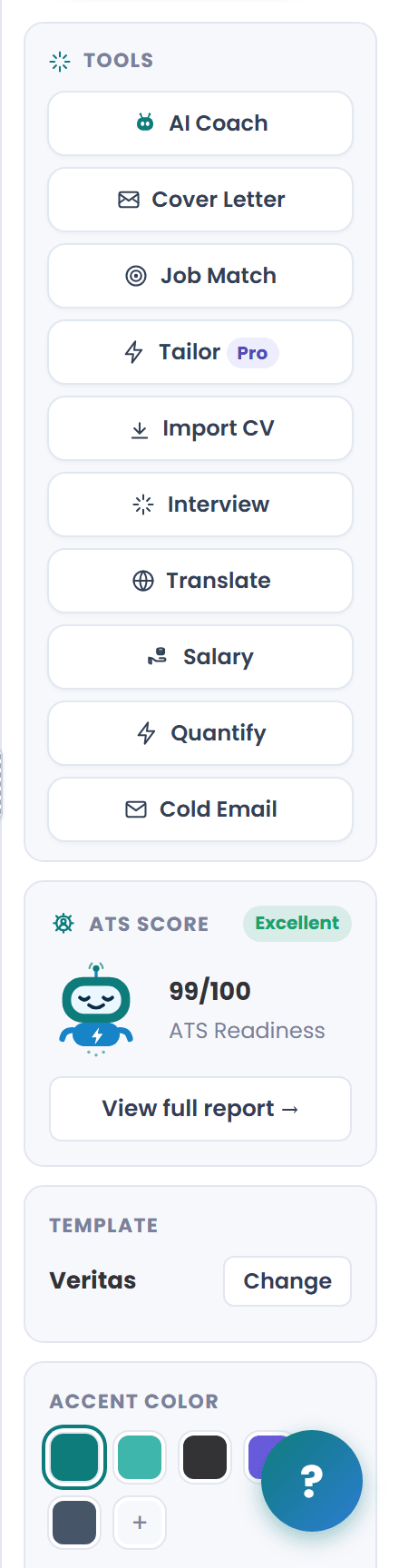
- Live ATS Score (0–100) — grades quantified impact, action verbs, formatting and structure as you type, so the format-failure and quantification findings become a live checklist instead of a guess.
- Job Match / keyword gap — paste the posting and see the exact title and terms you're missing, ranked by impact. This is the 10.6× job-title lever and the tailoring lever, automated.
- AI Coach — reads your whole resume and rewrites weak bullets into quantified ones, then explains your score in plain English. Draft-and-edit, the way the 2026 data rewards.
- Tailor to a job — adapt one master resume to a specific posting in minutes and keep a version per role, so tailoring stops being the thing you skip.
- 20 ATS-verified templates — single-column, table-free layouts tested against Workday, Greenhouse, Lever, Taleo, iCIMS and SmartRecruiters, with a real PDF export (selectable text, never a locked image).
Build a resume the data says will get read
Live ATS score, job-title and keyword match, and 20 ATS-verified templates. Free to build and score, no card. The PDF is $4.99 once.
Already have a resume? Paste it into the live ATS Score — free, no account needed — and see where it stands on the exact factors above before you send it into that 180-person funnel.
Frequently asked questions
Is it true that 75% of resumes are rejected by an ATS before a human sees them?
No — that figure is essentially a myth. Researchers traced it to a 2012 marketing pitch from a company (Preptel) that shut down in 2013 without publishing any study. In reality, recruiter data suggests most applicant-tracking systems rank and sort resumes for human review rather than auto-rejecting them. The goal isn't to 'beat a bot' — it's to rank well for the recruiter's search.
What single change most improves my chances of getting an interview?
The largest reported effect is matching the exact job title from the posting. Jobscan's analysis of about 2.5 million applications linked including the exact title to being 10.6× more likely to get an interview. Set your resume headline to the target job title (honestly — supported by your real experience), because recruiters search their ATS by the title they're filling.
Do recruiters really only spend six seconds on a resume?
The 'six seconds' number comes from a small 2012 study (25 people). A larger replication found initial review times of roughly 17 to 46 seconds. The reliable takeaway isn't the exact number — it's that the first pass is a fast skim of your top third, so your level and best quantified result must be visible immediately.
PDF or Word (.docx) — which parses better?
A clean, single-column file parses well either way, but the data favors simplicity over file type. One analysis of 1,000 rejected resumes found failure rates around 4% for a plain DOCX, 18% for PDF, and 31% for a DOCX that used tables for layout. Tables and columns cause far more problems than the choice between PDF and Word. Use PDF unless a posting asks for .docx, and never use tables for layout.
How much does tailoring my resume actually matter?
A lot, partly because so few people do it. Teal's data suggests tailoring can make you up to 6× more likely to get an interview, and Jobscan has shown tailoring lifting callbacks by 30–50% — yet around 54% of candidates send the same generic resume everywhere. You don't need a full rewrite: match the job title, mirror the posting's language for skills you have, and promote your most relevant bullets to the top.
Will using AI to write my resume get it rejected in 2026?
Not for using AI — for sounding like unedited AI. Generic boilerplate and keyword-stuffed prose can trip AI-content and spam flags, and recruiters spot them instantly. Because recruiters increasingly see an AI-generated summary of your resume first, specific and quantified bullets matter more than ever. Use AI to draft and tighten, then edit every line to be true, specific, and in your own voice.