Ask whether to put a photo on your resume and you get a rule with no source attached. Sometimes the rule is right. It is almost never explained, and it is usually stated as if the same thing were true everywhere, which it is not — a Munich hiring manager and a Chicago one expect opposite things from the top of your page.
This piece does something narrower and more useful: it quotes what the actual regulators say. Not what a resume blog says they say. Every rule below comes from the body that writes or enforces it in that country, and every one is linked so you can check it.
One thing to hold on to before the detail, because it changes how you read all of it. Anti-discrimination law almost always governs what an employer may ask for, not what you may send. There is no jurisdiction in the five countries below where attaching your own photo is unlawful for you. The risk of doing it is different, and worth understanding on its own terms.
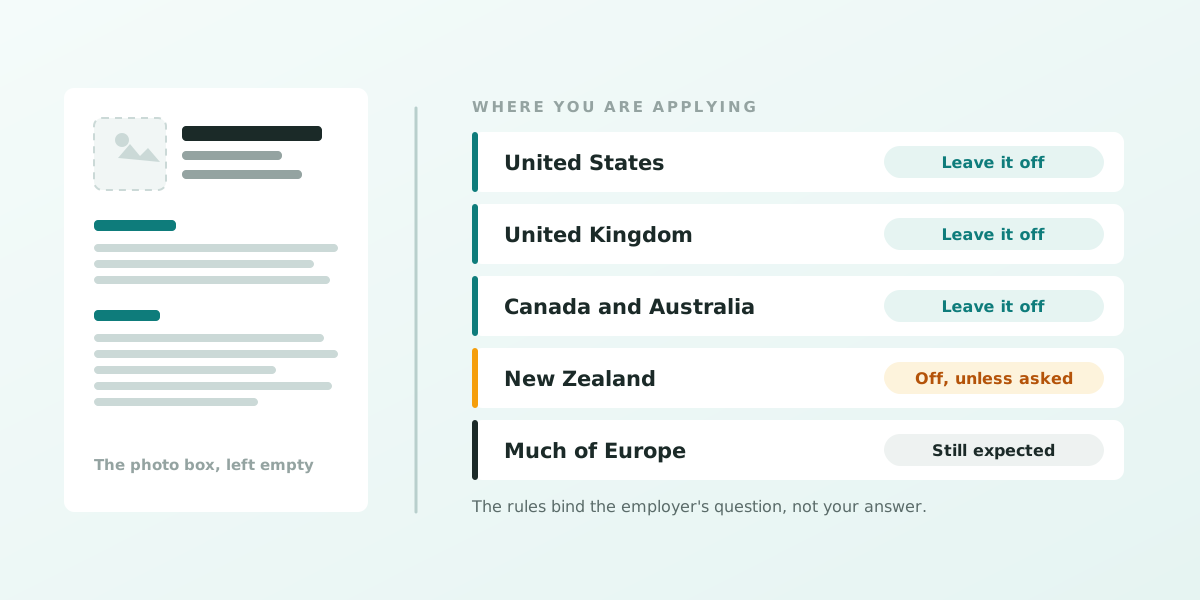
The short answer for each country
- United States: no photo. The EEOC tells employers not to ask for one, and many US employers discard applications that arrive with one rather than risk a bias claim.
- United Kingdom: no photo. No date of birth, no marital status, no nationality beyond your right to work.
- Canada: no photo. Human rights commissions tell employers their forms must not ask, directly or indirectly, about the protected grounds a photo reveals.
- Australia: no photo. State equal opportunity law makes requesting information that could be used to discriminate unlawful without a legitimate purpose.
- New Zealand: leave it off unless the employer asks. The Human Rights Commission is blunt that you should not be asked your age or marital status, and equally blunt that nothing in the Act stops an employer asking for a photo.
- Much of continental Europe: a photo is still normal, and in Germany, Austria and parts of southern and eastern Europe an application without one can read as incomplete.

United States: the EEOC says not to ask
The US Equal Employment Opportunity Commission publishes guidance on pre-employment inquiries, and it addresses photographs directly. On its prohibited practices page it says employers "should not ask for a photograph of an applicant", and adds that "if needed for identification purposes, a photograph may be obtained after an offer of employment is made and accepted".
The same page tells employers to avoid questions that would reveal "race, sex, national origin, disability status, age, religion, color or ancestry". A photograph reveals several of those in one glance, which is the whole reason it is singled out.
This is guidance for employers rather than a criminal prohibition on applicants, so nothing happens to you legally for attaching a headshot. What happens practically is worse for your chances: a recruiter at a company with a compliance function has been told not to hold that information, and the cheapest way to comply is to not open the file.
United Kingdom: no photo, and no health questions either
UK CV convention has been photo-free for years, and the legal backdrop is the Equality Act 2010. The clearest official statement of the recruitment rule comes from Acas, the UK's workplace advisory service: an employer "must not ask a job applicant about their health or any disability at any stage in the application or interview process, unless an exception applies".
That is a stricter rule than most applicants realise, and it is the one that explains the rest of the British CV's shape. If an employer cannot lawfully ask about your health before offering you the job, there is no version of the page where volunteering a disability, a medical history or a photograph that shows either helps you.
So a UK CV carries your name, city, phone, email and a LinkedIn URL. No date of birth. No marital status. No nationality line unless the role genuinely requires a specific right-to-work status, in which case one plain sentence handles it.
Canada: the form itself is regulated
Canadian human rights law is split between federal and provincial regimes, so the exact wording varies by province. Ontario's is the most quoted, and it is unusually specific about application forms. The Ontario Human Rights Commission says forms "should not have questions that ask directly or indirectly about race, ancestry, place of origin, colour, ethnic origin, citizenship, creed, sex, sexual orientation, record of offences, age, marital status, family status or disability".
On photographs it is just as direct: "employers should not request photos of potential employees, since they may provide information related to a number of Code-related grounds, such as race, colour, sex or age". The Commission also points out that photos are a poor way to run a diversity programme, and recommends voluntary self-identification with safeguards instead.
The practical read for a Canadian resume is the same as the American one, with one addition: leave your citizenship off the page. "Eligible to work in Canada" is a complete answer to the only question an employer is entitled to have.
Australia: it is the request that is unlawful
Australia's clearest statement on this comes from state equal opportunity law rather than the federal Acts. The Victorian Equal Opportunity and Human Rights Commission's guideline for the recruitment industry and employers puts it plainly: it is "against the law for you to request information from applicants that could be used to discriminate against them, unless you can show that you need that information for a non-discriminatory purpose".
Read the next sentence of that guideline carefully, because it is the part that catches employers out: the rule covers "verbal or written requests, interview questions, and application forms whether printed or online". Not just the form. The friendly chat as well.
For an Australian resume that means no photo, no date of birth, no marital status, no country of birth. Include your city and state, your phone and your email, and whichever visa or citizenship status the posting genuinely needs stated.
New Zealand: the honest exception
New Zealand is where the tidy version of this advice falls apart, and it is worth being straight about it. The Human Rights Commission's A–Z Pre-Employment Guide works through the common questions one by one. On age: you should not be asked. On marital status: you should not be asked. On whether you have children: employers should avoid asking.
On photographs, the same guide gives a different answer. Nothing in the Human Rights Act prevents an employer asking an applicant for a photo. The Act lists prohibited grounds of discrimination and does not name the request itself, so the question is lawful even where acting on what the photo shows would not be.
That is a genuine difference from the American and Canadian position, and it is why NZ advice hedges. Leave the photo off by default, because most New Zealand employers are not expecting one and a page without it is never penalised. Send one if it is asked for.
Europe is the opposite convention, not a mistake
The strongest evidence that "never use a photo" is a local convention rather than a universal truth is the European Commission's own CV tool. The Europass advice on creating a CV ends its polish-and-fine-tune step by telling you to "check for spelling and grammar mistakes, provide a professional e-mail address, and add a professional photograph of yourself".
That is the EU's own careers infrastructure recommending the thing every American resume guide forbids. Neither is wrong. They are describing different hiring cultures, and the file you send should match the one you are sending it into.
- Germany, Austria, Switzerland: a photo is conventional, and a complete application still often includes references and certificates. The AGG discrimination law has made employers warier about requiring one, but candidates still include it.
- France, Spain, Italy, Portugal: a photo is common and unremarkable.
- Netherlands, Nordics, Ireland: mixed, drifting towards leaving it off.
- Applying from Europe to a US, UK, Canadian or Australian employer: strip it. Send the local convention of the country you want to work in, not the one you are writing from.
Does the evidence say leaving details off actually helps?
There is one government-run trial worth knowing, and it is more careful than the statistics usually cited on this topic. Germany's Federal Anti-Discrimination Agency ran a pilot on depersonalised applications, evaluated by KOWA at the European University Viadrina and the IZA institute, and published the results in a summary of outcomes in March 2012.
- Eight organisations took part — companies, public bodies and local authorities — each for twelve months, starting November 2010.
- 8,550 depersonalised applications were examined across the pilot.
- 1,293 people were invited to an aptitude test or an interview; 246 were offered a job or a training place.
- The reported finding: when documents are depersonalised, there is a tendency towards equal opportunity across applicant groups.
The report is careful about what that does and does not prove, and so is this piece. Its authors note that the participating organisations were "a positive selection" — most already ran diversity programmes — so the observed effects "must not be considered as representative", and that the differences would likely be larger at less committed employers.
The same report cites a German labour-market study by Kaas and Manger (2012) finding that a Turkish-sounding name alone reduced the chance of an interview invitation by roughly 14% on average, and by around 24% at medium and small firms, at identical qualifications. That is the mechanism the whole depersonalisation idea is aimed at.
The parsing problem, separately from the law
Even where a photo is welcome, it creates a mechanical problem that has nothing to do with discrimination law. An image carries no text. Applicant tracking systems read your document by extracting characters and mapping them to fields, and an image in the header is a blank rectangle where a parser expects a name.
That alone is survivable. The damage usually comes from the layout a photo forces: to fit a headshot beside your name, templates put the header into a table or a two-column band, and a parser that reads columns in the wrong order can attach your phone number to your job title or lose the contact block entirely.
So even for a German or French application, the safest build is a single-column layout with the photo placed as a plain image beside a text header, rather than a design where the photo dictates the structure of the page.
See what a parser actually pulls out of your resume
Upload it and get the free ATS score check — including how cleanly your contact block reads.
What to put at the top of the page instead
The header is the most valuable strip on a resume and most people spend it on the wrong things. Here is what earns its space in the US, UK, Canada, Australia and New Zealand.
- Your name, at the top, in the largest type on the page.
- A title line under it that matches the role you are applying for. This is the single most useful line most people leave out — parsers match your current title against the posting's.
- City and state, province or region. Not your street address. Employers filter on commutable distance; nobody needs your postcode before an interview.
- One phone number and one professional email address.
- A LinkedIn URL, if the profile is current. A portfolio or GitHub URL where the work is the point.
- Right to work, in one line, only when the posting raises it. "Authorised to work in the US without sponsorship" or "Full working rights, Australia".
Priya Raman · 34 · Married, two children · 14 Ridgeway Ave, Denver, CO 80014 · Photo attached
Priya Raman, MSW, LCSW · Licensed Clinical Social Worker · Denver, CO · (303) 555-0164 · p.raman@email.com · linkedin.com/in/priyaraman
The second version is shorter and says more. The title line and the credentials do work that a photograph and an age never could: they tell a recruiter, and the software in front of the recruiter, what job you are applying for.
Details to leave off, and what to do instead
- Photograph — leave it off for the US, UK, Canada, Australia and New Zealand. Include it for Germany, Austria, France, Spain, Italy and most of eastern Europe.
- Date of birth or age — leave off everywhere in the five countries here. If you are worried about age bias, cut the earliest roles rather than the dates on the recent ones; undated experience reads as evasion.
- Marital status, children, dependants — leave off. Regulators in all five countries tell employers not to ask.
- Nationality, country of birth, visa detail — leave off unless the posting raises sponsorship, then one line.
- Full street address — replace with city and region.
- Health, disability, medical history — leave off. In the UK the employer cannot lawfully ask before an offer. Adjustments are a conversation after you have the job, not a disclosure on the page.
- Religion, political affiliation — leave off, including memberships that imply them, unless the employer is a faith-based or political organisation where it is genuinely relevant.
- Gender or pronouns — optional and personal. Nothing is lost by omitting them and nothing is gained by requiring them of yourself.
- National insurance, social security or ID numbers — never on a resume. These belong in a payroll form after you are hired, and a resume circulates far too widely to carry one.
How to decide in ten seconds
- Where is the employer based? US, UK, Canada, Australia, New Zealand — no photo. Continental Europe — photo.
- Does the posting ask for one? If it does, send it, whatever the country.
- Is a photo part of the job — acting, modelling, presenting? Then it is a work sample, and it goes in as a separate file.
- Still unsure? Leave it off. No employer in the five countries above has ever rejected a candidate for the absence of a headshot.
If you are applying across borders, keep two versions of the same resume rather than one compromise. Our single-column templates are built so that swapping the header does not disturb anything below it, and the annotated resume samples show what a header looks like when it is earning its space.
Frequently asked questions
Should you put a photo on your resume?
Not for a job in the US, UK, Canada, Australia or New Zealand. The EEOC tells US employers not to ask for one, Canadian human rights commissions say the same, and UK and Australian convention leaves it off. In Germany, Austria, France, Spain, Italy and much of eastern Europe a photo is still normal and its absence can look like an incomplete application. If the posting asks for a photo, send one wherever you are.
Is it illegal to put a photo on your resume?
No. Anti-discrimination law regulates what an employer may ask for, not what you may send, so attaching your own photo is not unlawful anywhere in these countries. The risk is practical: a recruiter told not to collect that information may discard the application rather than handle it, and you will never be told that is what happened.
Do employers reject resumes with photos?
Some do, as a compliance habit rather than a judgement about you. US and Canadian employers with a formal hiring process are advised not to hold information about race, age or sex before a decision, and the simplest way to comply is to screen out applications that contain it. There is no reliable published figure for how often this happens, and any site quoting a precise percentage is repeating a number with no traceable source.
Should you put your date of birth or age on a resume?
No, in all five English-speaking markets covered here. New Zealand's Human Rights Commission says outright that you should not be asked your age, and the equivalent bodies in the US, UK, Canada and Australia treat age as a protected ground. Keep dates on your recent roles — undated experience reads as concealment — and drop the earliest jobs instead if the history is long.
Should you include marital status or children on a resume?
No. Regulators in every country covered here tell employers not to ask. New Zealand's guide answers both questions directly: you should not be asked about your marital status, and employers should avoid asking whether you have children. It is not information that improves an application, and volunteering it hands over exactly what the rules were written to keep out of the decision.
Does a photo affect your ATS score?
Indirectly, and the layout matters more than the image. An image contains no text, so a parser finds nothing where it expects a name, and photos usually arrive inside a table or two-column header that a parser can read out of order. A single-column layout with a text header parses cleanly whether or not a photo sits beside it. You can see what a parser pulls out of your own file with the free ATS score check.
What personal details should a resume include?
Your name, a title line matching the role, your city and region, one phone number, one professional email address, and a LinkedIn or portfolio URL where it is current. Add a single line about right to work only when the posting raises sponsorship. Never put a national insurance, social security or other ID number on a resume.
Should I put a photo on a Europass CV?
Europass supports one and the European Commission's own guidance on creating a Europass CV tells you to add a professional photograph as part of polishing it. That reflects continental European hiring convention. If you are using Europass to apply to a UK, Irish or North American employer, leave the photo out even though the tool allows it.