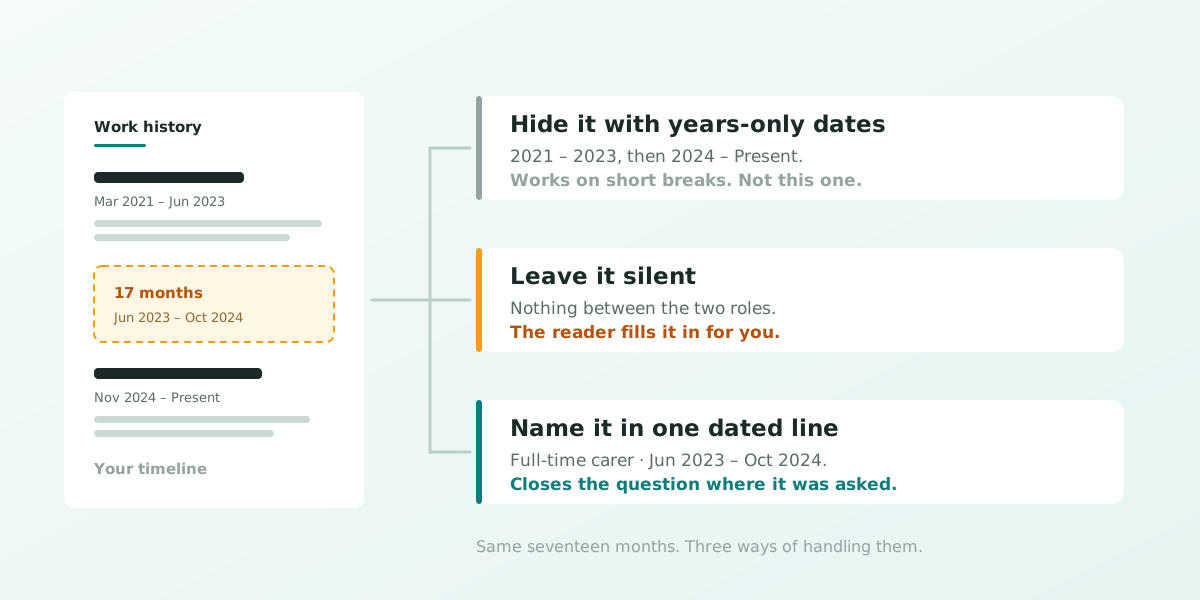
You left a job in March. You started looking again in September. Somewhere in between is a stretch of months with nothing in it, and now every résumé template you open seems designed to point at it.
The standard advice is four tips: write a summary, use years instead of months, explain it in the cover letter, mention a course you took. All four appear on nearly every page that ranks for this question, and none of them says what a gap actually costs, which is the thing that decides whether any of it is worth doing. There is research on that, and it points somewhere the tips do not.
What a gap actually costs you
The best evidence comes from a field experiment rather than a survey. Kory Kroft, Fabian Lange and Matthew Notowidigdo sent roughly 12,000 fictitious résumés to about 3,000 real job postings across the 100 largest US metropolitan areas, in sales, customer service, administrative support and clerical roles. The résumés were equivalent apart from one detail: how long the applicant had been out of work. The study was published in The Quarterly Journal of Economics in 2013.
The finding: the likelihood of getting a callback falls as the unemployment spell lengthens, and, in the authors' summary of it, most of that decline happens in the first eight months. After that the line largely flattens. Employers appear to be reading the length of the gap as a signal about the applicant, and reading it hardest early on.

Two practical things follow from that shape, and neither is on the standard list.
- A short gap is close to costless, so stop editing it. Three or four months between jobs is inside the range where the effect has barely started. Rearranging your dates to hide it spends effort on the cheapest problem you have.
- A long gap is not fixed by formatting. Once you are past a year, the reader has already priced it in, and no date-formatting trick changes that. What can change it is giving the time a name and a shape, which is a content problem rather than a layout one.
Gaps are far more common than the advice implies
It is worth knowing how ordinary this is, because most résumé advice is written as though a gap were rare and slightly shameful. It is neither.
- In the United States, the Bureau of Labor Statistics counted 1.8 million people jobless for 27 weeks or more in July 2026, which was 25.5 per cent of everyone unemployed. Roughly one unemployed American in four is already past six months.
- In the United Kingdom, the Office for National Statistics put the economic inactivity rate for people aged 16 to 64 at 20.9 per cent for April to June 2026. That is one in five working-age adults not in work and not looking, for reasons that include study, caring, illness and early retirement.
Neither figure tells you what a hiring manager thinks. What they do tell you is that a recruiter reading your résumé has read hundreds of others with gaps in them, which is a reason to be matter-of-fact about yours rather than furtive.
The years-only trick, and what it actually does
Writing 2023 – 2025 instead of March 2023 – October 2025 is the most repeated tip in this category. It works on one specific kind of gap and quietly backfires on the rest.
It helps when the gap is short and straddles a calendar year: leave a job in November 2024, start a new one in April 2025, and years-only dates make the break invisible without anything being untrue. It stops helping the moment the gap crosses a whole year. 2019 – 2021 followed by 2023 – Present does not conceal anything; it announces a gap of between one and three years and refuses to say which, which reads worse than the fact would have.
There is a second problem the tip never mentions. The résumé is not the only place your dates go. Most large employers put you through an application form that asks for start and end months separately, and some parse your uploaded file into those fields for you. If the form says months and your file says years, you will either fill in the months yourself a screen later or hand the system a record it cannot reconcile. Inconsistent dating across a résumé is also one of the standard ways a parser invents a gap that was never there.
Give the time a name
The single most effective thing you can do with a gap longer than about six months is to stop leaving it blank. An unexplained space invites the reader to fill it in, and readers fill it in badly. A dated, named entry closes the question in one line.
Put it in the work history, in the same format as the jobs around it, so the timeline is continuous:
A seventeen-month space between Sales Associate (Mar 2021 – Jun 2023) and Customer Service Advisor (Nov 2024 – Present), with nothing written in it.
The same two jobs with one line between them: Full-time caregiver · Jun 2023 – Oct 2024 — cared for a family member after surgery; completed a Level 2 customer service certificate during this period.
That is the whole technique. One line, dated the same way as everything else, factual, no apology and no over-explaining. It takes a seventeen-month hole that a reader would have to guess at and turns it into a period with a reason and an end date.
The same convention now exists on LinkedIn, which added a Career Break entry type to profiles in March 2022 with thirteen categories including caregiving, health and wellbeing, layoff, full-time parenting, travel and study. LinkedIn also reported that 51 per cent of hirers said they were more likely to contact a candidate who gave context about a break, though it published neither the sample size nor the fielding dates for that survey, so treat the number as the company's own marketing evidence rather than as research. The product change is the more useful signal: a platform that recruiters search every day now has a field for this, which makes naming a break a normal thing to do rather than an admission.
Six kinds of gap, and the line that works
The wording differs by reason, but the structure does not: what it was, when it ran, and one clause showing you are current. Nothing needs to be longer than a sentence, and nothing needs to be medical.
- Redundancy or layoff. "Role made redundant in a site closure, Aug 2024. Searching selectively since." Redundancy is the most common gap and the least penalised, because it is visibly not about you. Name it plainly and move on.
- Caring for someone. "Full-time carer for a parent, Feb 2024 – Jan 2025." You are not obliged to say who or why. The dated line is enough, and it is a period a great many readers have had themselves.
- Your own health. "Career break for health reasons, Mar – Nov 2024. Fully available and returned to work in Dec 2024." Give no diagnosis and no detail. The only fact an employer needs is that the period ended.
- Study or retraining. "Full-time study — Level 3 Diploma in Accounting, Sept 2023 – Jun 2024." This one is not really a gap, so put it in education or experience with the same weight as a job.
- Parenting. "Full-time parenting, 2022 – 2024." One line, no defensiveness. If you did anything adjacent to work — freelance pieces, a committee, a volunteer role with a real remit — list it underneath as its own entry.
- Travel or relocation. "Career break — travel, May – Dec 2023" or "Relocated from Auckland to Melbourne, Jan – Apr 2025, including visa processing." Relocation gaps in particular are worth naming, because otherwise the reader has to guess whether you are even eligible to work where they are.
One thing that is not on that list: an entry invented to fill the space. A consultancy that never had a client, or a freelance business with no work behind it, is the one move here that can actually end an application, because it is checkable and it is the kind of thing reference checks find. If you want the argument for how to reframe real experience without crossing that line, we wrote it up in career change without overstating your experience.
Where the explanation belongs
- The résumé gets the dated line and nothing more. Its job is to close the timeline, not to argue the case.
- The cover letter gets one sentence, and only if the gap is long or recent enough to be the obvious first question. Leading a cover letter with your gap makes it the subject of the letter, which is the opposite of what you want.
- The application form gets the truth in whatever fields it asks for. This is the one place where evasive dating causes real damage, because the form is what the employer keeps.
- The interview gets a two-sentence answer you have said out loud beforehand.
The interview answer
Three parts, in this order: what it was, that it is over, and what you have done to stay current. Then stop talking. The most common mistake is not saying too little but saying too much, and filling the silence with detail nobody asked for.
"So, um, there were a few things going on — my mum got ill, and then the market was awful, and honestly I applied to about 200 places and heard nothing, and I did think about retraining but then I wasn't sure, and, well…"
"I took fourteen months out to care for a family member after surgery. That ended last October and I've been available full time since. I kept my Level 2 certification current and did two months of temp work in a similar role in the spring."
The second version is not a better story. It is the same facts, bounded. It answers the question, it puts an end date on the period, and it hands the interviewer something to ask about next.
Before you send it
- Is every date on the page in the same format, and does that format match what the application form is going to ask for?
- Does your timeline account for every month, either with a job or with a named, dated entry?
- Is anything on the page there only to fill space? Remove it.
- Does the gap entry have an end date? An open-ended break reads as ongoing even when it is not.
- Have you said, somewhere, that you are available now?
- Have you said your interview answer out loud, and does it end?
If you want to see how the timeline reads to software before a person sees it, the free ATS score check will parse your file and show you the dates and headings it managed to pull out, which is where phantom gaps caused by inconsistent formatting turn up. For a worked example of a continuous, densely dated work history in a field where dates get checked hard, the warehouse resume sample is annotated line by line, including how to group agency assignments so they read as continuity rather than as six short jobs.
See how your dates parse before a recruiter does
Upload your résumé and the checker shows the timeline it extracted, including gaps you did not put there.
Frequently asked questions
How do you explain a gap in employment on a resume?
Put a dated entry in the work history in the same format as the jobs around it, naming what the period was: "Full-time carer, Feb 2024 – Jan 2025" or "Career break for health reasons, Mar – Nov 2024". One line, no apology, no diagnosis, and an end date. That closes the question in the place the reader is already looking, which is better than leaving a blank space for them to guess at or burying an explanation in a cover letter they may not read.
How long of an employment gap is too long?
There is no threshold at which a gap disqualifies you, but the evidence suggests the damage is front-loaded rather than cumulative. In the field experiment by Kroft, Lange and Notowidigdo published in the Quarterly Journal of Economics in 2013, callback likelihood fell as unemployment lengthened with most of the decline occurring in the first eight months. Practically, that means a three-month gap is barely worth managing, a gap approaching a year is worth naming explicitly, and a gap of several years is worth pairing with something recent and current, such as a certification, temp work or volunteering.
Should I use years instead of months to hide a gap?
Only if every entry uses years and the result is still honest. Years-only dating hides a short break that straddles a calendar year, and hides nothing at all when the gap runs longer than twelve months, where it just tells the reader the gap is somewhere between one and three years. It also collides with the application form, which usually asks for start and end months separately, so you end up supplying the detail you avoided a screen later.
Do employers actually check employment dates?
Large employers commonly verify dates at offer stage, either directly with previous employers or through a background screening provider, and payroll records make it one of the easiest things to check. That is the real argument against creative dating: it survives the résumé, survives the interview, and fails at the last stage, when you have turned down other options. Approximate dates on a résumé are normal and forgivable; a fabricated employment period is not.
Should I mention a gap in my cover letter?
One sentence, and only when the gap is long or recent enough to be the obvious first question. If the gap is under six months, or old, do not raise it — you are answering a question nobody asked and making it the subject of the letter. When you do address it, keep it to what the period was, that it has ended, and one clause about being current, then spend the rest of the letter on the job.
How do I explain a gap caused by being fired?
Separate the two things. The gap is a period of time and gets a dated line like any other; the dismissal is a question about a specific job and belongs in the interview, not on the résumé. If you are asked, describe what happened in one or two factual sentences without arguing your side of it, say what you would do differently, and move to what you have done since. Do not write "terminated" or a reason for leaving on the résumé itself — no résumé convention asks for it, and volunteering it makes it the headline.
Does a career break hurt more for some jobs than others?
It depends most on whether the field's requirements move while you are away. Where currency is licensed or dated — nursing, aviation, accounting, teaching, anything with a certification that expires — a break matters mainly through the certificate, so renewing it removes most of the problem. In fields with fast-moving tools, a recent project or course does the same job. In work where the skills are stable, a break is largely a scheduling fact, and naming it plainly is usually the end of it.