You apply. Nothing happens. Six weeks later the same job is still sitting there, still accepting applications, still telling you it was posted two days ago. At some point every job seeker starts to wonder whether the role was ever real, and the honest answer is that from the outside you usually cannot tell.
What you can do is narrow it down a long way in about two minutes, using things the posting and the employer have already published. That is what this guide is. Seven checks, in the order that costs you the least effort, each one with an honest note on how much it actually proves. It also covers the part that most ghost job advice skips: the several boring, legitimate reasons a real job sits open for months, because a method that flags everything is the same as no method at all.
What a ghost job is, and what it isn't
The term covers at least four different situations, and they call for different responses. Lumping them together is why so much of the advice is useless.
- The stale req. The job was real, someone was hired or the search was abandoned, and nobody took the posting down. Extremely common and rarely malicious. Most job boards keep serving a posting until the employer's system actively withdraws it.
- The paused req. The role exists on paper, the budget was frozen, and the posting stays up in case the freeze lifts. Applications go into a pile that may be read in three months.
- The pipeline req. Deliberately open, never attached to one vacancy. The employer is collecting candidates for roles it expects to need. Common in nursing, retail, logistics, hospitality and volume sales, and often disclosed if you read carefully.
- The scam listing. Not a hiring practice at all. It exists to harvest personal data or to run an advance-fee fraud. Different problem, different tells, and the one case where you should walk away rather than apply cheaply.
Only the last of those is fraud. The first three are ordinary institutional slack, and that matters for how you should feel about it: the posting that wasted your Tuesday evening was probably nobody's decision at all. It also matters for detection, because slack leaves different fingerprints from intent.
Most of the numbers you'll read are junk
This topic has a citation problem. The widely quoted figures circulate between career blogs, each citing the last, and when you follow them back the trail ends without ever reaching a study. We traced the common ones. Here is what was left standing.

The three that survive
- 18–22% of postings, on one platform. The applicant tracking system Greenhouse reported in its 2024 State of Job Hunting report (published December 2024) that in any given quarter, 18 to 22 per cent of jobs posted on its platform are classified as ghost jobs. This is a company counting its own customers' postings, which is the closest thing to direct measurement anyone has published. Read the definition before you read the number: it counts roles already filled, roles paused indefinitely, and pipeline postings. Most of that is slack, not deception.
- Up to 21% of job ads, as an upper bound. Hunter Ng of Baruch College, CUNY, analysed roughly 270,000 reviews from the Interviews section of Glassdoor using a BERT-based classifier, and found that up to 21 per cent of job ads may be ghost jobs (working paper, 29 October 2024). Three caveats the headlines drop: it is a preprint and has not been peer reviewed, up to is a ceiling rather than an estimate, and it infers ghost jobs from what candidates wrote about their interviews rather than from the postings themselves.
- A method, rather than a number. Singer and Oktay's “Ghost jobs, real costs” in Business Economics (2025) is peer reviewed, and works from job posting data rather than surveys. Its useful contribution here is not a headline percentage but the finding that ghost postings can be identified from a combination of features of the posting itself. That is the premise the rest of this guide rests on.
The one that gets misquoted hardest
You will constantly meet the claim that 40% of job listings are fake. The underlying research is real and you can read it: ResumeBuilder.com ran an online survey through Pollfish that launched on 22 May 2024, screening 1,641 hiring managers, of whom 649 completed it. Forty per cent said their company had posted a fake listing in the past year.
The rest did not survive at all. The 27.4% of LinkedIn listings figure traces to a blog post by a résumé tool vendor with no published method. 1 in 7 postings are ghost jobs appears under a headline promising a new study that is never named in the piece. 87.5% of marketing professionals encounter phantom listings has no sample, no date and no researcher attached anywhere we could find. The 47% figure has no origin at all. We have left all of them out, and you should be suspicious of any guide that repeats them.
The two-minute check
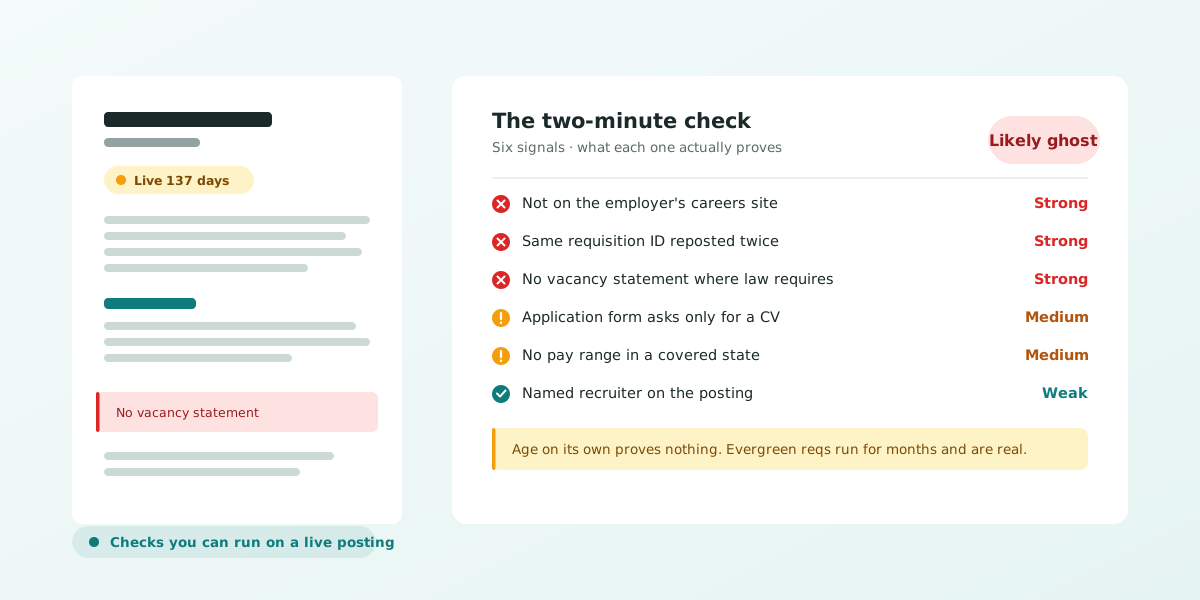
These are ordered by cost, cheapest first, and weighted by what they actually prove. Run them in order and stop when you have made up your mind. No single one is a verdict on its own; two strong signals together usually are.
1. Is the job on the employer's own careers site?
Open the company's own careers page and search for the title. Not the job board, the employer. This is the single most informative thing you can do, and it takes about twenty seconds. Job boards scrape and cache aggressively, and a posting can survive on an aggregator for weeks after the employer has withdrawn it. If the role is not on the employer's site, you are most likely looking at a corpse. If it is there, note the date shown, because you will want it in a moment. Strong signal, in both directions.
2. The requisition ID and the repost clock
Most employers hire through an applicant tracking system, and most of those put a requisition ID in the URL. Greenhouse and Lever job boards carry an ID per posting; Workday URLs typically carry a code beginning JR. Note the ID. Now check whether the posting also exists on a job board with a different, more recent date. A genuine backfill cycle produces a new requisition each time a seat opens. The same requisition ID resurfacing month after month, its date reset each time, is one long-running req being refreshed to sit at the top of search results. Strong signal. It is also the check that defeats the “posted 2 days ago” label, which measures when a posting was last touched rather than when the job opened.
3. The vacancy statement, where the law requires one
In Ontario this stopped being guesswork on 1 January 2026. Under the Employment Standards Act, employers with 25 or more employees must state in every publicly advertised job posting whether the posting is for an existing vacancy, alongside the expected pay range and a statement of whether AI is used to screen applicants. An existing vacancy means a position imminently available for a qualified candidate to fill. If you are looking at an Ontario posting from an employer of that size and the statement is missing, that is a compliance failure worth weighing. If the statement is present and says there is no existing vacancy, the employer has told you the answer. Strong signal in Ontario; not yet available elsewhere.
4. How much the application form asks for
Open the form without submitting it. A req that a recruiter is actively working tends to carry the machinery of a real process: knockout questions about work authorisation and notice period, a demographic or equal opportunity section, sometimes a scheduling step. A posting that wants a CV and an email address and nothing else is cheaper to run and easier to leave open, which is exactly what pipeline and harvesting postings are. Medium signal. Plenty of small employers run genuinely light forms, so this counts against a posting only alongside something else.
5. The pay range, in a place that requires one
Several US states and cities require a good-faith pay range in job adverts, and Ontario now requires expected compensation as well. A posting covered by one of those rules that carries no range at all was, at minimum, not prepared carefully. Watch also for the range so wide it carries no information, which is what employers publish when the level has not actually been decided, and a level that has not been decided is a role that is not ready to be filled. Medium signal.
6. Who is attached to the posting
A named recruiter or hiring manager on the posting means somebody owns it and can be asked about it. An agency advert that will not name the client is a weaker position: some of those are ordinary confidential searches, and some are CV collection with no client behind them. If the same agency has fifteen near-identical adverts across a city, you are looking at a net rather than a role. Weak to medium signal.
7. Applicant count against posting age
Where a board shows both, compare them. A posting that has been live for months and collected hundreds of applications without closing tells you either that nobody is reading them or that nobody is empowered to say yes. Treat this as the last check rather than the first, because both numbers are unreliable: the age resets on repost, and applicant counts are frequently estimates. Weak signal.
When an old posting is a real job
This is the half that most guides leave out, and without it the checks above turn into a machine for talking yourself out of applying. There are several ordinary reasons a genuine, funded, open role looks exactly like a ghost.
- Evergreen requisitions. Hospitals, care providers, warehouses, call centres, driving jobs and volume sales roles hire continuously and keep one posting open all year. The role is real, the vacancy is real, and the posting is twelve months old because there is always another seat.
- Backfills posted before the incumbent leaves. A team that knows about a resignation in March for a June departure will often post in March. For three months the posting looks like a job with no urgency, because the seat is still occupied.
- Compliance advertising. A US employer sponsoring a worker for permanent residence has to run the recruitment steps the Department of Labor requires for PERM, including a state job order and newspaper advertisements, to test whether qualified US workers are available. Canada's labour market impact assessment process works similarly. These postings are legally required, genuinely open to applicants, and attached to a role the employer already has a specific person in mind for. They are not fraud, and they are not a good use of your evening.
- An internal candidate plus a policy. Many employers, and nearly all unionised and public-sector ones, must advertise externally even when the succession is settled. The posting is honest by the standards of the policy that produced it.
- One requisition, many cities. A single remote or multi-site role advertised across fifteen locations reads as spam and is one real job.
- A frozen search that is about to thaw. Budget freezes end. Some of the postings that go quiet for two months become live processes in the third.
The practical consequence: adjust for the sector before you judge. A twelve-month-old staff nurse posting at a hospital trust is unremarkable. A twelve-month-old posting for one senior product manager at a fifty-person startup is a different proposition entirely, because that company does not have a continuous need for that role.
What the law requires, and where
This is moving quickly, and it varies enormously by where you are. As of writing, in September 2026:
- Ontario, Canada. In force. The vacancy statement, pay range and AI-screening disclosure requirements described above took effect on 1 January 2026 for employers with 25 or more employees. Internal-only postings and generic help-wanted notices are exempt.
- New York, United States. Passed, not yet law. Senate bill S8877 cleared both chambers in 2026 and would require employers with 100 or more staff, and third-party job posting platforms, to disclose the expected hiring timeframe, with a $2,500 fine per publication that doubles for each 30-day period an advert stays up. It awaited the Governor's signature at the time of writing, so check its current status before relying on it.
- California, Pennsylvania and New Jersey. Bills introduced, none passed. California's AB 1251, Pennsylvania's HB 2321 and New Jersey's S2136 would each require some form of disclosure about whether an advertised position exists.
- United States, federally. Nothing specific. The Congressional Research Service published a briefing on ghost job postings for members of Congress in April 2025, which notes the central obstacle to enforcement: an employer's intent to hire is subjective and hard to prove, which makes deception claims difficult to bring.
- United Kingdom, Australia and New Zealand. No equivalent duty. There is no requirement in any of the three that an advertised role must exist or that the employer must say whether it does. Fraudulent listings are reachable under general consumer protection and fraud law, but an ordinary stale or pipeline posting is not unlawful.
What to do when you still can't tell
Most of the time you will finish the check somewhere in the middle. That is fine, because the right response to uncertainty is not to skip the application, it is to change what the application costs you. A ninety-minute bespoke application to a role that might not exist is the thing to avoid. A fifteen-minute one is a cheap lottery ticket.
Two hours: rewrite the whole résumé around the posting, write a cover letter from scratch, research the company, then wait six weeks and hear nothing.
Fifteen minutes: run the seven checks, swap in the eight or nine terms the posting actually uses, send it, log the date and the requisition ID, move on.
The tailoring still matters, because the posting is where the screening vocabulary comes from whether or not a human ever reads your application. The efficient version is to lift the terms rather than rewrite the document: our guide to pulling keywords out of a job description covers which ones are worth taking and which are noise. If you want to know what the scanner does with the result, the 23 checks an ATS resume checker actually runs is the specification, and the EvoResume ATS score check runs them on your own document in about thirty seconds.
Two habits are worth building. Keep a log with the employer, the date, the requisition ID and the outcome; after a month it will tell you which companies recycle postings, which is information no article can give you about your own market. And keep one strong base résumé that you adapt rather than rebuild each time, so that a ghost job costs you fifteen minutes instead of an evening. If you are starting that document from scratch, the 2026 walkthrough covers it end to end. And since Ontario postings now have to tell you when AI is doing the screening, what employers can and cannot detect about an AI-written résumé is worth reading alongside it.
Last thing, and it is the part that matters most. The reason to learn this is not to become the person who can prove a job was fake. It is to stop reading silence as a verdict on you. A great deal of the discouragement in a long job search comes from applications that were never going to be read by anyone, and knowing which ones those probably were is worth something on the days the search is going badly.
Spend the saved time on the résumé instead
Build a base résumé you can adapt in fifteen minutes, and see what a scanner makes of it before you send it anywhere.
Frequently asked questions
What is a ghost job?
A ghost job is a listing that is not attached to a vacancy the employer is actively trying to fill. In practice the term covers four different things: a stale posting for a role already filled, a role paused by a budget freeze, a pipeline posting kept open to collect candidates for future needs, and outright scam listings that exist to harvest personal data. Only the last is fraud. The first three are usually administrative slack rather than anyone's decision to deceive you.
How can you tell if a job posting is real?
Check the employer's own careers site rather than the job board, because boards keep serving postings after an employer withdraws them. Then look at the requisition ID in the application URL and whether the same ID keeps resurfacing with a reset date, which indicates one long-running req being refreshed rather than a new opening. In Ontario, check for the statement about whether an existing vacancy exists, which employers with 25 or more staff have been required to include since 1 January 2026. No single check is conclusive, but two strong signals together usually settle it.
Why do companies post jobs they don't intend to fill?
The Congressional Research Service's April 2025 briefing for Congress lists several reasons employers give: signalling growth to investors, keeping current employees aware they are replaceable, appearing open to external applicants while an internal candidate is favoured, and casting a wide net in case exceptional talent appears. Add to that the mundane ones, which are probably more common: nobody took the posting down after the hire, or the budget was frozen mid-search and the posting stayed live in case it thawed.
Are ghost jobs illegal?
It depends entirely on where you are. In Ontario, employers with 25 or more employees have had to disclose whether a posting is for an existing vacancy since 1 January 2026. New York passed a bill in 2026 requiring disclosure of expected hiring timeframes, which was awaiting the Governor's signature as of September 2026, and California, Pennsylvania and New Jersey have introduced similar bills that have not passed. There is no federal US rule, and no equivalent duty in the UK, Australia or New Zealand. Scam listings are separately reachable under fraud and consumer protection law everywhere.
How long is too long for a job posting to stay up?
There is no threshold that works across sectors, which is why age alone is a weak signal. Hospitals, warehouses, call centres, driving jobs and volume sales roles run evergreen postings all year for genuine continuous hiring. A twelve-month-old nursing posting is unremarkable; a twelve-month-old posting for a single senior role at a small company is not, because that employer has no continuous need for it. Judge the age against how often that employer would genuinely need that role.
Does a reposted job mean the company rejected everyone?
Not usually. Reposting is often just a refresh to push the listing back up the search results, and the giveaway is that the requisition ID has not changed. A genuine second search after a failed one normally produces a new requisition. If the ID is the same and the description is word for word identical, you are looking at the same posting with a new date on it rather than a new decision about candidates.
Should you still apply if you think it might be a ghost job?
Usually yes, but cheaply. Skipping a real job costs you the job, while a fifteen-minute application to a posting that turns out to be dead costs you fifteen minutes. The mistake is spending ninety minutes on a bespoke application to a posting that failed several of the checks. Lift the vocabulary the posting uses, send an adapted version of a résumé you already trust, log the requisition ID, and move on. The exception is a suspected scam listing, where the right move is not to apply at all.
Is it true that 40% of job listings are fake?
No, and that figure is a misreading of a real survey. ResumeBuilder.com surveyed hiring managers through Pollfish in May 2024, screening 1,641 people of whom 649 completed it, and 40 per cent said their company had posted a fake listing in the past year. That is a statement about companies, not listings, gathered from a self-selected online panel. A company posting one fake role among two hundred real ones counts identically to one where every posting is a ghost. The best-supported figures on listings come from Greenhouse, which reported that 18 to 22 per cent of postings on its own platform in a given quarter are classified as ghost jobs.