You used AI to help write your resume, and now you are staring at the result wondering whether the person on the other end will know. It is a fair question. Most of the answers floating around are not much use, because they collapse three very different things into one word: detect.
An applicant tracking system, an AI-content detector and a human recruiter are three separate readers with three separate jobs. Only one of them looks at your prose at all, and even that one is not hunting for AI. Below is what each reader actually does, what the published research says about how well detection works, and the seven things that make a resume read as machine-written whether or not a machine wrote it.
Three readers, three different jobs
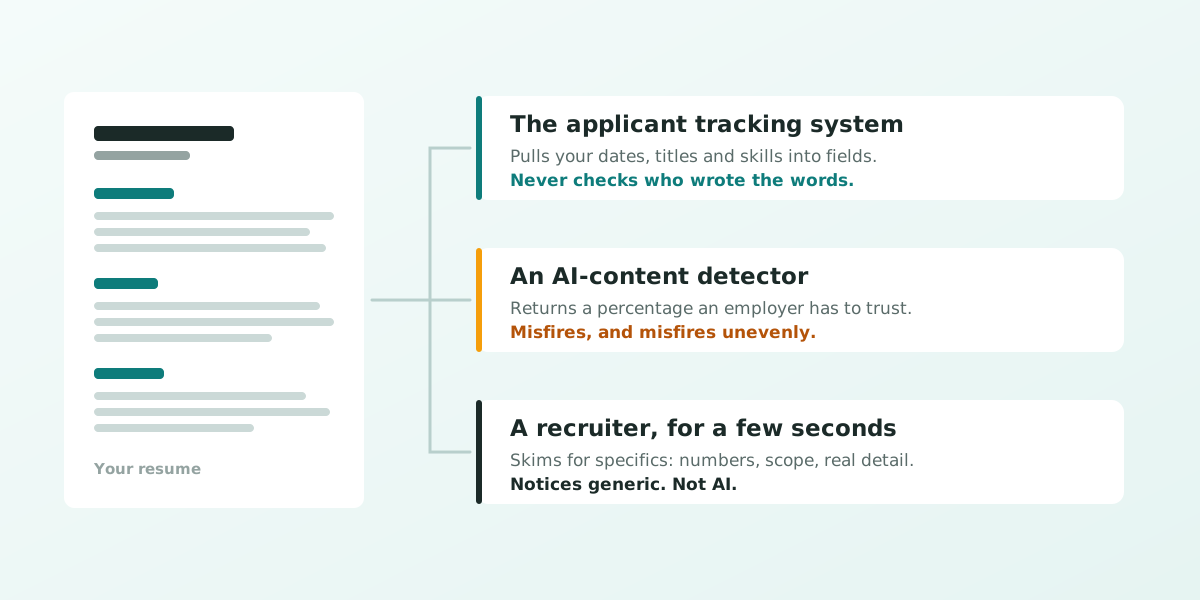
Before worrying about detection, it helps to know who is actually reading. Your application passes through up to three checkpoints, and they are looking for completely different things:
- The applicant tracking system. It extracts your dates, titles, employers, education and skills into database fields, then ranks you against the job requisition. It is a filing system with a search box on top.
- An AI-content detector, if the employer bolts one on. This is separate software that guesses at authorship and hands back a percentage. It is not standard in hiring, and the next section explains why that is just as well.
- A recruiter, for a few seconds. This is the only reader who takes in your sentences as sentences, and what registers in those few seconds is whether you sound specific or interchangeable.
The ATS is not looking for AI
This is the most common misunderstanding, and it costs people a lot of unnecessary worry. Parsing is not detection. An ATS reads your resume to find out what it says: where a job title ends and a company name begins, which dates belong to which role, which skills to index you under. Nothing in that pipeline forms an opinion about who composed the words. We went through every check a résumé scanner runs in what an ATS resume checker actually checks, and authorship is not among them.
The major platforms behind most corporate hiring — Workday, Greenhouse, iCIMS, Lever, SAP SuccessFactors, Taleo — sell matching and workflow. Detecting AI authorship is a different product with a different failure mode, and an employer who wanted it would have to add it deliberately. So the practical risk from the machine layer is not that it spots your AI draft. It is that it mis-reads a resume built on a layout it cannot parse, which is a formatting problem and entirely fixable. You can check yours in the browser with the free EvoResume ATS score checker.
AI detectors exist. The evidence on them is poor.
Some employers do run application text through a detector. The question is what that verdict is worth, and here the published research is unusually blunt.

In 2023 a Stanford team led by Weixin Liang tested seven commercial GPT detectors on two sets of writing that were definitely human. On essays by US eighth-graders the detectors were close to perfect. On TOEFL essays written by non-native English speakers, they wrongly labelled more than half as AI-generated. The paper, published in the journal Patterns, suggests the cause is mechanical rather than malicious: detectors lean on how surprising your word choices are, and someone writing carefully in a second language tends to use plainer, more predictable vocabulary. The tool reads restraint as a robot.
The other data point comes from the company with the most to gain from getting this right. OpenAI launched its own AI Text Classifier in January 2023 and withdrew it that July, citing its "low rate of accuracy". On its own published numbers, it had correctly identified 26% of AI-written text. If the organisation that built the generator could not build a working detector for it, a percentage from a third-party tool deserves to be treated as a rumour rather than a finding.
Why 88% of hiring managers believe they can tell
You will see confident claims that recruiters spot AI instantly. The most-cited source is a survey Insight Global ran with Atomik Research in October 2024, covering 1,005 US hiring managers at organisations with 100 or more employees. In it, 88% said they can tell when candidates use AI to help with applications, cover letters or resumes. A smaller number, 54%, said they would actually care.
Read the first figure carefully, because it is doing less work than it appears to. It measures confidence, not accuracy. Nobody handed those 1,005 managers a blind stack of resumes and scored them. Set that self-reported 88% beside the Stanford result on detectors and a more useful picture emerges: many people believe they can identify AI writing, and the only instruments we have actually measured perform badly. Both point the same way. Suspicion is common, proof is rare, and what people are reacting to is a quality they can feel but tend to mislabel.
The seven things recruiters actually notice
None of these prove a machine was involved. Plenty of entirely human resumes are full of them, and a carefully edited AI draft has none. They are the features that make a resume read as interchangeable, which is the real reason applications get skimmed past. Work through them and you have fixed the thing that actually matters.
1. Adjectives standing where numbers should be
"Significantly improved", "substantially reduced", "greatly increased". A language model reaches for an intensifier because it does not know your figures. You do. This is the most common tell and the easiest to remove.
Significantly improved customer response times through process optimisation.
Cut average first-response time from 14 hours to 3 by routing tickets by product area instead of by queue order.
2. Every bullet the same length and shape
Real career histories are lumpy. Some roles produced one enormous result; others were three years of steady maintenance. When all fourteen bullets run to two lines and open with a strong verb followed by a subordinate clause, the rhythm gives it away. Let the important ones be longer and the minor ones be short.
3. Duties dressed as achievements
AI is good at making a job description sound impressive without adding any information. The test: strip the verb and ask what changed because you were there. If nothing did, it is a duty wearing a costume.
Spearheaded the management of a cross-functional team to drive alignment on key deliverables.
Ran the weekly release sync for engineering, design and support; cut missed release dates from 5 in Q1 to 0 in Q3.
4. The job ad's vocabulary inside your own history
Ask a model to tailor your resume to a posting and it will often lift that posting's phrasing wholesale into your past roles, so a job you left in 2022 now describes itself in the exact words a company wrote in 2026. Mirroring the posting's terminology is right; mirroring its sentences is not. Our guide to pulling keywords out of a job description covers where those terms belong and where they backfire.
5. Scale words carrying no scale
"Large-scale", "enterprise-level", "high-volume", "complex". Each is a placeholder for a number the writer did not have. A recruiter reading them learns nothing, and a hiring manager who has run the real thing notices the gap immediately.
Managed a large-scale migration for an enterprise-level client base.
Migrated 2,400 accounts from Zendesk to Intercom over six weeks with no loss of ticket history.
6. A summary that would fit a stranger
The classic: "Results-driven professional with a proven track record of delivering value in fast-paced environments." Cover the name at the top and it could belong to anyone in any industry. A summary should be unusable by the next person who reads it.
7. A skills list your bullets never support
Models pad skills sections generously, because the posting mentioned those tools. If Kubernetes appears in your skills and nowhere in eight years of described work, that is a question in the interview you would rather not be asked. Every skill you list should be traceable to something you did.
Skills: Python, SQL, Tableau, Kubernetes, Terraform, Spark, Airflow, dbt, Snowflake.
Skills: SQL, Python, dbt, Airflow, Snowflake, each named in a role below with what I built using it.
So is it OK to use AI on your resume?
For drafting and editing, the direction of travel among employers is toward permission rather than prohibition, though there is no universal rule and a specific employer can still say otherwise. The clearest illustration is Anthropic, the AI company that in early 2025 asked applicants not to use AI assistants on applications at all. By July 2025 it had reversed that, telling candidates they may use AI to refine their resumes and cover letters while keeping restrictions on live interviews. Some employers have gone further in technical hiring: Meta began rolling out an AI-enabled coding interview in October 2025, in which candidates work with an AI assistant, and Canva’s engineering team published a post titled “Yes, You Can Use AI in Our Interviews” saying it now expects candidates to use their own AI tools.
The pattern is consistent: using AI to prepare is increasingly treated as ordinary, while using it to perform in a live assessment is where employers draw the line. Applying that to a resume is straightforward. A resume is prepared work, like a portfolio or a writing sample. Nobody expects you to have produced it without a spellchecker, a template or a friend's second opinion, and a model is another tool in that category.
The line that actually matters: reframing or fabricating
There is one genuine risk in handing your career history to a language model, and it has nothing to do with detection. Models invent. Asked to strengthen a bullet, they will happily supply a percentage you never measured, promote you half a level, or attribute a team's result to you alone. Nobody catches that at the screening stage. It gets caught in the interview, when someone asks how you arrived at 40% and you have no answer, or at reference check, when a title does not match.
So the rule is simple: AI may choose your words, never your facts. Every number in your resume should be one you could defend for ten minutes under friendly questioning. That line, with vigorous reframing on one side and invention on the other, is the same one we mapped in detail for people switching industries in how to rewrite your resume for a career change without lying. AI makes the line easier to cross by accident, which is the real reason to read every generated bullet before it ships.
A ten-minute pass that strips the tells
Run this over any AI-assisted draft before you send it. It is the difference between a resume that reads as yours and one that reads as everybody's.
- Verify every number. Go bullet by bullet and confirm you can source each figure. Delete any you cannot. This step alone removes the only serious risk.
- Replace intensifiers with measurements. Search the draft for "significantly", "substantially", "greatly", "drastically". Each one is either a number you know or a claim you should drop.
- Delete scale words that carry no scale. "Large-scale", "enterprise-level", "high-volume", "complex". Give the figure or cut the word.
- Add one detail per role that only you would know. A system name, a team size, a customer segment, why the project existed. Specificity is the thing no model can supply on your behalf.
- Break the rhythm. If every bullet is the same length, shorten two and expand the one that carries your best result.
- Read the summary as a stranger. If it could be pasted onto someone else's resume unchanged, rewrite it around what you actually do.
- Cross-check the skills list. Anything not evidenced in a bullet comes out, or earns a bullet.
- Read it aloud. The fastest test there is. Sentences you would never say out loud are the ones that sound machine-made.
See what a recruiter's software sees
The ATS score check reads your resume the way a parser does, covering structure, searchability and quantified impact, and names what is missing. Free, in your browser, no account.
Does the answer change in the UK, Australia or Canada?
The mechanics do not. The same applicant tracking platforms are used across the US, UK, Canada, Australia and New Zealand, and none of them screen for authorship. The vocabulary changes: you send a resume in the US and Canada and a CV in the UK, Ireland, Australia and New Zealand, and a UK or Australian CV usually runs to two pages with a short personal profile at the top. That profile is exactly where generic AI phrasing does the most damage, since it is the first thing read and the easiest to fill with nothing.
One regulatory change is worth noting for Australian applicants. Under the Privacy and Other Legislation Amendment Act 2024, from 10 December 2026 organisations covered by the Privacy Act must state in their privacy policy where they use personal information in automated decisions that could significantly affect someone's rights or interests. That is a disclosure about the employer's own automation rather than about yours, and it does not require them to explain any individual decision. It does mean that from December, an Australian employer's privacy policy is worth a look to see whether software is ranking you.
What this comes down to
Employers cannot reliably tell that you used AI, the screening software is not asking, and the detectors that claim to answer the question fail hardest on people writing carefully in a second language. What a recruiter can tell, in about six seconds, is whether your resume says anything. That judgment is unaffected by which tool produced the first draft, and entirely affected by what you did with it afterwards.
Use the model for what it is good at: structure, phrasing, getting past a blank page, turning a messy history into clean sections. Supply the parts it cannot know, which are the numbers, the specifics and the truth. If you would rather start from a layout that already parses cleanly, our breakdown of the best ATS resume template covers the format, and rebuilding an old CV into an ATS resume walks through doing it from a file you already have.
Frequently asked questions
Can employers tell if you used AI to write your resume?
Not reliably. There is no test that proves authorship, and the applicant tracking systems that screen most applications do not examine writing style at all. Recruiters often suspect AI: in an Insight Global survey of 1,005 US hiring managers in October 2024, 88% said they can tell. That figure measures their confidence rather than their accuracy, and it has never been checked against a blind test. What they are reacting to is generic writing, which is fixable.
Do applicant tracking systems detect AI-written resumes?
No. An ATS parses your resume into structured fields such as dates, titles, employers and skills, then ranks you against the job requisition on relevance. Nothing in that process evaluates who wrote the text. AI-content detection is separate software an employer would have to add deliberately, and it is not a standard part of the major hiring platforms.
Is it bad to use AI to write your resume?
No, provided you edit what it produces and every fact in it is true. The direction among employers is toward permission: Anthropic reversed its own ban in July 2025 and now lets candidates use AI to refine application materials, Meta introduced an AI-enabled coding interview in October 2025, and Canva tells candidates it expects them to use AI tools. The problem is never the tool. It is sending an unedited first draft, which reads as generic, and letting a model invent numbers you cannot defend.
Will I be rejected for using AI on my resume?
Usually not for using it. In the Insight Global survey, 54% of hiring managers said they would care if a candidate used AI, so attitudes are genuinely split, but caring is not the same as rejecting and no employer can confirm you did. You are far more likely to be passed over for a resume full of vague claims and unquantified achievements, which is what an unedited AI draft produces and what the ten-minute pass in this guide removes.
Do AI detectors actually work on resumes?
Poorly, and unevenly. A Stanford study published in Patterns in 2023 tested seven commercial GPT detectors and found they wrongly flagged more than half of TOEFL essays written by non-native English speakers as AI-generated, while classifying essays by US eighth-graders near-perfectly. OpenAI withdrew its own AI Text Classifier in July 2023 for a low rate of accuracy, having correctly identified 26% of AI-written text. Resumes are shorter and more formulaic than essays, which makes the problem harder rather than easier.
Should I tell an employer I used AI to write my resume?
Only if you are asked. If an application form or an interviewer asks directly, answer honestly, because a false declaration is a far more serious problem than AI assistance. Otherwise there is no need to volunteer it, any more than you would mention which template or spellchecker you used.
Is it OK to use ChatGPT to write my CV in the UK or Australia?
Yes, on the same terms as anywhere else, and the mechanics are identical because the same applicant tracking platforms are used across the UK, Australia, New Zealand and Canada. Pay particular attention to the personal profile at the top of a UK or Australian CV: it is the first thing a recruiter reads and the section where generic AI phrasing does the most damage. Fill it with specifics about what you actually do.