Social Worker Resume Sample: LCSW and MSW Resume Example for 2026
Complete guide · 18 min read · Updated 2026
Social work hiring runs on two screens that happen almost at once. A human resources system checks whether you hold the licence the posting names in the state the job is in, and a hiring supervisor checks whether the caseload you have carried looks like the caseload they are about to hand you. A resume that answers both in the first third of the page gets read. One that opens with a paragraph about a passion for helping people does not.
Below is a complete social worker resume sample for a US agency job, annotated section by section, plus what changes for MSW new graduates, child welfare, school social work, medical and hospice settings, and private clinical practice. The sample is an LCSW with six years across community mental health and county child welfare, which is the most common mid-career profile in American social work hiring.
How does your social worker resume score?
Upload your resume and get its ATS score out of 100, with each finding quoting the line it is about. Free, no account, and the file never leaves your browser — it is read locally and scanned on the results page.
Choosing your template
A social work resume carries a stack of facts that only mean something next to their dates: licence type and state, expiry, ASWB exam category, supervision hours, field placement hours, caseload sizes. A single-column layout keeps every one of those beside the thing it belongs to. Two-column templates with a credentials sidebar are the most common reason a licence state or an expiry date gets separated from its licence during parsing, and county agencies and health systems screen through NEOGOV, Workday and Taleo, which all read strictly top to bottom.
Browse all 20 templates →Section-by-section: what to write
Header and title line
Name, then credentials in the order the profession uses: highest degree, then licence. "Naomi Castellano, MSW, LCSW". Under it, a title line naming the role you are applying for, then city and state, phone and email. Put the licence itself in the header or the summary, with the state and the expiry, because a supervisor cannot schedule you on a caseload without it.
Professional summary
Three or four lines: years of practice, the settings you have worked, your licence with the state, your current caseload size, and the modalities you actually deliver. "Licensed Clinical Social Worker with 6 years across community mental health and county child welfare, carrying a 42-client outpatient caseload" tells a supervisor more in one line than a paragraph of values ever will. Name languages here if you are bilingual — it is a hiring criterion in most agencies, not a nice-to-have.
Licences and certifications
Give this its own heading and put the licence first: type, state, issuing board and expiry. Then the ASWB exam category you passed and the year, then clinical certifications such as TF-CBT, EMDR, CADC or QPR, then CPR if the setting requires it. If you are pre-licensure, say exactly where you are: "LSW — Colorado, active; accruing supervised hours toward LCSW, 1,400 of 3,360 completed". Vagueness at this line stalls an application that would otherwise move.
Professional experience
For each role: title, agency, city and state, setting, and dates. Then the load you actually carried — caseload size, population, acuity, statutory deadlines met, court appearances, groups run, interns supervised. "Managed 17 to 21 open family cases across investigation, ongoing services and permanency, meeting statutory contact deadlines on 98% of monthly face-to-face visits" is the level of detail that gets you screened in.
Education and field placements
Degree, school, city and state, year, and the words "CSWE-accredited" beside the MSW and BSW. Accreditation is a licensing prerequisite, so a reviewer is checking for it. List field placements with the agency, the setting and the hours for each — for anyone under three years qualified these are the strongest clinical evidence on the page, and they belong above employment rather than buried under it.
Skills
Split clinical from case management from systems. Clinical: biopsychosocial assessment, DSM-5-TR diagnosis, treatment planning, CBT, DBT skills, Motivational Interviewing, crisis intervention, suicide risk assessment. Case management: safety and risk assessment, permanency planning, court report writing, benefits enrolment, discharge planning. Systems: the EHR or case management platform by name — Epic, Cerner, and the state system such as Colorado Trails or CONNECTIONS. Agencies search for their own platform literally.
Supervision, committees and outcomes
This is what separates two social workers with the same job titles. Interns supervised and from which programme, licensure hours you countersign, quality or access projects with a measured result, committee work, programme development, training you delivered to colleagues. A supervisor reading two similar resumes hires the one that shows the candidate has already been trusted with more than a caseload.
Social Worker resume sample, annotated
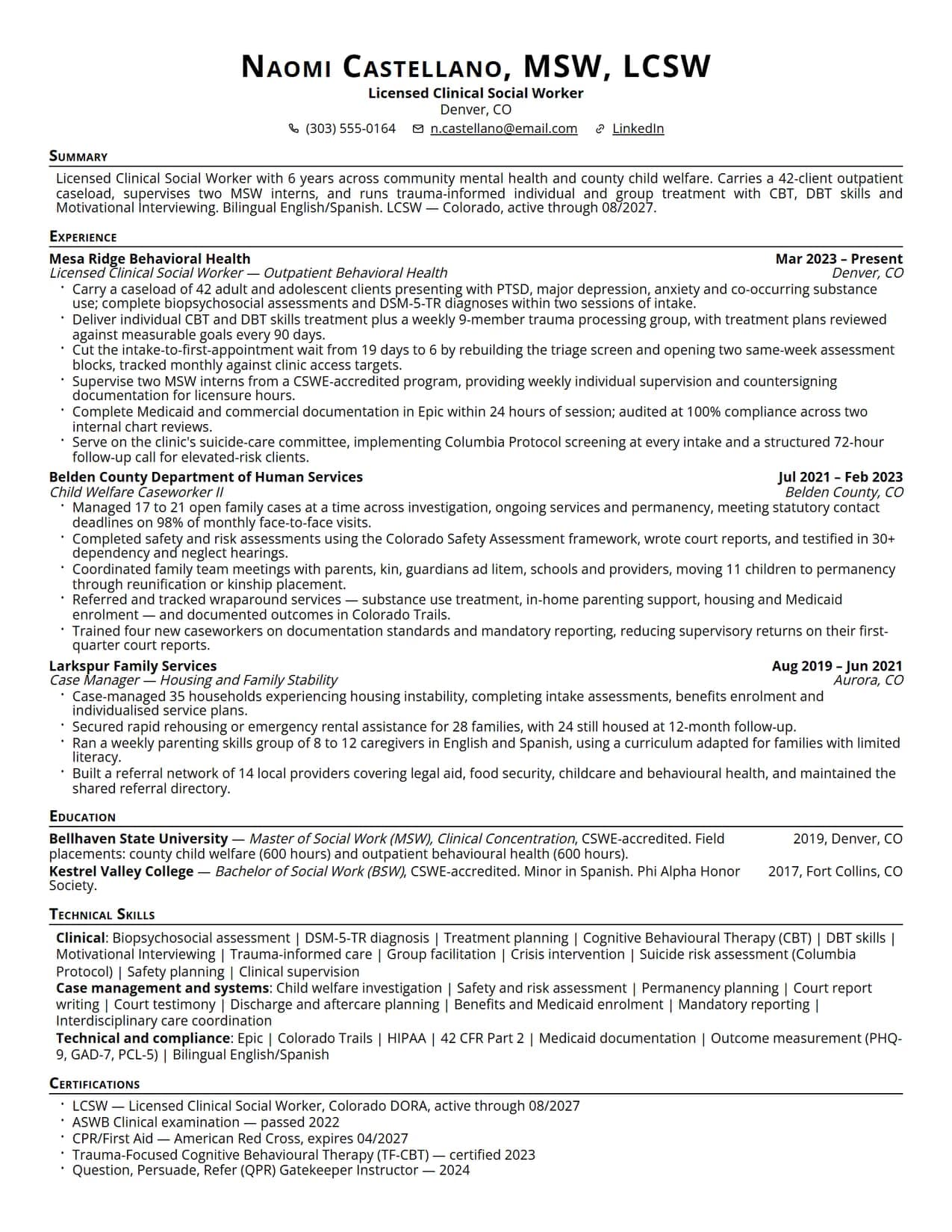
Naomi Castellano, MSW, LCSW, a licensed clinical social worker in Denver with six years across community mental health and county child welfare
This is six years of practice on one page, which is what a tightly written social work resume looks like before it earns a second one. Read it as a structure to copy rather than wording to copy — the notes below show where it is strong and where a real applicant should push further.
The annotations follow the page top to bottom, in the order a hiring supervisor reads it.
Header and credential line
"Naomi Castellano, MSW, LCSW" with "Licensed Clinical Social Worker" as a title line directly beneath. Degree before licence is the convention, and the title line matters mechanically as well: applicant tracking systems match your stated title against the posting's, and a header carrying only a name gives the parser nothing to match.
The licence, and where it sits
The licence appears at the end of the summary — "LCSW — Colorado, active through 08/2027". That works, and it is the single most valuable string on the page. Moving it up beside the location would be better still, because it is the first thing a county HR screener looks for and it currently sits four lines lower than it needs to.
Professional summary
Six years, both settings, the caseload number, the modalities and the languages, in four lines with no adjectives. The caseload figure is doing most of the work: "42-client outpatient caseload" lets a supervisor size the candidate up instantly in a way that "extensive experience" never could.
The strongest experience bullet
"Cut the intake-to-first-appointment wait from 19 days to 6" is the best line in the section, because access time is the metric community mental health clinics are measured on and it names both the before and the after. One bullet of that kind is worth four that describe the job.
Caseload numbers in the child welfare role
"17 to 21 open family cases at a time" and "98% of monthly face-to-face visits" are exactly right for public child welfare, where statutory contact compliance is audited and a candidate who reports it is telling a supervisor they have worked to it. Court testimony volume in the next bullet does the same job for the legal side of the role.
Supervision, listed as work rather than as a title
Supervising two MSW interns and countersigning their licensure documentation appears as a bullet under the current role, not as a separate heading. That is the right placement: it shows the agency already trusted this candidate with more than a caseload, and it sits where a reader is already looking.
Education and field placements
Both degrees carry "CSWE-accredited", and the MSW line gives the two placements with their hours. Accreditation is a licensing prerequisite, so writing it out saves a reviewer a lookup. For a candidate with six years of practice, education sitting below experience is the correct order; a new MSW would flip the two blocks.
The "Technical Skills" heading
This is where the sample loses ground. The block is well organised into clinical, case management and systems, and it names Epic and Colorado Trails literally, which is what agency searches match on. But calling it "Technical Skills" undersells three quarters of what is in it. Rename it "Skills" or "Areas of Practice" and nothing else about the section needs to change.
Certifications
The licence, the ASWB Clinical exam year, CPR, TF-CBT and QPR, each with a date or an expiry. Dates are the point: a certification with no year reads as one nobody has checked. A generic "mandatory reporter training" line was cut from this list, and rightly — every social worker has it, so it takes space without separating you from anyone.
What a hiring supervisor checks in the first ten seconds
Social work hiring is a compliance screen followed by a fit screen, and they happen in that order. An agency cannot put you on a caseload without the licence its funding and its statute require, so that is checked before anyone forms a view about your practice.
Four questions, roughly in this sequence. A gap at any one of them ends the review.
What to lead with, by social work setting
The evidence that wins a child welfare job is not the evidence that wins a hospice or a school job. Leading with the wrong category tells a supervisor you have not read the posting.
| Setting | Lead with | Also useful | Avoid leading with |
|---|---|---|---|
| MSW new graduate | Field placements with agency, setting and hours; capstone population; ASWB exam status | Practicum supervision, human services work before the degree, languages | Unrelated retail or service jobs |
| Clinical / outpatient behavioural health | Licence and state, caseload size, diagnoses treated, modalities delivered | Group facilitation, supervision of interns, outcome measures used | General "provided therapy" statements |
| Public child welfare | Open case count, statutory contact compliance, court reports and testimony, permanency outcomes | State case management system by name, safety assessment framework, family team facilitation | Total years with no caseload figure |
| School social work | Student caseload, IEP and 504 involvement, tiered intervention work, attendance and behaviour outcomes | State school social work certification, crisis response role, parent engagement | Clinical modalities with no school context |
| Medical / hospital | Discharge planning volume, units covered, insurance and benefits navigation, interdisciplinary rounds | EHR by name, advance directives, psychosocial assessment throughput | Long-term therapy experience |
| Hospice and palliative | Bereavement caseload, family systems work, IDT participation, Medicare hospice documentation | Certification, volunteer coordination, community education | Acute crisis work with no end-of-life detail |
| Substance use and co-occurring | Levels of care worked, ASAM criteria, MAT coordination, group volume | CADC or state addiction credential, 42 CFR Part 2 handling | Generic case management bullets |
| Housing, homelessness and community | Households served, placement and retention rates, benefits enrolment, coordinated entry | Landlord and provider networks, HMIS by name, language access | Clinical diagnosis language |
| Supervisor or programme manager | Staff supervised, budget or programme ownership, retention and outcome metrics | Supervision credential, policy and quality work, grant reporting | Direct caseload task lists |
| Private clinical practice | Licence and independent practice status, specialisms, panels credentialed with | Telehealth licensure by state, referral sources, no-show and retention figures | Agency duties with no clinical outcome |
Licences, pre-licensure hours and the ASWB exam
This is the section where mistakes are caught fastest, because most state boards publish a searchable licence verification. State what you hold precisely and state when it expires.
Turn social work duties into evidence: six rewrites
Every social worker completes assessments, writes case notes and links clients to services. Listing those describes the licence, not the practitioner. What distinguishes you is the load you carried, the acuity you handled and anything that measurably changed.
Instead ofProvided case management services to clients.
WriteCarried 17 to 21 open family cases across investigation, ongoing services and permanency, meeting statutory contact deadlines on 98% of monthly face-to-face visits.
Case count, case type and a compliance figure let a supervisor picture the week. "Clients" could mean eight or eighty.
Instead ofCompleted assessments and treatment plans.
WriteCompleted biopsychosocial assessments and DSM-5-TR diagnoses within two sessions of intake, with treatment plans reviewed against measurable goals every 90 days.
Names the framework and the cadence. Assessment turnaround is a real access metric that clinics track.
Instead ofDocumented in the electronic record.
WriteCompleted Medicaid and commercial documentation in Epic within 24 hours of session; audited at 100% compliance across two internal chart reviews.
The system by name is a literal search term, and an audit result turns a routine duty into a verified one.
Instead ofWorked to improve client access.
WriteCut the intake-to-first-appointment wait from 19 days to 6 by rebuilding the triage screen and opening two same-week assessment blocks.
Names the metric, the intervention and both ends of the change. Access time is what community mental health funding is measured on.
Instead ofSupervised students.
WriteSupervised two MSW interns from a CSWE-accredited programme, providing weekly individual supervision and countersigning documentation for licensure hours.
Countersigning is a licensure responsibility, not a mentoring one, and it tells a reader what level of trust you already hold.
Instead ofAttended court as required.
WriteWrote court reports and testified in 30 or more dependency and neglect hearings, including contested permanency hearings.
Volume and hearing type. Public child welfare supervisors are hiring for the ability to hold up under cross-examination.
Confidentiality on a resume
Social work is one of the few fields where a resume can create an ethical problem rather than just a hiring one. The person reading it is trained to notice.
Final checks before you apply
Keywords ATS looks for
Weave these into your resume where they’re true to your experience, and always mirror the exact wording from the specific job post you’re applying to.
Common mistakes to avoid
Social Worker resume: FAQ
What should a social worker resume include?
A header with your name and credentials in degree-then-licence order, a title line matching the posting, your licence type, state and expiry, a three-to-four-line summary naming your setting and caseload, licences and certifications with dates, experience with caseload sizes and populations, CSWE-accredited education with field placement hours, split clinical and systems skills, and any supervision, committee or programme work.
How do you write credentials after your name on a social work resume?
Highest degree first, then licence, then certifications: "Naomi Castellano, MSW, LCSW" or "David Ruiz, MSW, LMSW, CADC". Degrees come first because they are permanent and licences can lapse. Do not list a licence you are still accruing hours toward in the credential line — that belongs in the licences section with the hours completed.
How long should a social worker resume be?
One page for an MSW new graduate, two pages once you have three or more years of practice. Social work is one of the fields where two pages is normal, because licences, accreditation, placements and caseload histories are all separately verified. Do not compress a real work history to fit an imagined one-page rule.
Do you put your licence number on a social work resume?
Usually not. Licence type, state and expiry are what a hiring manager needs, and most state boards publish a searchable licence verification anyway. Include the number if the posting asks for it; otherwise "LCSW — Colorado, active through 08/2027" is enough.
What goes on an MSW resume with no experience?
Field placements with the agency, setting and hours for each, the populations and modalities you worked with, your ASWB exam status with the test date if you have not sat it yet, and any practicum, volunteer or human services work that predates the degree. Put education above experience and list the CSWE accreditation. Placements are experience — write them with the detail you would give a job.
What is the ASWB exam and should it be on my resume?
The Association of Social Work Boards writes the licensing examinations used across the United States and Canada, in four categories: Bachelors, Masters, Advanced Generalist and Clinical. Put the category and the year you passed it in your licences section, because it tells a reviewer which licence level you are eligible for without them having to work it out from your degree.
How much do social workers earn in the US?
The Bureau of Labor Statistics puts the median annual wage for social workers at $61,780 as of May 2025, with employment projected to grow 6 percent from 2025 to 2035, faster than the average across all occupations. Clinical licensure, setting and state move that figure a long way, so check the BLS state and metro tables for your licence level before naming a number.
Do social work resumes go through an ATS?
Yes. County and city agencies mostly recruit through NEOGOV, hospital systems through Workday or Taleo, and non-profits through Greenhouse or a hosted careers page. Keep the layout single-column, use standard headings, export a text-based PDF unless Word is asked for, and name your licence, your modalities and your case management system exactly as the posting does.