Medical Assistant Resume Sample (USA): CMA Resume Example for 2026
Complete guide · 14 min read · Updated 2026
A medical assistant resume has to answer two questions in the first few seconds, and most of them answer neither. Are you certified, and by whom? And can you do both halves of the job, the clinical back office and the administrative front office, or only one?
Below is a complete medical assistant resume sample for a US clinic role, annotated section by section, plus what changes for new graduates coming out of an externship, for specialty practices, and for people moving between urgent care, family medicine and hospital outpatient settings. The sample is a CMA with five years across family medicine and urgent care.
Choosing your template
Medical assisting resumes carry two parallel skill stacks and a credential that has to be verifiable. A single-column layout keeps the clinical duties, the administrative duties and the certification dates in one reading order, so a certification stays attached to the body that issued it. Two-column templates with a credentials sidebar are the common reason a CMA date or a BLS expiry gets detached during parsing, and large clinic groups and hospital systems recruit through Workday, Taleo and iCIMS, which read strictly top to bottom.
Browse all 20 templates →Section-by-section: what to write
Header and credential line
Name, then the credential in the form the certifying body uses: "Danielle Reyes, CMA (AAMA)". Under it a title line matching the posting, then city and state, one phone number and a professional email. The credential belongs in the first inch of the page because it is the first thing screened, and putting it only in a certifications block at the bottom costs you the four seconds where it mattered.
Professional summary
Three or four lines: your certification and issuing body, years of experience, the setting, how many providers you support and roughly how many patients you see, then the EHR by name. "CMA (AAMA) with 5 years in family medicine and urgent care, supporting 4 providers and 90 to 110 visits per week, Epic and athenahealth" tells a clinic manager the size of the operation you are used to. Skip an objective unless you are a new graduate.
Certifications and licences
Give this a real heading and put the awarding body and the expiry on every line: "CMA (AAMA) — American Association of Medical Assistants, recertified through 01/2028". CMA (AAMA), RMA (AMT), CCMA (NHA) and CMAC (AMCA) are separate credentials from separate bodies and employers often specify one. Add BLS with its month and year, and any state-specific requirement such as an Arizona or California x-ray or phlebotomy permit where the role needs it.
Clinical experience
For each job: title, practice, city and state, specialty and dates. Then the volume and the procedures. Patients roomed per day, venipunctures per day, EKGs, injections, point-of-care tests you run under CLIA-waived protocol, and any assisting you do in-procedure. "Room 22 to 26 patients per day for 4 providers" is the level of specificity that separates you from every resume that says "provided patient care".
Administrative duties
Do not let these disappear. Most medical assistant postings ask for both halves, and clinics screen for the administrative half because it is the part that is harder to hire for. Scheduling, insurance verification, prior authorisations, referral coordination, records requests, copay collection, ICD-10 and CPT coding support. Put a number on at least one of them, such as a prior-authorisation turnaround you shortened.
Education and externship
Programme name, school, city and state, and the year. Say whether the programme was CAAHEP or ABHES accredited, because eligibility for the CMA (AAMA) exam depends on it and a recruiter checking your credential path will look. List the externship with its hours and the setting: a 200-hour externship at a multi-specialty practice is real clinical experience and should be described as such.
Skills, split three ways
Clinical, administrative, and systems and compliance. Clinical: vitals, phlebotomy, EKG, injections, specimen collection, sterile technique, autoclave. Administrative: scheduling, insurance verification, prior authorisations, referrals. Systems: Epic, athenahealth, eClinicalWorks, plus HIPAA, OSHA bloodborne pathogens and CLIA-waived testing. Name the EHR exactly as the posting spells it, because clinics search for their own system literally.
Medical Assistant resume sample, annotated
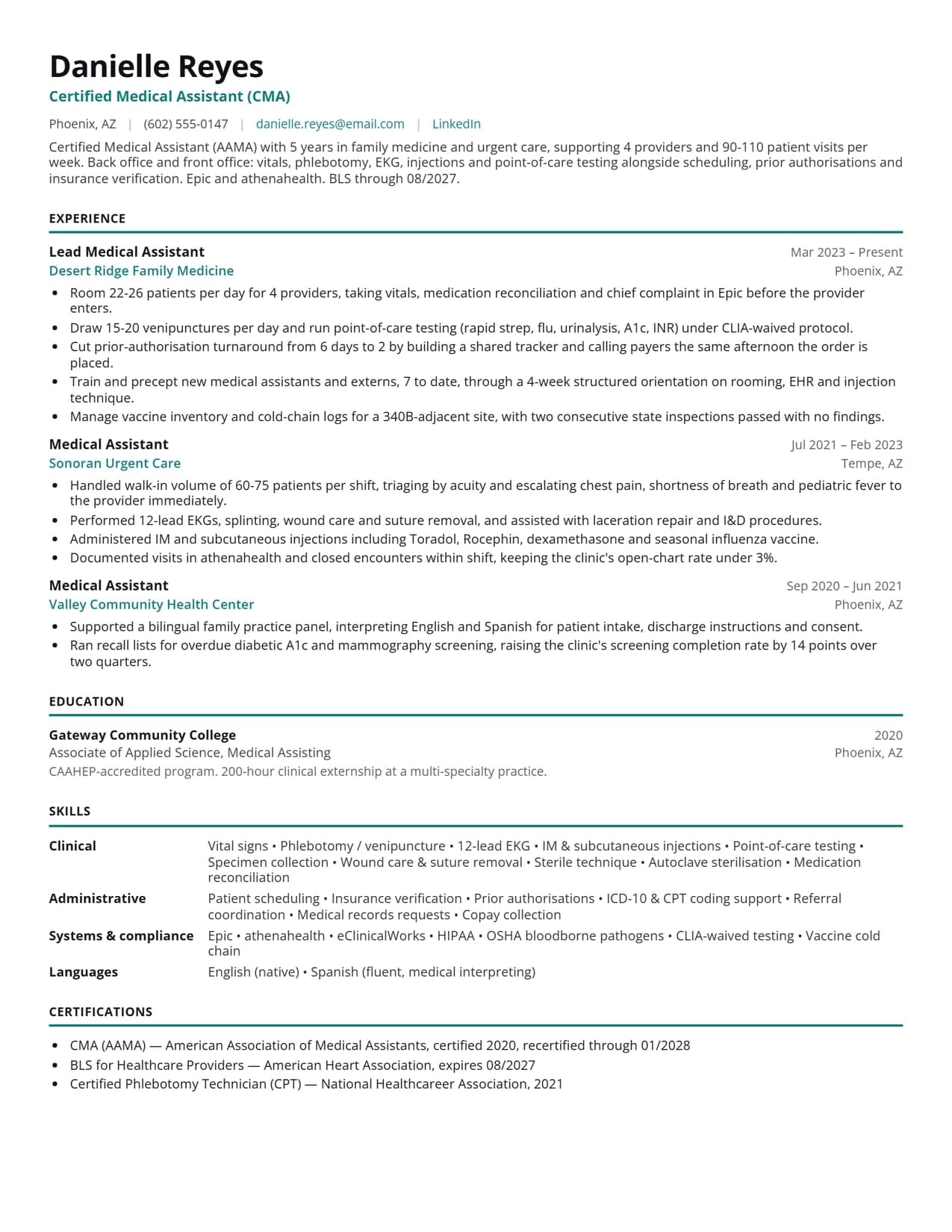
Danielle Reyes, CMA (AAMA), a certified medical assistant in Phoenix with five years across family medicine and urgent care
This is a full five-year medical assistant history on one page, which is what this profession usually looks like at that length. Read it as a structure to copy rather than wording to copy, and note where the annotations say it falls short — a sample that only praises itself teaches nothing.
The annotations follow the page top to bottom, in the order a clinic manager reads it.
Header and title line
Name, then "Certified Medical Assistant (CMA)" as a title line directly under it, then contact details on one row. The title line is doing real work: applicant tracking systems match your current title against the posting's, and a header carrying only a name gives the parser nothing to match on.
What this header is missing
The name reads "Danielle Reyes", not "Danielle Reyes, CMA (AAMA)". The credential is on the page, but it is at the very bottom under Certifications. Moving "CMA (AAMA)" into the name line costs nothing and puts the single most screened fact about a medical assistant in the first inch.
Professional summary
Four lines carrying the certification, the setting, four providers, 90 to 110 visits a week, both halves of the job, two EHRs by name and a BLS date. That is a lot of verified detail in a small space and it is the strongest block on the page. If anything it runs slightly long; the BLS date could move down to Certifications where it is repeated anyway.
Experience: volume before duty
"Room 22-26 patients per day for 4 providers" opens the first job with a number rather than a verb, which is the right instinct. Compare it with the third job, which opens with "Supported a bilingual family practice panel" and never says how many patients. The bilingual interpreting is genuinely valuable and it is undersold by having no volume beside it.
The prior-authorisation bullet
"Cut prior-authorisation turnaround from 6 days to 2" is the only bullet on the page describing something that changed because this person was there. Clinics feel prior-authorisation delay directly, so it lands. A resume with five years on it should carry two or three bullets at this level, not one.
Precepting and inventory
Training seven medical assistants and externs, and passing two state inspections with no findings on vaccine cold chain, both belong here. Between two candidates with identical clinical duties, this is the material that decides it, and it is what a lead or senior medical assistant posting is screening for specifically.
Skills, split four ways
Clinical, Administrative, Systems and compliance, Languages. This is the layout this profession needs, because a reader can confirm back-office and front-office depth separately in one glance. Epic, athenahealth and eClinicalWorks are named individually rather than collapsed into "EHR", which is what makes them findable.
Certifications at the bottom
The content is right — awarding body and expiry on every line, which most medical assistant resumes omit. The placement is the compromise. It reads correctly for someone with five years of experience, where the work history is the argument, but a new graduate should move this block directly under the summary, because the credential is the strongest thing they have.
What a clinic manager checks in the first few seconds
Medical assistant hiring is volume hiring. A busy practice may see forty applications for one opening and screen them in an afternoon, so the first pass is a small number of yes-or-no checks rather than a considered reading.
Four questions, roughly in this order. A gap at any one of them usually ends the review before the experience section is reached.
Turn medical assistant duties into evidence: eight rewrites
Every medical assistant takes vitals, rooms patients and documents in an EHR. Listing those describes the certification, not the person holding it. What distinguishes you is volume, procedure range, and anything that measurably changed in the clinic because you were in it.
Instead ofRoomed patients and took vital signs.
WriteRoom 22 to 26 patients per day across 4 providers, completing vitals, medication reconciliation and chief complaint in Epic before the provider enters.
Volume and provider count let a manager size your pace. "Roomed patients" could mean eight a day or thirty.
Instead ofPerformed phlebotomy.
WriteDraw 15 to 20 venipunctures per day including paediatric and difficult sticks, with specimen labelling and courier handoff under CLIA-waived protocol.
Daily count plus the hard cases. Paediatric draws are a genuinely different skill and worth naming.
Instead ofAssisted with in-office procedures.
WriteAssisted with laceration repair, incision and drainage, and skin biopsies: set up sterile field, handled instruments and provided post-procedure wound care instructions.
Names the procedures. "Assisted" alone does not say whether you set up the tray or held a light.
Instead ofHandled insurance and authorisations.
WriteCut prior-authorisation turnaround from 6 days to 2 by building a shared tracker and calling payers the same afternoon the order was placed.
The administrative half is where a number is easiest to find and rarest to see. This is the bullet that gets read twice.
Instead ofDocumented in the electronic health record.
WriteDocumented in athenahealth and closed encounters within shift, holding the clinic's open-chart rate under 3%.
Names the system and attaches a metric clinics actually track. Open charts are a real operational pain.
Instead ofGave injections and vaccines.
WriteAdminister IM and subcutaneous injections including Toradol, Rocephin, dexamethasone and seasonal influenza vaccine, with vaccine cold-chain logging and inventory reconciliation.
Naming the medications shows scope, and cold chain is a compliance responsibility most resumes never mention.
Instead ofTrained new staff.
WriteTrained and precepted 7 new medical assistants and externs through a 4-week structured orientation on rooming, EHR workflow and injection technique.
A count and a structure. Precepting signals you are the person a manager can build a team around.
Instead ofWorked with a diverse patient population.
WriteInterpreted English and Spanish for intake, discharge instructions and consent across a bilingual family practice panel of roughly 1,400 patients.
Bilingual capability is one of the most valuable things a medical assistant can offer a clinic, and it is routinely buried in a vague sentence like the first one.
New graduate medical assistant resume: what counts before your first job
Entry-level medical assistant hiring is competitive, and the mistake most new graduates make is treating the externship as an education line item rather than as the clinical experience it is.
Your externship is the only clinical evidence you have. Give it the space a job would get.
What to lead with, by setting
The evidence that wins a family medicine job is not the evidence that wins a dermatology or an urgent care job. Leading with the wrong category tells the hiring manager you sent the same resume everywhere.
| Setting | Lead with | Also useful | Avoid leading with |
|---|---|---|---|
| New graduate | Externship hours, patient volume by the end, EHR used | Certification status and date, BLS, prior healthcare work | Unrelated retail or hospitality jobs |
| Family medicine | Patients roomed per day, providers supported, both office halves | Recall lists, screening rates, immunisation workflow | Generic duty lists |
| Urgent care | Walk-in volume per shift, triage by acuity, EKG and splinting | Procedure assisting, wound care, X-ray permit where held | "Fast-paced environment" |
| Paediatrics | Paediatric draws, immunisation schedules, weight-based dosing support | Developmental screening tools, parent education | Adult-only procedure lists |
| Dermatology / specialty | Procedure assisting, biopsy and specimen handling, cosmetic scheduling | Prior authorisations for specialty drugs, surgical scheduling | General rooming duties |
| Hospital outpatient | EHR by name, volume, compliance record, float experience | Point-of-care testing menu, inventory and cold chain | Small-practice informality |
| Phlebotomy-heavy roles | Draws per day, difficult and paediatric sticks, specimen handling | CPT certification, lab courier and labelling workflow | Administrative duties first |
| Lead or senior MA | Staff trained and precepted, schedule or inventory ownership, inspection record | Process changes with a measured result, EHR super-user work | Bedside task lists |
| Front-office weighted | Scheduling volume, insurance verification, prior-authorisation turnaround | Referral coordination, copay collection, records requests | Clinical procedures only |
Certifications, and writing them so they survive a screen
This is the section where a medical assistant resume is most often let down by formatting rather than by content. The credential is usually there. It is frequently unfindable, undated, or written in a form nobody searches.
How clinics and hospital groups actually screen these resumes
Large multi-site practices and hospital-owned outpatient groups recruit through the same applicant tracking platforms as any other large employer, and medical assistant postings attract high volume, which means heavier filtering.
Final checks before you apply
Keywords ATS looks for
Weave these into your resume where they’re true to your experience, and always mirror the exact wording from the specific job post you’re applying to.
Common mistakes to avoid
Medical Assistant resume: FAQ
What should a medical assistant resume include?
A header with your name and credential in the form the certifying body uses, a title line matching the posting, a three-to-four-line summary naming your certification, setting, provider count and patient volume, a certifications section with awarding bodies and expiry dates, clinical experience with daily volumes and procedures, administrative duties with at least one number attached, education with the externship and its hours, and skills split into clinical, administrative and systems.
How long should a medical assistant resume be?
One page for most medical assistants, including new graduates and anyone with under about seven years of experience. Two pages is reasonable once you have supervisory or lead responsibilities, multiple specialties, or a long certification stack. Do not shrink a real work history to fit an imagined one-page rule, and do not pad a short one to fill a second page.
Do you need certification to work as a medical assistant?
It varies by state and by employer rather than by federal rule, and many postings require or strongly prefer a credential. CMA (AAMA) is awarded by the American Association of Medical Assistants and requires graduation from a CAAHEP or ABHES accredited programme. RMA comes from American Medical Technologists and CCMA from the National Healthcareer Association. Check the specific posting, since employers often name the one they accept.
How do I write a medical assistant resume with no experience?
Lead with education and treat the externship as a job entry rather than a course note. Give it its own block with the practice type, the hours, the EHR you documented in, the visit types you supported and the daily patient volume you handled by the end. Add your certification status precisely, including an exam date if you have not sat it yet, and count any prior healthcare work such as caregiving, pharmacy technician, front-desk or CNA experience.
Should a medical assistant resume list clinical and administrative skills separately?
Yes, and it is one of the highest-value formatting decisions on this particular resume. Most postings ask for both halves, and a reader scanning a single undifferentiated list cannot tell quickly whether you have back-office depth, front-office depth or both. Two labelled groups answer the question in one glance, and a third group for systems and compliance keeps the EHR names findable.
What is the difference between a CMA, an RMA and a CCMA?
They are three separate certifications from three separate bodies with different eligibility routes and different exams. CMA (AAMA) requires an accredited programme, RMA is issued by American Medical Technologists, and CCMA is issued by the National Healthcareer Association. None is a subset of another, so write out which one you hold with the body in brackets rather than the generic phrase "certified medical assistant".
What patient volume should I put on a medical assistant resume?
Whatever you can defend in an interview. Patients roomed per day and providers supported are the two numbers that travel best, because they let a clinic manager size your pace against theirs. Venipunctures per day, EKGs per week and walk-in volume per shift work for phlebotomy-heavy and urgent care roles. An approximate range is fine, and more useful than no number at all.
Do clinic resumes go through an ATS?
Yes, especially at hospital-owned outpatient groups and large multi-site practices, which recruit through the same platforms as any large employer. Keep the layout single column, use standard headings, export a text-based PDF unless Word is asked for, and spell the EHR and your certification exactly as the posting spells them. You can see what a parser pulls out of your own file with the free ATS score check.