Welder Resume Sample (USA): AWS Certified Pipe and Structural Welder Resume Example for 2026
Complete guide · 13 min read · Updated 2026
A welding foreman reading a stack of resumes is answering one question, and it is narrower than most job-search advice assumes: what can this person be put on tomorrow without a test that costs the shop half a day? Positions, processes, materials and the code the work is built to. Everything else on the page is context around those four.
Below is a complete welder resume sample for a US pipe and structural career, annotated section by section, plus what changes for shop fabrication against field and turnaround work, what a welder with no experience should lead with, and how the qualification that gates the job is named in the UK, Canada, Australia and New Zealand. The sample is an AWS Certified Welder in Texas with seven years across process piping, refinery turnarounds and structural steel.
How does your welder resume score?
Upload your resume and get its ATS score out of 100, with each finding quoting the line it is about. Free, no account, and the file never leaves your browser — it is read locally and scanned on the results page.
Choosing your template
A welder's resume is a qualification record before it is anything else, and qualification records break in two-column layouts. Single column keeps every certificate attached to its position, its process and its year, in the reading order a QC coordinator checks them in. Put those into a sidebar and an applicant tracking system can lift them out of sequence, which is how "6G, GTAW root, carbon and 316L, ASME Section IX" reaches a foreman as four unconnected fragments. Fabrication shops and contractors hiring at volume screen on exactly those fields, so the layout that keeps them together is the one that gets read.
Browse all 20 templates →Section-by-section: what to write
Header and qualification line
Put the qualification in the title line rather than saving it for a block at the bottom. "Welder · AWS Certified · 6G Pipe + Structural" answers the assignment question in the first inch of the page. Add your city and, if you travel, say so: welding hiring is local until it suddenly is not, and a shop staffing a turnaround needs to know which you are.
Professional summary
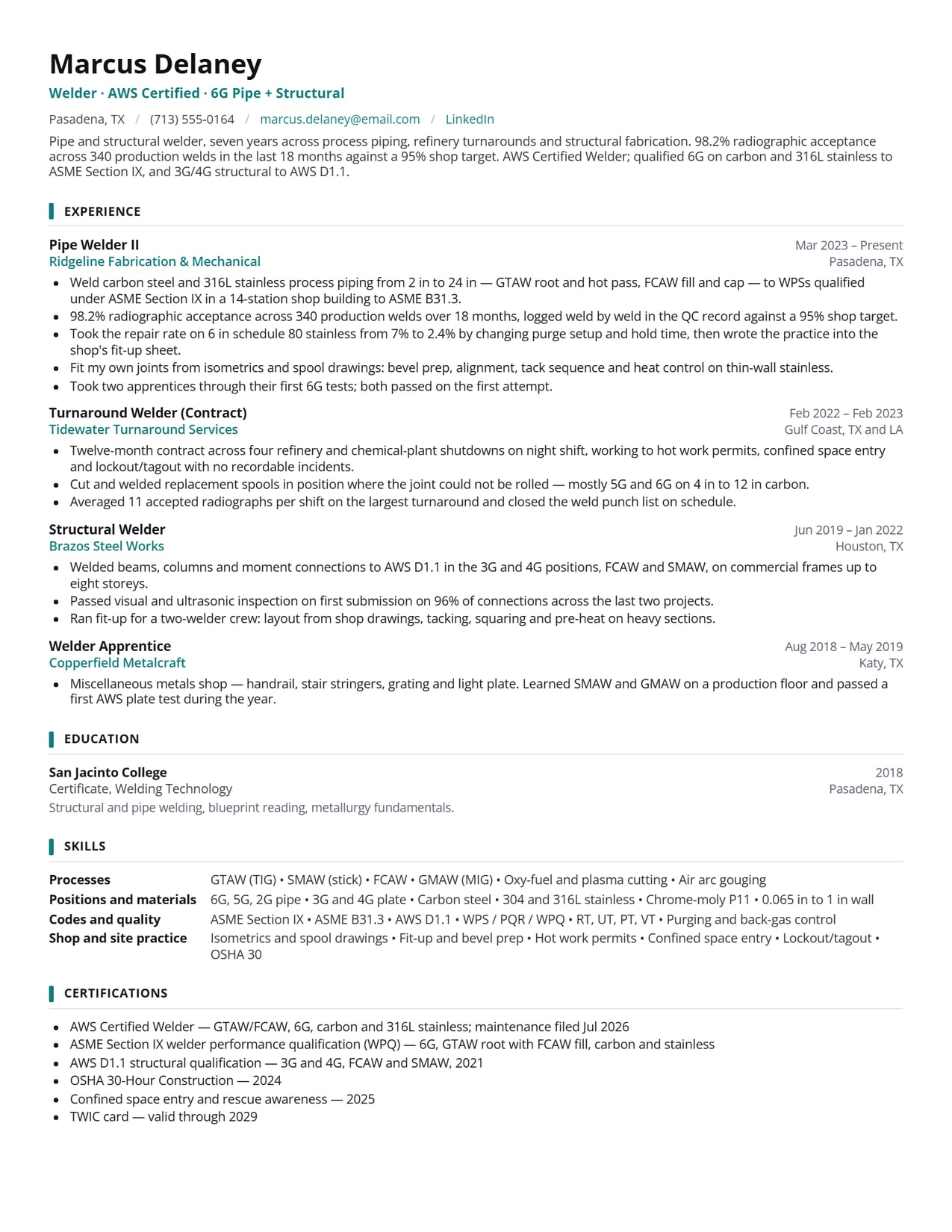
Three lines, one of which is a number a QC manager can act on. Radiographic acceptance or repair rate, the positions you hold, the processes you run and the code your work was built to. "Hard-working welder with a strong work ethic" is true of the whole stack and checkable in none of it.
Experience: the current shop
Open with the scale and the work, not with a verb. Pipe sizes, wall thickness, materials, station count and the code the shop builds to tell a foreman more than any list of duties, because they set the level everything after them happened at. Then give the numbers: acceptance rate, repair rate, and where they were recorded.
The contract role, labelled as one
Turnaround and shutdown work is normal in this trade and belongs on the title line as contract. "Turnaround Welder (Contract)" turns a twelve-month stay from an unexplained departure into a contract that ended, and it lets the entry say what the work was: night shift, permits, confined space, and what you closed out.
Structural years, written for their breadth
Structural experience is worth more than pipe welders often let it look. Name the code (AWS D1.1), the positions, the processes and the kind of steel, and say what passed inspection first time. Fit-up is a separate skill and worth its own line: a welder who can lay out and tack is cheaper to a shop than one who cannot.
The apprenticeship, kept short
Keep the first job and keep it to one or two lines. It shows the trajectory and it stops a reader wondering what happened before your first qualified year. What it must not do is take up the space a current qualification needs.
Education
One entry: the programme, the award and the year. A welding certificate matters to a first employer and very little to a fourth, so it sits below experience once you have qualifications and shop history to lead with. Keep it if you have it; do not pad it if you came up through the shop.
Skills, split four ways
Processes, positions and materials, codes and quality, shop and site practice. Splitting them lets a reader confirm four separate capabilities in a glance, and it forces you to name positions and materials individually rather than collapsing them into "all-position welder", which matches nothing a recruiter searches for and tells a foreman nothing they can schedule around.
Certifications and qualifications
Every line gets the process, the position, the material and the issuing body, and anything with a currency requirement gets its date. An AWS Certified Welder record stays live only while the six-monthly maintenance is filed, and a welder performance qualification is held by the employer who tested you, so say who holds it. A bare "AWS certified" tells a QC coordinator nothing they can accept.
Welder resume sample, annotated
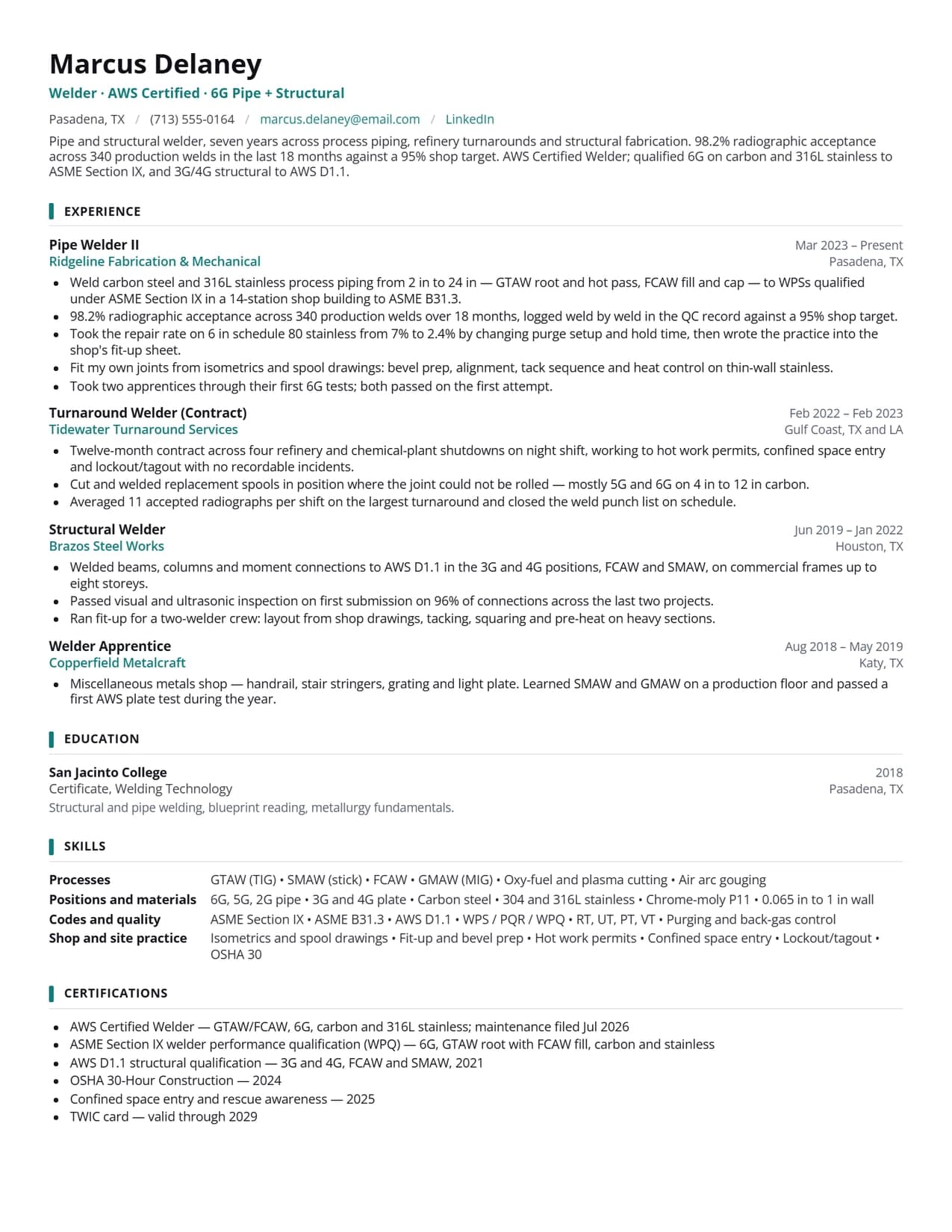
Marcus Delaney, an AWS Certified Welder in Pasadena, Texas with seven years across process piping, refinery turnarounds and structural steel fabrication
Seven years, four employers and a full qualification list on one page. Read it as a structure to copy rather than wording to copy, and pay attention to where the annotations say it falls short, because a sample that only praises itself teaches nothing.
The annotations follow the page top to bottom, in the order a welding foreman reads it.
Header and title line
"Welder · AWS Certified · 6G Pipe + Structural" is the best decision on the page. Trade, credential and capability arrive together in the first inch, so a foreman knows before reading anything else whether this resume is worth the next thirty seconds. Most welder resumes leave all three at the bottom under Certifications, where they are found after the reader has already formed a view.
What this header leaves out
No travel line and no shift note. In a trade where a lot of the good money is on turnarounds and shutdowns, "Available for travel and shutdown work" or "Nights and rotating shifts" is real scheduling information and costs one line. There is room for it here.
Professional summary
Three lines carrying seven years, three kinds of work, a 98.2% radiographic acceptance rate over a stated volume, the positions and the two codes. The acceptance figure is the most persuasive thing on the page because radiography is the number this trade is genuinely measured on and the one a QC coordinator can ask about.
First entry: scale before verbs
"Weld carbon steel and 316L stainless process piping from 2 in to 24 in" names materials and a diameter range before it describes a single task. Compare that with the "performed welding on various materials" that opens most resumes in this trade, which could equally describe a first-year apprentice.
The acceptance bullet
"98.2% radiographic acceptance across 340 production welds over 18 months, logged weld by weld in the QC record against a 95% shop target" is the strongest line here. It gives the measure, the volume, the period, the comparison and where the number lives. One bullet like that is worth five duty descriptions, and it is the one that survives being questioned.
The repair-rate bullet
"Took the repair rate on 6 in schedule 80 stainless from 7% to 2.4% by changing purge setup and hold time, then wrote the practice into the shop's fit-up sheet" does something most welder resumes never attempt: it describes a process improvement rather than a task. Repair costs a shop money directly, so this reframes a welder as someone who protects margin.
The contract entry
"Turnaround Welder (Contract)" with a stated twelve-month term, the number of shutdowns, the shift pattern and a safety record. That is the correct shape for any fixed-term role, and it is why a one-year stay between two longer ones does not read as a red flag. Our guide to contract and temp work covers the general version of this.
The structural years
Three bullets that name the code, the positions, the processes and the inspection outcome, plus a line about fit-up. The fit-up line is doing quiet work: a welder who can lay out, tack and square from shop drawings costs a fabricator less than one who needs a fitter, and almost nobody says it.
Skills, split four ways
Processes, positions and materials, codes and quality, shop and site practice. The materials and thickness range are what make this resume surface when a shop searches its applicant pool for 316L or for chrome-moly. The weakness is the template's own heading, "Skills", which undersells a block whose second row is a scheduling answer.
Certifications at the bottom
The content is right: every line carries the process, the position, the material and a date, the AWS maintenance filing is dated, and the WPQ says who holds the record. The placement works only because the title line already carried the headline credential. A welder without that title line should move this block directly under the summary.
The honest gap
There is no weld map, no NDT report and no reference to the QC department that logged those numbers, because a resume cannot carry them. Bring a one-page qualification summary and your test papers to the interview. The resume's job is to get you into the room where the paperwork can be looked at.
What a welding foreman checks in the first few seconds
Hiring a welder is usually a station standing empty against a schedule that has already been promised to a client. The first pass through a stack of applications is a short series of yes-or-no checks rather than a considered read, and a gap at any one of them ends it.
Four questions, roughly in this order.
Turn welding duties into evidence: eight rewrites
Every line below is a real thing welders write. The rewrite carries the same fact and adds the scale, the outcome or the comparison that makes it worth reading.
Instead ofPerformed welding on various materials using different processes.
WriteWeld carbon steel and 316L stainless process piping from 2 in to 24 in — GTAW root and hot pass, FCAW fill and cap — to WPSs qualified under ASME Section IX.
The first sentence is true of everyone who has held the job. The second tells a foreman the material, the diameter range, the process split and the code, which is everything they need to decide whether to call you.
Instead ofAWS certified welder.
WriteAWS Certified Welder — GTAW/FCAW, 6G, carbon and 316L stainless; maintenance filed Jul 2026.
A certification is a specific test on a specific joint, and AWS certification stays active only while six-monthly maintenance is filed. Without process, position, material and a date, a QC coordinator cannot accept it.
Instead ofKnown for high-quality welds with few rejects.
Write98.2% radiographic acceptance across 340 production welds over 18 months, logged weld by weld in the QC record against a 95% shop target.
The claim is the same. The second version names the measure, the volume, the period, the comparison and where the number lives, so it survives a follow-up question instead of collapsing under one.
Instead ofExperienced with all welding positions.
WriteQualified 6G and 5G on pipe, 3G and 4G on plate, 0.065 in to 1 in wall.
"All positions" is vaguer than the list it replaces and matches nothing a recruiter searches for. The thickness range is the part most welders leave out, and it is what decides whether your qualification covers the job.
Instead ofReduced weld defects.
WriteTook the repair rate on 6 in schedule 80 stainless from 7% to 2.4% by changing purge setup and hold time, then wrote the practice into the shop's fit-up sheet.
The second version names the joint, the numbers, the cause and the fix, and the last clause says the improvement outlived you. That is what makes it an achievement rather than a good month.
Instead ofRead blueprints and worked from drawings.
WriteFit my own joints from isometrics and spool drawings: bevel prep, alignment, tack sequence and heat control on thin-wall stainless.
Fit-up is a separate, chargeable skill. A welder who can lay out and tack costs a fabricator less than one who needs a fitter standing alongside, and the generic version of this line throws that away.
Instead ofWorked on plant shutdowns.
WriteTwelve-month contract across four refinery and chemical-plant shutdowns on night shift, working to hot work permits, confined space entry and lockout/tagout with no recordable incidents.
Turnaround work is bought on availability, permit discipline and safety record. The rewrite names all three; the original names none of them.
Instead ofTrained new welders.
WriteTook two apprentices through their first 6G tests; both passed on the first attempt.
A pass rate is the only version of this claim that means anything. It also tells a foreman you can be left with a second-year without supervision, which is worth money to a shop.
Welder resume with no experience: what actually counts
Nobody starts qualified, and every foreman reading your resume began somewhere similar. A first employer is buying trainability, hands and evidence that you will still be there in a year. Write for those three.
What to lead with, by kind of shop
The same seven years should be arranged differently depending on where you are sending it. This is the edit most welders never make, and it costs them interviews at the shops they most want.
| Where you are applying | Lead with | Do not bury |
|---|---|---|
| Process piping and pressure work | 6G, GTAW root, ASME Section IX and B31.3, stainless and chrome-moly | Radiographic acceptance and repair rate, with the volume behind them |
| Structural fabrication | AWS D1.1, 3G and 4G, FCAW and SMAW, heavy section experience | Fit-up, layout and first-pass inspection results |
| Turnaround and shutdown contracting | Availability, travel, permit and confined-space discipline, safety record | Positions you can weld in place where the joint cannot be rolled |
| Pipeline | API 1104, 5G and 6G, downhill stick, field conditions | Production rate and the terrain and diameters you have worked |
| Shop production and manufacturing | GMAW and FCAW throughput, fixtures, repeatability, robotic cell experience | Any quality data you have, including scrap and rework rates |
| Aerospace, food or pharma stainless | GTAW, thin-wall control, purge discipline, cleanliness and finish standards | Documentation habits and any orbital welding experience |
Qualifications, written so a QC coordinator can act on them
This block decides your rate and it is the block most often written carelessly. Three rules cover it.
First, a qualification is a test, so write the test. Process, position, base metal, thickness range, and the code or standard. "AWS certified" is a category, not a record, and it cannot be accepted by anyone.
Second, say what keeps it live. The American Welding Society states that its Certified Welder programme is performance-based, with "no prerequisite courses or certifications required prior to testing", and that to keep certification active you must submit maintenance documentation every six months confirming you still perform the process you were certified in. Put the last filing date on the page.
Third, separate what you hold from what an employer holds. An AWS Certified Welder credential is yours. A welder performance qualification under ASME Section IX is a record held by the employer who tested you, so name them: a new shop will want to know who to call, and saying so first reads as someone who understands the paperwork.
Outside the US: the same resume, a different gate
The structure of this page travels unchanged. What changes is the credential that decides whether you can be employed at all, and naming it wrongly is the fastest way to look like an outsider to the trade.
In Canada the gate is the CWB Group. Its guidance states that people welding on certain products, buildings and structures must be qualified by the CWB and working for a certified company, that a CWB welding personnel qualification is the only nationally recognised welding credential within Canada, and that most qualifications are retested every two years. Lead with your CWB qualification and the standard it sits under, usually CSA W47.1, and give the date of your last retest.
In the UK welder approval is normally to BS EN ISO 9606-1, and CSWIP certification is issued by TWI Certification Ltd, which is accredited by UKAS to ISO/IEC 17024 for the certification of personnel. Write the approval range as the certificate writes it, because the range is the qualification: process, material group, thickness, diameter and position.
In Australia and New Zealand, Weld Australia offers welder certification to ISO 9606 and AS 1796, and structural steel work is built to AS/NZS 1554. Name the certificate number and the standard as they appear on the document rather than paraphrasing them.
How shops actually screen these resumes
Two filters, in sequence, and they fail resumes for different reasons.
The first is a keyword and field match. A fabricator or contractor running a posting through an applicant tracking system pulls employer, title and dates into fields and searches the rest for the terms in the posting: the code, the positions, the processes, the materials. This is why writing 6G and 316L in full matters, and why qualifications belong in running text rather than in a sidebar that can be lifted out of order. Paste the posting into the free ATS score check and you can see which of those terms your resume is missing before you send it.
The second is a foreman reading for thirty seconds, looking for the positions, the code and a number they recognise. Nothing you write about attitude survives that pass, and almost anything you write with a figure attached does.
For context on the market, the US Bureau of Labor Statistics reports a median annual wage of $53,750 for welders, cutters, solderers and brazers as of May 2025, with a high school diploma or equivalent as the typical entry-level education, and employment projected to grow 2 percent from 2025 to 2035, about 10,300 jobs. Pipe and speciality work sits well above that median, which is exactly why the positions and the code belong at the top of your page rather than the bottom.
Keywords ATS looks for
Weave these into your resume where they’re true to your experience, and always mirror the exact wording from the specific job post you’re applying to.
Common mistakes to avoid
Welder resume: FAQ
What should a welder put on a resume?
The processes you run, the positions you are qualified in, the materials and thickness range you have welded, and the code the work was built to. Then two numbers a QC manager can act on, usually radiographic acceptance or repair rate, and the safety documents that decide which sites you can be sent to. That combination answers the only question a foreman has, which is what you can be put on tomorrow without a test.
Do I need AWS certification to get a welding job?
Not always to be hired, but it shortens the conversation and it travels between employers, which a shop test does not. The American Welding Society states that its Certified Welder programme is strictly performance-based, with "no prerequisite courses or certifications required prior to testing", and that you keep it active by submitting maintenance documentation every six months confirming you still perform the process you were certified in. Put the process, position and material on the resume, and the date you last filed maintenance.
What is the difference between a welder qualification and a certification?
A welder performance qualification (WPQ) is a record that you welded a specific test coupon to a specific welding procedure, and it belongs to the employer who tested you and holds the paperwork. An AWS Certified Welder credential is held by you and recognised outside the company that tested you. Both belong on the resume, written differently: name the code and the joint for a WPQ, and say who holds the record.
How do I write welding positions on a resume?
Write them as the code writes them, grouped by pipe and plate. 1G, 2G, 5G and 6G are pipe; 1G, 2G, 3G and 4G are plate. 6G is the one that gets read first on a pipe resume because a 6G qualification generally covers the positions below it, so name it if you hold it and say on what material and thickness. Do not substitute "all-position welder" for the list — it is vaguer than the thing it replaces.
What numbers should go on a welder resume?
Radiographic acceptance rate against the shop's target, repair or reject rate and how it changed, first-pass inspection rate, pipe diameters and wall thicknesses, and the volume of welds behind the percentage. Give the period and where the figure was recorded, because a number with a source survives a follow-up question and a number without one does not. Do not invent precision you cannot defend in an interview.
How do I write a welder resume with no experience?
Lead with the qualification and the hours behind it rather than with employment. The programme you trained on, any plate or pipe test you have already passed, the processes and positions you practised, and the thickness ranges you worked. Add any production job that taught you pace and inspection, and say what test you are sitting next and when. One passed test is worth more than a page of enthusiasm because it is the only thing a shop can verify.
How do I list a welding qualification outside the US?
Name the awarding body, because the letters do not cross borders. In Canada the CWB Group states that a CWB welding personnel qualification is the only nationally recognised welding credential in the country, that welders on certain work must be qualified by the CWB and working for a certified company, and that most qualifications are retested every two years. In the UK, welder approval is normally to BS EN ISO 9606-1, with CSWIP certification issued by TWI Certification Ltd. In Australia and New Zealand, Weld Australia certifies welders to AS 1796 and ISO 9606, with structural work built to AS/NZS 1554. Write the qualification exactly as it appears on the document.
How long should a welder resume be?
One page up to about ten years, two after that if the second page is qualifications and shops rather than padding. The sample on this page is seven years, four employers and a full qualification list on one page, which is what this trade looks like when it is written tightly rather than trimmed.