Automotive Technician Resume Sample (USA): Mechanic Resume Example for 2026
Complete guide · 13 min read · Updated 2026
A service manager reading technician resumes is trying to answer one question the page almost never answers: how much diagnostic work can this person close without help? Everything else follows from it. Flat-rate hours, whether you can be left with the escalations, whether the shop pays a master rate or an apprentice rate.
Below is a complete automotive technician resume sample for a US dealership and independent-shop career, annotated section by section, plus what changes for fleet work, for a technician moving from lube-and-tire into diagnostics, and for the UK, Canada, Australia and New Zealand where the qualification that gates the job has a different name. The sample is an ASE Master technician in Arizona with eight years across a dealership, an independent shop and one contract fleet role.
How does your automotive technician resume score?
Upload your resume and get its ATS score out of 100, with each finding quoting the line it is about. Free, no account, and the file never leaves your browser — it is read locally and scanned on the results page.
Choosing your template
A technician resume is a certification list, a shop history and a set of tools, and the certification list is the part that breaks. Single-column keeps each ASE certificate attached to the year it was earned and each shop attached to its dates. Two-column templates put certifications in a sidebar, and a sidebar is the layout an applicant tracking system most often reads out of order, which is how “ASE Master Automobile Technician (A1–A8), recertified 2024” arrives at a service manager as a list of letters with no years against them. Dealership groups hiring at volume screen on exactly those fields.
Browse all 20 templates →Section-by-section: what to write
Header and certification line
Put the certification in the title line, not just in a block at the bottom. “Automotive Technician · ASE Master (A1–A8) + L1” answers the pay-grade question in the first inch of the page. Add your city, because technician hiring is local and a service manager is filling a bay this month.
Professional summary
Three lines, and at least one of them a number a service manager can act on. Comeback rate, first-time fix, flat-rate efficiency and the kind of shop you are used to are the four that carry weight. Skip “hard-working team player”: every resume in the stack says it, and none of them can be checked.
Experience: the current shop
Lead with the size and mix of the shop rather than with a verb. Bay count, weekly repair-order volume and the makes you work on tell a reader more about your capability than any list of duties, because they set the scale everything else happened at.
A contract role, labelled as one
Fleet and contract work is normal in this trade and should say so on the title line. “Fleet Technician (Contract)” turns a nine-month stay from an unexplained departure into a contract that ended, and the entry then has room to say why they needed someone and what you handed over.
Earlier shops, and the apprenticeship
Independent-shop years are worth more than technicians think and should be written for their breadth: mixed makes, no factory scan tool, everything from HVAC to driveability. Keep the apprenticeship, and keep it short. It is the line that shows the trajectory.
Education
One line. The programme, the award and the year. Trade school matters to a first employer and almost not at all to a fourth, so it sits below experience once you have certifications and shop history to lead with.
Technical skills, split four ways
Diagnostics, systems, tools and software, shop practice. Splitting them lets a reader confirm four separate capabilities in a glance, and it forces you to name scan tools and information systems individually rather than collapsing them into “diagnostic equipment”, which is what makes you findable when a shop recruits around a platform it already owns.
Certifications and licences
Every line gets an issuing body and a year, and anything with an expiry gets the expiry. ASE certifications lapse after five years, so a certificate with no date on it reads to a service manager as a certificate that might have lapsed. Put EPA 609 here too: it is a legal requirement for the air conditioning work, not a nice-to-have.
Automotive Technician resume sample, annotated
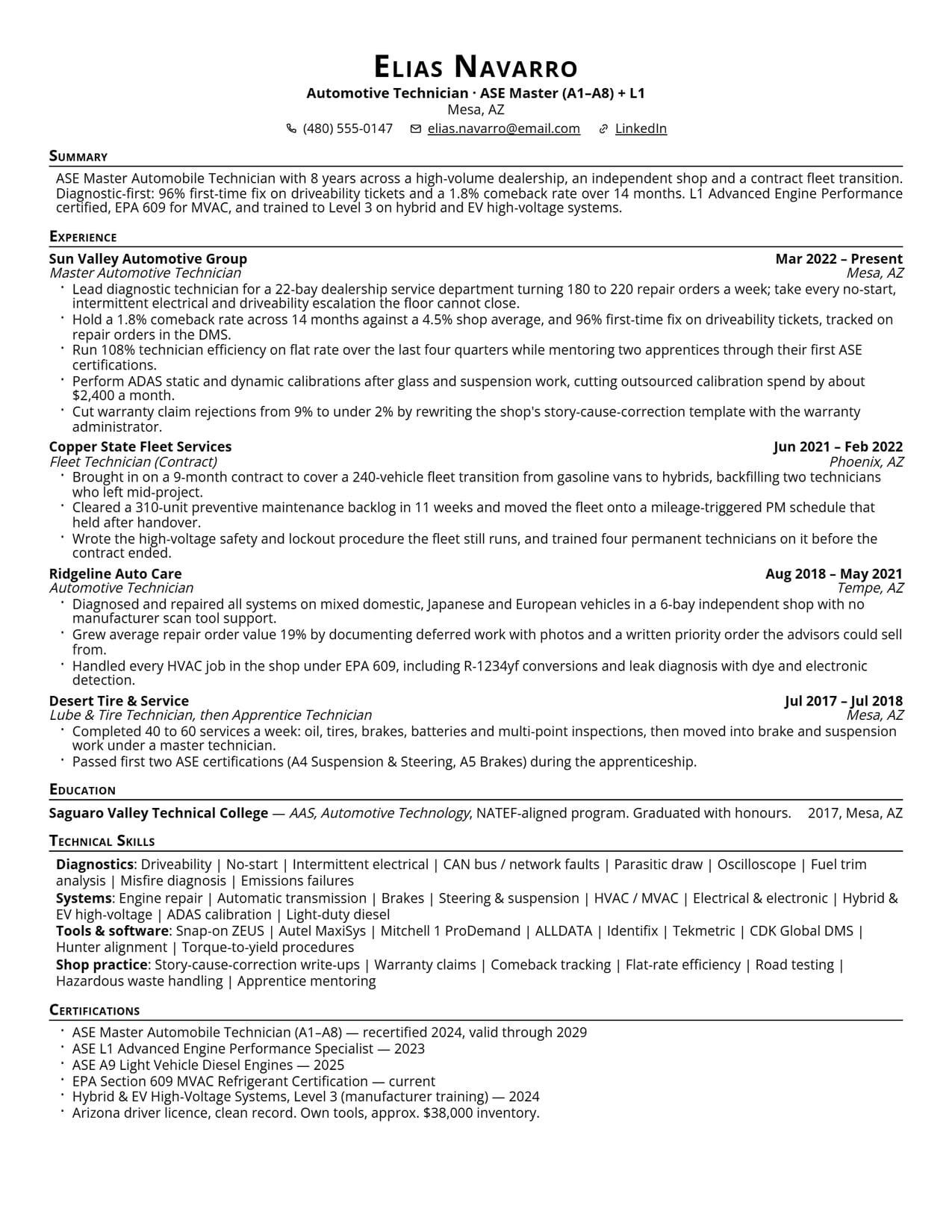
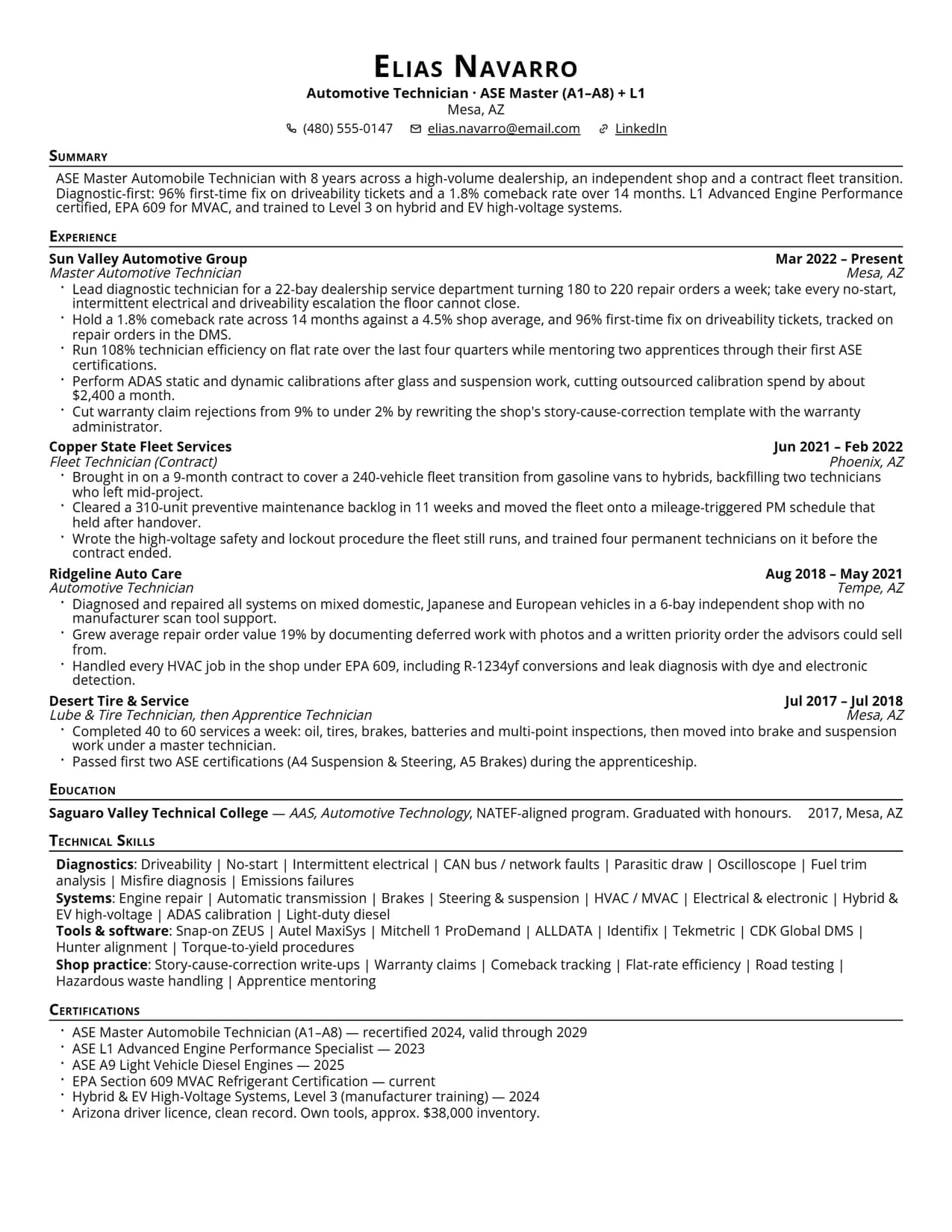
Elias Navarro, an ASE Master technician in Mesa, Arizona with eight years across a dealership service department, an independent shop and one contract fleet transition
Eight years, four shops and a full certification list on one page, which is what this trade looks like at that length when it is written tightly rather than trimmed. Read it as a structure to copy rather than wording to copy, and pay attention to where the annotations say it falls short, because a sample that only praises itself teaches nothing.
The annotations follow the page top to bottom, in the order a service manager reads it.
Header and title line
"Automotive Technician · ASE Master (A1–A8) + L1" is the strongest decision on the page. Role and pay grade arrive together in the first inch, so a service manager knows before reading anything else whether this is a master rate or a B-tech rate. Most technician resumes leave that at the bottom under Certifications, where it is found after the reader has already formed a view.
What this header leaves out
No availability line and no shift note. In a trade that runs Saturdays and staggered shifts, "Available Saturdays" or "Open to a four-day, ten-hour schedule" is real information and costs one line. There is room for it here.
Professional summary
Three lines carrying eight years, three kinds of shop, a 96% first-time fix rate, a 1.8% comeback rate over a stated period, and three certifications including the legal one. That is a lot of checkable substance in a small space, and the comeback figure is the single most persuasive thing on the page because it is the number shops actually manage to.
First entry: scale before verbs
"Lead diagnostic technician for a 22-bay dealership service department turning 180 to 220 repair orders a week" sets the scale before it describes any task. Compare that with the "performed diagnostics and repairs on customer vehicles" that opens most resumes in this trade, which could describe a first-year apprentice or a twenty-year master.
The comeback bullet
"1.8% comeback rate across 14 months against a 4.5% shop average, tracked on repair orders in the DMS" is the best line here. It is measured, it names the comparison, and it says where the number came from, which is what makes a reader believe it rather than skim past it. One bullet like this is worth five duty descriptions.
The warranty bullet
"Cut warranty claim rejections from 9% to under 2% by rewriting the shop's story-cause-correction template" is doing something clever. Warranty rejections cost a dealership money directly, so this reframes a technician as someone who protects margin, which is not how technicians usually get to describe themselves.
The contract entry
"Fleet Technician (Contract)" with a stated nine-month term and a reason it existed. The entry says why they needed someone, what state the backlog was in, and what was handed over. That is the correct shape for any fixed-term role, and it is why this nine-month stay does not read as a red flag. Our guide to contract and temp work covers the general version of this.
The apprenticeship, kept short
Two bullets for the lube-and-tire year, one of which is the first two ASE tests passed during it. It shows the trajectory without spending page space on oil changes, and it stops the reader wondering what happened before 2018.
Skills, split four ways
Diagnostics, Systems, Tools & software, Shop practice. The tools are named individually, which is what makes this resume surface when a shop searching its applicant pool types Autel or Tekmetric. The flaw is the template's own heading, "Technical Skills", which undersells a block whose last row is about write-up quality and mentoring.
Certifications at the bottom
The content is right: every line carries a body and a year, the Master certification carries its recertification date and expiry, and EPA 609 is present. The placement works here only because the title line already carried the headline certification. A technician without that title line should move this block directly under the summary.
What a service manager checks in the first few seconds
Technician hiring is a bay sitting empty against a booked schedule. The first pass through a stack of applications is a short series of yes-or-no checks rather than a considered read, and a gap at any one of them usually ends it.
Four questions, roughly in this order.
Turn technician duties into evidence: eight rewrites
Every line below is a real thing technicians write. The rewrite carries the same fact and adds the scale, the outcome or the comparison that makes it worth reading.
Instead ofPerformed diagnostics and repairs on customer vehicles.
WriteTake every no-start, intermittent electrical and driveability escalation the floor cannot close, across a 22-bay shop turning 180 to 220 repair orders a week.
The first sentence is true of everyone who has ever held the job. The second says what you get given when other technicians are stuck, which is the only sentence a service manager actually wants to read.
Instead ofASE certified technician.
WriteASE Master Automobile Technician (A1–A8), recertified 2024 and valid through 2029; L1 Advanced Engine Performance, 2023.
ASE certification expires after five years. Without the letters and the dates, a reader cannot tell whether you are current or which tests you hold, and both of those set your pay grade.
Instead ofKnown for quality work with few comebacks.
Write1.8% comeback rate across 14 months against a 4.5% shop average, tracked on repair orders in the DMS.
The claim is the same. The second version names the measure, the period, the comparison and where the number lives, so it survives a follow-up question instead of collapsing under one.
Instead ofExperienced with diagnostic equipment and repair information systems.
WriteSnap-on ZEUS and Autel MaxiSys for scan and scope work; Mitchell 1 ProDemand, ALLDATA and Identifix for procedures and known fixes.
Shops recruit around the platform they already own. Named tools match a search; the phrase “diagnostic equipment” matches nothing at all.
Instead ofWorked on air conditioning systems.
WriteHandled every HVAC job in a 6-bay shop under EPA 609, including R-1234yf conversions and leak diagnosis with dye and electronic detection.
The certification and the newer refrigerant are what make this a capability rather than a task. R-1234yf work in particular tells a reader you have been near recent vehicles.
Instead ofTrained junior technicians.
WriteMentored two apprentices through their first ASE certifications while holding 108% flat-rate efficiency.
Mentoring normally costs a technician hours, so doing it without losing efficiency is the whole point and the original sentence throws it away.
Instead ofResponsible for warranty paperwork.
WriteCut warranty claim rejections from 9% to under 2% by rewriting the shop's story-cause-correction template with the warranty administrator.
Warranty rejections are money the dealership does not get back. This is one of the few chances a technician gets to describe a financial outcome, and most resumes waste it on the word “paperwork”.
Instead ofFleet maintenance experience.
WriteCleared a 310-unit preventive maintenance backlog in 11 weeks and moved a 240-vehicle fleet onto a mileage-triggered PM schedule that held after handover.
Fleet work is measured in units and uptime. The handover clause is the part that says the improvement survived you, which is what a fleet manager is buying.
Automotive technician resume with no experience: what actually counts
Nobody starts as a diagnostician, and every service manager reading your resume began somewhere similar. What a first employer is buying is trainability, hands, and evidence that you will still be here in a year. Write for those three.
What to lead with, by shop type
The same eight years should be arranged differently depending on where you are sending it. This is the edit most technicians never make, and it costs them interviews at the shops they most want.
| Where you are applying | Lead with | Do not bury |
|---|---|---|
| Franchise dealership | Manufacturer training levels, factory scan tool experience, warranty write-up quality | Flat-rate efficiency and your comeback rate |
| Independent shop | Breadth across makes, diagnosis without factory tools, customer-facing explanation | The systems you own end to end, from HVAC to driveability |
| Fleet or municipal | Uptime, preventive maintenance schedules, downtime cost, DOT-adjacent work | Documentation and anything you handed over that survived you |
| Specialist or performance | The specific systems and the depth, plus tooling you can use unsupervised | Diagnostic method: how you isolate rather than replace |
| EV or hybrid work | High-voltage training level, safety procedure, battery and inverter diagnosis | That you can still cover conventional work, which pays the bills |
Certifications, written so a service manager can act on them
This is the block that decides your rate, and it is the block most often written carelessly. Three rules cover it.
First, letters and years on everything. ASE states that technicians certified in tests A1 through A8 are recognised as ASE-Certified Master Automobile Technicians, and that certifications are valid for five years before a recertification test is needed. A certificate with no date attached invites the reader to assume the worst.
Second, separate the legal requirements from the credentials. EPA Section 609 is not a nice-to-have: the EPA states that Section 609 certification is required to service any motor vehicle air conditioning system for consideration, regardless of what refrigerant is used. It belongs on the page as a permission, not as an achievement.
Third, write manufacturer training as levels and dates, because that is how dealerships price it internally, and a level with no year is treated as expired.
Outside the US: the same resume, a different gate
The structure of this page travels unchanged. What changes is the credential that decides whether you can be employed at all, and naming it wrongly is the fastest way to look like an outsider to the trade.
In the UK the working qualification is normally a level 3 NVQ, SVQ or IMI award in vehicle maintenance and repair, and MOT testing is a separate authorisation on top of it. GOV.UK's eligibility guidance for MOT testers requires a full UK driving licence for the classes you want to test, that you "be a skilled mechanic with at least 4 years' full-time employment servicing and repairing the types of vehicles you're going to test", no unspent convictions, and that you be "of good repute". If you hold MOT tester status, put it in your title line and name the classes: it is the single most sellable thing on a UK technician CV.
In Canada, Automotive Service Technician is a Red Seal trade. The Red Seal endorsement is recognised across the provinces and territories, so it is the credential to lead with, along with your provincial certificate of qualification and any apprenticeship hours completed.
In Australia and New Zealand the entry qualification is a Certificate III in light vehicle mechanical technology, with state and territory licensing sitting on top for some work. Write the certificate number and the training organisation as they appear on the document rather than paraphrasing them.
How shops actually screen these resumes
Two filters, in sequence, and they fail resumes for different reasons.
The first is a keyword and field match. A dealership group running a job posting through an applicant tracking system pulls employer, title and dates into fields and searches the rest for the terms in the posting: the certifications, the systems, the scan tools. This is why naming tools individually matters and why certifications belong in running text rather than in a sidebar that can be lifted out of order.
The second is a service manager reading for thirty seconds. They are looking for scale, diagnostic depth and a number they recognise. Nothing you write about attitude survives that pass, and almost anything you write with a figure attached does.
For context on what the market pays, the US Bureau of Labor Statistics reports a median annual wage of $50,620 for automotive service technicians and mechanics as of May 2025, with typical entry-level education given as a postsecondary nondegree award and employment projected to grow 5% over 2025 to 2035, about 40,900 jobs. Check your own metro before naming a number in an interview, because the spread around that median is wide.
Keywords ATS looks for
Weave these into your resume where they’re true to your experience, and always mirror the exact wording from the specific job post you’re applying to.
Common mistakes to avoid
Automotive Technician resume: FAQ
What should an automotive technician put on a resume?
Certifications with their letters and years, the size and mix of every shop you have worked in, and two or three numbers a service manager can act on: comeback rate, first-time fix on driveability tickets, flat-rate efficiency. Then the scan tools and information systems you have actually used, named individually. That combination answers the only question the reader has, which is how much diagnostic work you can close without help.
Do I need ASE certification to get a technician job?
Not always to be hired, but it sets the pay grade and it is the fastest way to be taken seriously on paper. ASE states that technicians certified in tests A1 through A8 are recognised as ASE-Certified Master Automobile Technicians, and that certifications remain valid for five years, after which you must retest. Write the specific tests and the year on your resume, because “ASE certified” with no detail cannot be priced by whoever is reading it.
Should I put EPA 609 on my resume?
Yes, and near the top of your certifications. The US Environmental Protection Agency states that Section 609 certification is required to service any motor vehicle air conditioning system for consideration, regardless of what refrigerant is used in the system. Without it there is a category of work a shop cannot assign you, so it changes what you are worth to them on day one.
How do I write a mechanic resume with no experience?
Lead with the qualification and the hands-on hours rather than with employment. Trade school programme, any ASE tests already passed, the systems you worked on in the shop bay at college, and any lube-and-tire or tyre-fitting job you have held, written for what it taught you about volume and inspection quality. One or two entry certifications beat a page of enthusiasm, because they are the only thing on the page a service manager can verify.
What numbers should go on a technician resume?
Comeback rate against the shop average, first-time fix percentage, flat-rate efficiency, weekly repair-order volume, bay count and the makes you cover. Those six describe the job. Avoid inventing precision you cannot defend: a service manager who asks how you tracked your comeback rate will find the bottom of a made-up number in one follow-up question, and the honest version was always going to be enough.
Is it a mechanic resume or an automotive technician resume?
Both, and it matters for search rather than for status. Job postings in the US split roughly between “automotive technician”, “automotive service technician” and “mechanic”, so use the exact title from the posting in your own title line and let the other terms appear naturally in the body. The US Bureau of Labor Statistics classifies the occupation as automotive service technicians and mechanics, which is why both words keep turning up in job ads for the same bay.
How do I list an automotive qualification outside the US?
Name the awarding body, because the letters mean nothing across a border. In the UK that is usually an NVQ, SVQ or IMI level 3 in vehicle maintenance and repair, and if you hold MOT tester status say so and give the classes. In Canada it is the Red Seal endorsement for Automotive Service Technician, which is recognised in every province and territory. In Australia and New Zealand it is a Certificate III in light vehicle mechanical technology plus any state licensing. Write the qualification exactly as the issuing body writes it.
How long should an automotive technician resume be?
One page up to about ten years, two after that if the second page is shops and certifications rather than padding. This trade accumulates real content quickly, so the constraint is usually the opposite of the usual advice: the problem is not too much material, it is eight years written so flatly that it reads like one year repeated eight times.