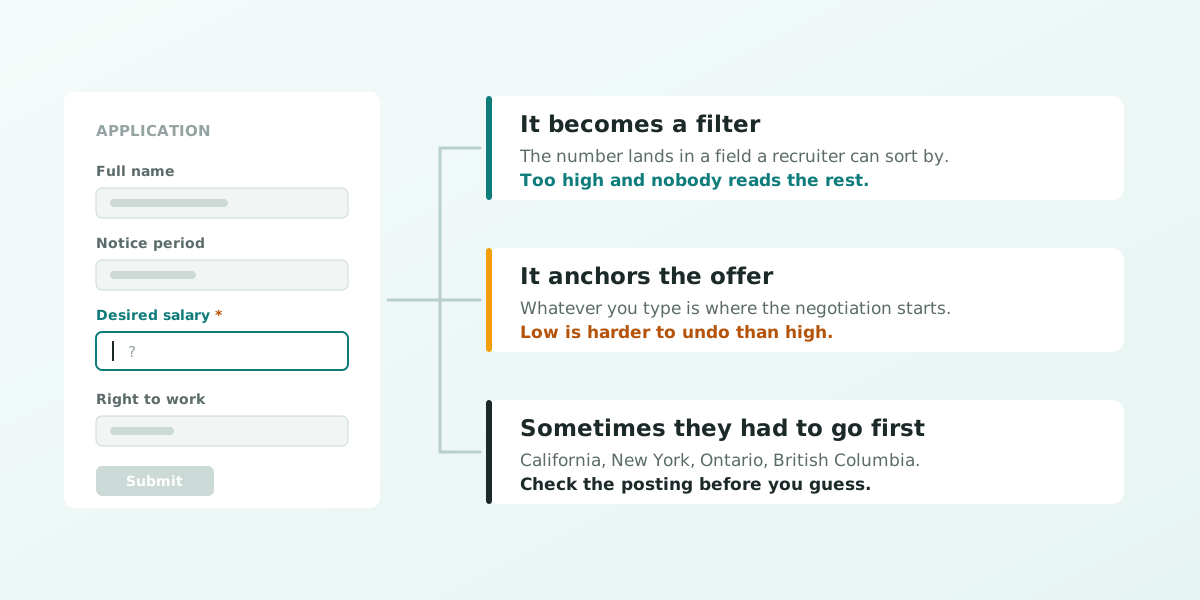
You are four screens into an application, the résumé is uploaded, and the form asks for your salary expectations. The field is required. It will not accept the word negotiable. There is no context, no range on the posting, and no way to ask a question before you answer. Whatever you type is the number that goes into the file, and it will still be there in six weeks when someone works out what to offer you.
This is one of the few moments in a job search where a single unconsidered keystroke has a price attached. Type too high and a recruiter filtering a long list never opens your résumé. Type too low and you have set the ceiling on your own offer before anyone has met you. Most advice on this is written for the interview version of the question, where you can deflect and ask what the range is. On a form you cannot deflect. You have to have a number ready.
The box is four different questions wearing one label
"Salary expectations" looks like a single question and behaves like four. Which one you are being asked changes the right answer, and you can tell them apart by looking at the field rather than the label.
- A screening filter. Large employers set a budget for a role before it is posted. The number you type goes into a sortable field, and a recruiter working a list of three hundred applications sorts by it. This is the version where a high number costs you the read.
- An anchor. Smaller employers, and most agencies, use it to work out where the conversation starts. Nobody is filtering; someone is making a note. This is the version where a low number costs you money.
- A seriousness check. Some forms ask because a wildly out-of-band answer tells them you have misread the role. A graduate asking for a director's salary and a director asking for a graduate's both fail this one.
- A compliance field. A growing number of jurisdictions require the employer to publish a pay range, and some forbid asking what you currently earn. In those places the expectations box is a formality sitting next to information you should already have.
You cannot always tell which one you are in. What you can do is answer in a way that survives all four, and that is a narrow enough target to aim at: a number at the bottom of a band you would genuinely accept, in a form the field will store.
In more places every year, the employer had to go first
Before you guess, read the posting again. The rules on this changed quickly between 2021 and 2026, and a lot of job-search advice still assumes the applicant has to open. Depending on where the job is, the employer may have been legally required to publish a range, and may be forbidden from asking what you currently earn.
This is not universal and it is not tidy. It is worth knowing the specific rules where you are applying rather than a general impression of them.
California
California's Labor Code section 432.3 does two separate things. Employers may not "seek salary history information, including compensation and benefits, about an applicant for employment", and may not rely on prior salary in deciding whether to hire you or what to pay you. Separately, employers with 15 or more employees must include the pay scale in a job posting, and must provide the pay scale to an applicant on reasonable request. The state defines a pay scale as a good-faith estimate of the salary or hourly range the employer reasonably expects to pay on hire. The Department of Industrial Relations sets all of this out in its California Equal Pay Act guidance.
New York State
New York's pay transparency law covers employers with four or more employees and requires them to list compensation ranges for advertised job opportunities, promotions and transfers, stated as a minimum and maximum annual salary or hourly rate, with commission-based roles identified as such. It also prohibits retaliation against an applicant or employee who asks for that information. The New York State Department of Labor publishes the requirement.
Ontario
Ontario's rules are the most specific of the group and are new enough that many applicants have not met them yet. Under the Employment Standards Act, for publicly advertised job postings posted on or after 1 January 2026, an employer with 25 or more employees must include "information about the expected compensation or range of expected compensation for the position". Where a range is given it "is limited to an amount equivalent to $50,000 per year or less", and the requirement does not apply where the expected compensation is more than $200,000 a year. There is a second clause worth knowing: if the employer uses artificial intelligence to screen, assess or select applicants, it "must disclose the use of the artificial intelligence in the posting". Ontario's ESA guide carries the full text.
British Columbia
British Columbia's Pay Transparency Act is short and blunt. Section 2 requires that in an advertisement for a publicly advertised job opportunity an employer "must … specify either (i) the expected salary or wage for the job, or (ii) the expected salary or wage range". Section 3 goes further than most: "An employer must not seek pay history information about an applicant for employment by any means, whether directly from the applicant or through a third party, unless the pay history information is publicly accessible." Both are in the Act itself.
The UK, Australia and New Zealand
None of the three requires a salary range in a job advert, which is why the expectations box is still doing so much work in those markets. What Great Britain requires instead is annual reporting: any employer with 250 or more employees on the snapshot date must report and publish its gender pay gap data within a year of that date, under GOV.UK's statutory guidance. That is useful to an applicant in a roundabout way, because a large employer's published figures tell you something about how it distributes pay even when it will not tell you the band for one job.
New Zealand changed the other side of the problem. The Employment Relations (Employee Remuneration Disclosure) Amendment Act became law on 27 August 2025, making it unlawful for an employer to dismiss, demote or otherwise disadvantage an employee for discussing or disclosing their own pay, or for asking a colleague about theirs. Employment New Zealand's summary of the new protections is clear that nobody is obliged to disclose, only protected if they choose to. It does not require pay ranges on adverts. What it does is make the informal route to a number safer: asking someone who does the job what it pays.
Work out your three numbers before you meet the box
The reason the field feels impossible is almost never that the question is hard. It is that people meet it for the first time at the moment they have to answer it. Do the arithmetic once, before you start applying, and every form afterwards takes ten seconds.
- Your walk-away. The figure below which you would decline and keep looking. Work it out from what you need rather than from what you want: housing, transport, childcare, debt, the commute this job would add. This is the only one of the three that is a fact about you rather than a judgement about the market.
- The market band. What the role pays where you live, for someone with your experience. Not a national average — a band, with a bottom and a top.
- Your target. Somewhere in the upper half of the market band, adjusted for anything genuinely unusual about you. If your walk-away is above the market band, the problem is the role rather than the number, and it is better to know that before you apply.
For the market band, use published statistics rather than a salary site's estimate for the specific company. In the US, the Bureau of Labor Statistics publishes Occupational Employment and Wage Statistics with national, state and metropolitan tables, which is the right granularity because pay for the same job in two cities is not the same job. In the UK the equivalent is the Office for National Statistics' Annual Survey of Hours and Earnings, drawn from a 1% sample of HMRC PAYE records and broken down by occupation, industry and location. For scale, ASHE put median gross annual earnings for full-time employees at £39,039 in April 2025, up from £37,439 in April 2024. That headline is a poor guide to any individual job and a good sanity check on a number you are about to type.
Then add the second half of the picture, which most people leave out until the offer. Employer pension contribution, bonus structure and whether it has ever paid, shift or on-call premiums, overtime rules, holiday, notice period, whether the role is genuinely remote. A job paying five percent less with a materially better pension is not paying less. You cannot put all that in the box, but you need it in your head, because the box is the first move in a negotiation about the whole package.
What to type, by the kind of field it is
Once you have the three numbers, the remaining decision is mechanical. Look at the field, work out what it will accept, and answer accordingly.

Free text
Give a range and one clause of reasoning. "£46,000 to £52,000, depending on shift pattern and on-call" does three things at once: it names a band, it shows you know what varies in this role, and it opens a conversation rather than closing one. Keep the spread to roughly ten to fifteen percent. A range of £35,000 to £60,000 reads as someone who has not looked into it, which is a worse impression than a number that is slightly wrong.
A single required number
Put the bottom of your range in, not the middle. A single figure is read by whoever opens the file as the most they will have to pay, so anything you type becomes a ceiling. The bottom of a range you would genuinely accept keeps you inside the filter and still leaves room to move upward once you have made the case in person. If the bottom of your range is genuinely above the budget, you were never going to get this job at a number you could live with, and finding that out on day one is worth something.
A minimum and a maximum
Treat the minimum as a promise, because that is how it is used. Put your walk-away in it and never a figure you would resent accepting. Set the maximum at your target rather than at your dream, and keep the two close together. Systems that ask for both are usually matching your minimum against a budget field, so a low minimum entered as a tactic does not open a door, it just lowers your offer.
Numbers only
The field that rejects letters is the one that catches people out, because every evasive answer fails validation. "Negotiable" will not save. Zero is read as an error or as a blank, and some screens sort it to the bottom. A very large placeholder reads as a joke and occasionally as a filter you failed deliberately. This field is the whole argument for working the number out before you open the form.
Optional, or a text box that accepts anything
This is the only version where deferring is a real option, and even here it is better to give a range with a caveat than to write nothing. "Open, and looking for something in the region of $70,000 to $78,000 depending on the full package" is a defer that still gives them something to work with. A blank optional field is fine. A blank field with "TBD" in it is not.
The five answers people actually give, and what each one costs
Almost every answer to this box is a version of one of five, and four of them have a specific failure mode.
- "Negotiable". Reads as reasonable, behaves as missing data. In a numeric field it does not save at all; in a text field it leaves the recruiter to invent a number for you, and the invented number is rarely generous. It also means nothing, because everyone is negotiable.
- The current salary, unchanged. Common, and the most expensive habit in job search. It carries every previous employer's decisions into the new one, and in a jurisdiction that has banned salary history questions, the employer is not even allowed to ask for it. Volunteering it hands over something the law says they should not have.
- A round number pulled from nothing. £50,000 or $100,000 because they are numbers. Sometimes right by accident. It fails the seriousness check when the market band for the role is nowhere near.
- A wide range. "$60,000 to $110,000" is read as the bottom figure, because that is the one that costs least. You have given away your minimum and got nothing for the top of your range.
- A researched figure at the bottom of a band you would accept. The one that works, in every field type, in every jurisdiction, and under all four versions of the question.
Salary expectations: Negotiable / open to discussion, currently on £41,500.
Salary expectations: £46,000 to £52,000, depending on shift pattern and on-call.
The rewrite is shorter and gives away less. It also removes the current salary, which in several jurisdictions the employer was not allowed to ask for, and which anchors the offer to a decision made by a previous employer rather than to this role.
Salary history is a different question, and often a prohibited one
Forms blur two questions that are legally distinct in a lot of places. "What do you expect to earn?" is a question about this job. "What do you currently earn?" is a question about your last one, and the second is the one that has been restricted.
California's rule is the clearest example: an employer "cannot, orally or in writing, personally or through an agent, seek salary history information" from an applicant, and cannot rely on prior salary in deciding whether to hire or what to pay. If you volunteer it without being prompted, the employer may consider it, but prior salary still cannot be used to justify a pay disparity based on sex, race or ethnicity. British Columbia's version, quoted above, bans seeking pay history by any means including through a third party.
Two practical consequences. First, if a form asks for your current salary in a jurisdiction that prohibits it, that is worth noticing about the employer, and you are entitled to leave it blank or write "not disclosed" where the field allows. Second, do not volunteer it anywhere. There is no version of this where telling an employer your current salary improves your offer. If you are underpaid, it caps you. If you are well paid, it prices you out. The expectations question is the one you should answer, and it should be answered with a market figure rather than a personal history.
What happens to the number after you submit it
It stops being a sentence and becomes a field. The answer is stored on your candidate record rather than left as free text somewhere, and it stays there for the life of the requisition and often longer. Three things follow from that.
- It is sortable and filterable. A recruiter with three hundred applications and a budget can order the list by that field, or cut everything above a threshold, without opening a single résumé. This is the mechanism behind the advice to keep the number inside the band rather than above it.
- It follows you between roles. Apply again at the same company a year later and the old record is usually still there, with the old figure on it. That is an argument for answering with a figure you would still defend rather than one you typed to get past a screen.
- It is visible to the person who eventually makes the offer. Hiring managers see the candidate record. A number typed in week one is on the screen in week six when someone is deciding what to put in the letter.
None of this means the number is binding. It means it is durable, which is a different and more useful thing to know. You are allowed to revise it, and revising it upward with a reason is normal. Revising it upward twice, without a reason, is not.
When the box is a knockout question
Some applications are configured so the expectations field is scored automatically. Over the threshold and the application is rejected or deprioritised before a person sees it. You can sometimes spot this: the field is required, numeric only, sits alongside other knockout questions about right to work, notice period or licences, and the form gives no way to add context.
In that shape, a figure at the bottom of your acceptable range is doing real work rather than being timid. You are buying the chance to have the conversation. What you should not do is drop below your walk-away to clear the filter, because the filter is telling you something true: the budget is below what you need, and no amount of interviewing changes an approved salary band.
The same reasoning applies in reverse to the rest of the application. If the numeric field is a filter, the résumé behind it is being read by a parser with its own thresholds. Paste the posting into the free ATS score check and you can see which of its terms your résumé is missing before you spend an answer on the salary box.
If you have already put the wrong number in
This is recoverable more often than people assume, and the recovery is a sentence rather than a campaign.
If the number was too low and you have not yet been offered, raise it at the first point where you have new information, and attribute the change to that information. "When I applied I had the job title and not much else. Now that I understand the on-call rota and the size of the region, I would be looking at $84,000 to $90,000." That is a normal thing to say and it is the reason recruiters ask again at screening stage.
If the number was too high and you are being screened out, the fix is the same move in the other direction and is easier, because nobody objects to it. Say which part of the package changed your view. If you are already at offer stage, the expectations figure has done its job and the negotiation is now about the offer in front of you, not about what you typed in week one.
What does not work is pretending the earlier number was a typo, or refusing to engage with it. It is on the record. Treat it as a first estimate made with less information, because that is exactly what it was.
The whole thing, in six lines
- Read the posting first. In California, New York, Ontario and British Columbia the employer may already have had to publish a range.
- Work out three figures before you apply: walk-away, market band, target.
- Use published wage statistics for the band, at state or metro level rather than national.
- Answer according to the field. Free text takes a range and a reason; a single required number takes the bottom of your range; a min/max pair takes your walk-away as the minimum.
- Never volunteer your current salary. In several places the employer is not allowed to ask for it.
- If the number turns out wrong, revise it once, with a reason, at the first point you have new information.
Get the résumé past the filter, then argue about the number
Paste a job posting and see which of its terms your résumé is missing. Free to run, no account needed to see your score.
If you are filling in trade or shift-work applications, where the box usually asks for an hourly rate and the package hides in the premiums, the welder résumé sample shows how the same certifications and numbers get written on the page the form is attached to. And if your history is a run of contracts and the "current salary" question has no clean answer, how to list contract and temp work covers the structural version of that problem.
Frequently asked questions
What should I put for salary expectations on a job application?
A researched figure at the bottom of a band you would genuinely accept, given in whatever form the field will store. If the field is free text, write a range with a one-clause reason, such as "£46,000 to £52,000 depending on shift pattern and on-call". If it is a single required number, put the bottom of your range rather than the middle, because a single figure is read as the most the employer will have to pay. Work the band out from published wage statistics for your occupation in your state, metro or region rather than from a national average.
Should I put "negotiable" for salary expectations?
Avoid it. In a numeric field it will not save at all, and in a text field it reads as reasonable but behaves as missing data, leaving whoever opens your record to guess a number for you. It is also uninformative, since every candidate is negotiable. If you genuinely want to defer, give a range and say what would move you inside it, which defers the decision without leaving the field empty.
What do I do when the salary field only accepts numbers and is required?
Type the bottom of your acceptable range. Zero is usually read as an error or a blank and can sort you to the bottom of a list, and an obviously fake large number reads as a joke or as someone deliberately failing the screen. This is the field that makes it worth deciding your walk-away figure before you start applying, because there is no way to write your way around it at the moment you meet it.
Is it illegal for an employer to ask about my salary history?
It depends where the job is, and salary history is a different question from salary expectations. California's Labor Code section 432.3 says an employer cannot seek salary history information from an applicant and cannot rely on prior salary in deciding whether to hire or what to pay. British Columbia's Pay Transparency Act says an employer must not seek pay history information by any means, including through a third party, unless it is publicly accessible. Other jurisdictions have no such rule. Regardless of the law where you are, there is no version of disclosing your current salary that improves your offer.
Do employers have to tell me the salary range?
In some places, yes. New York State requires employers with four or more employees to list a compensation range in job advertisements. California requires employers with 15 or more employees to include the pay scale in a posting and to give it to an applicant on reasonable request. Ontario requires expected compensation in publicly advertised postings from employers with 25 or more employees for postings made on or after 1 January 2026, with a range capped at $50,000 and an exemption above $200,000. British Columbia requires the expected salary or wage, or a range, in publicly advertised job opportunities. Great Britain, Australia and New Zealand have no equivalent advert requirement.
Should I give a single number or a range?
Give a range where the field allows one, and keep the spread to roughly ten to fifteen percent. A wide range is read as the bottom figure and tells the reader you have not researched the role. Where only one number is accepted, give the bottom of your range: it keeps you inside any budget filter and still leaves room to move up once you have made the case in an interview.
What if I ask for too much and get screened out?
That happens when the expectations field is scored automatically, which is common on large employers' forms. You will usually not be told. The defence is to keep your figure inside the market band rather than above it, and to treat a rejection at that stage as information about the budget rather than about you. What you should not do is answer below your walk-away figure to clear a filter, because an approved salary band does not move during interviews.
Can I change my salary expectations later in the process?
Yes, once, with a reason. Recruiters ask the question again at screening precisely because the number on the form was given with almost no information. Attribute the revision to what you have learned since: the size of the territory, the on-call rota, the seniority of the team. Revising upward repeatedly without a reason reads as opportunism, and the original figure stays visible on your candidate record either way.