There is a particular kind of worry that arrives after you send an application. You rounded a start date to the month. You wrote Senior Analyst when your contract said Analyst II. You said a project cut processing time by about a third and you are no longer certain whether it was a third or a quarter. Somewhere in the back of your mind is a picture of an investigator with your resume in one hand and a phone in the other, working down the page line by line.
That picture is wrong in both directions, and both errors cost people something. Some of what you wrote is checked automatically, against a database, in less time than it takes to read this sentence. Most of what you agonised over is never checked at all, because there is nothing to check it against. This piece draws the line between the two using what the verification companies and regulators publish about themselves.
Your resume has two halves, and they are checked completely differently
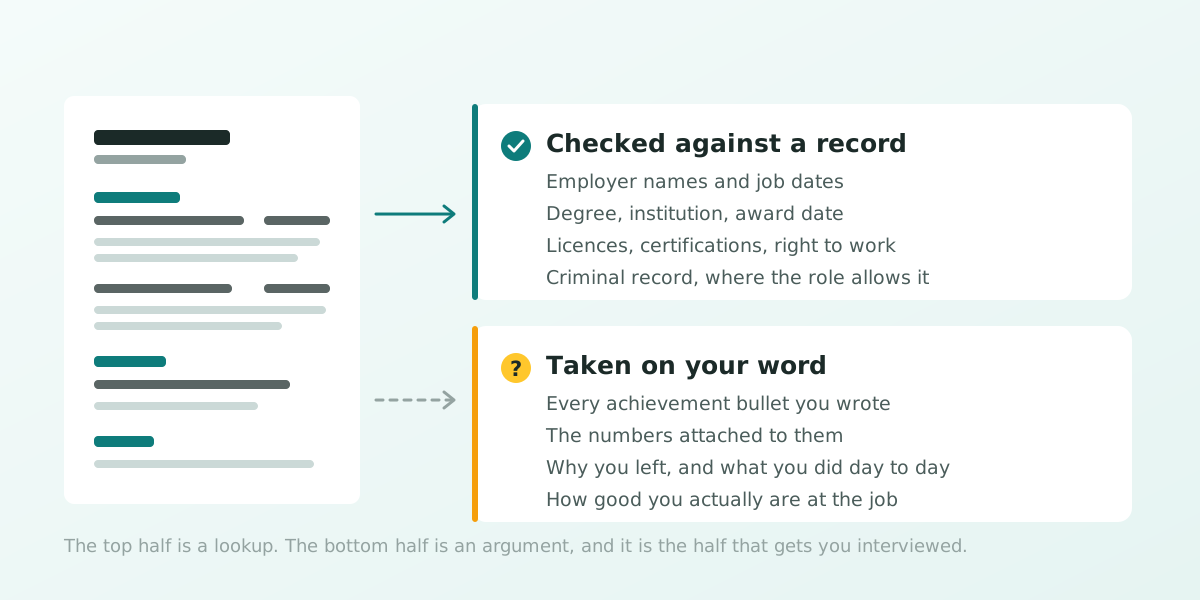
Every line on a resume falls into one of two categories. The first is facts held on a record somewhere else: who employed you, between which dates, what qualification you hold and from where, which licence you carry, and in some roles what a criminal record check returns. Someone else already wrote these down, independently of you, and an employer can go and read them.
The second is everything you wrote yourself: what you achieved, the numbers attached to it, what you were responsible for day to day, why you left, and how good you are. None of that exists on any record. It is all claim, and it is assessed by people talking to you rather than by anybody looking it up.

Your employment history is already sitting in a database
In the US, employment verification is mostly not a phone call any more. It is a query. Equifax runs a service called The Work Number, which employers and payroll providers feed automatically, and Equifax states on its own product page that the database “offers credentialed verifiers access to more than 839 million employee records”, contributed by “over 5 million employers … directly or through payroll providers”.
Sit with what that means for a moment. You did not opt in to it. Your employer sent the data as part of running payroll, most likely every pay cycle, and it has been accumulating for as long as you have been working for employers that participate. When a new employer or a lender verifies you, the answer can come back in seconds, and it comes from your former employer's payroll system rather than from a manager's memory.
This is exactly why start and end dates deserve care. Not because rounding a month is a moral failing, but because the record is precise and machine-read, and a mismatch shows up as a discrepancy rather than as a rounding. The fix is to go and read what the record says.
Your degree is the single easiest claim on the page to check
Education is the other half of the automated picture, and in the US it is close to comprehensive. The National Student Clearinghouse, a non-profit that institutions report to directly, states its coverage as 97% of currently enrolled US postsecondary students and 96% of US four-year postsecondary degrees.
So the honest position is this: if you claim a degree you did not finish, and your institution reports to the Clearinghouse as the overwhelming majority do, an employer who checks will find out, and finding out costs them a query rather than an investigation. This is the one category where the old warning is straightforwardly true.
It also means the reverse is safe. Writing “BSc Computer Science, 2019” when that is what you hold carries no risk whatsoever, and writing “Completed 90 of 120 credits toward a BSc, 2016 to 2018” for an unfinished degree is both accurate and better than the vague phrasing people reach for when they are trying not to lie and not to lose the credit either. Say what you did. The record agrees with you.
What no database holds
Here is the part nobody tells job seekers, and it is the reason so much application anxiety is misdirected. There is no record anywhere of the following:
- Every achievement bullet you wrote. No system stores the fact that you rebuilt a reporting process or trained six people.
- The numbers attached to them. A payroll database does not know your conversion rate, your ticket volume or the percentage you improved anything by.
- What you actually did all day. A job title on a payroll file is a code in an HR system, not a description of your work.
- Why you left. Many employers set a policy of confirming dates and title and declining to characterise a departure, precisely because saying more creates legal exposure for them.
- How good you are. This is what interviews, work samples and references are for, and it is why they still exist despite all the automation above.
None of that is an invitation to invent. An interviewer who asks two follow-up questions about a number you made up will find the bottom of it in about ninety seconds, and that failure is worse than the modest claim would have been. The point is different: the risk in this half is being disbelieved in a conversation, not being caught by a database. Those two risks are managed in completely different ways.
Improved reporting efficiency significantly across the team.
Cut the monthly close from 6 days to 2 by moving three manual reconciliations into a scheduled job.
The second version is not riskier than the first. It is safer, because it is specific enough to defend and specific enough to be worth asking about. Vague claims survive verification and fail interviews, which is the worst of both.
Outside the US, the machinery is different
The two-halves rule holds everywhere. What changes is how easy the first half is to look up, and job seekers in the UK, Australia, Canada and New Zealand should not assume the American picture applies to them.
United Kingdom
There is no single employer-queryable database of your work history. What exists is your own tax record. GOV.UK's guidance on getting proof of your employment history states that “you can get a record of the current and past 5 years' employment” through your personal tax account, the HMRC app, or a paper application, and gives loan applications and work visa renewals among the reasons people request one. That makes it a self-check rather than an employer lookup: you can see what HMRC holds, and an employer generally cannot.
For licensed work the position flips completely, because the licence is public. Security work is the clearest example: the Security Industry Authority publishes a register of licence holders, and GOV.UK sets out which activities need a licence, including manned guarding, door supervision and public space surveillance. A claimed SIA licence is checkable in seconds by anyone.
Australia, Canada and New Zealand
Employment history in these markets is usually confirmed the traditional way, by contacting the employer, which means the accuracy of your dates matters just as much but the check is slower and more human. Qualifications and licences are the exception again: professional registers, trade licences and regulated-occupation registrations are public or semi-public in all three, and they are checked as a matter of routine rather than as a matter of suspicion.
If a check goes wrong, there is a process and most people never use it
Background checks contain errors. Records get merged between people with similar names, an employer reports a termination date that is not the date you actually finished, a court record attaches to the wrong file. In the US, the Fair Credit Reporting Act gives you a specific procedural protection at exactly this moment, and the Federal Trade Commission spells out what an employer has to do.
Under the FTC's guidance on using consumer reports, before an employer takes an adverse action based on a background report they must give you “a notice that includes a copy of the consumer report you relied on to make your decision” plus “a copy of A Summary of Your Rights Under the Fair Credit Reporting Act”. The FTC's stated purpose for that advance notice is that it “gives the person the opportunity to review the report and tell you if it is correct”.
After the decision, the FTC says you must be told the reporting company's name, address and phone number, told that the company “did not make the decision to take the unfavorable action”, and given notice of your right to dispute the information and “to get an additional free report from the company if the person asks for it within 60 days”.
Read that as a practical instruction rather than as law. If you are rejected after a background check and a report arrives with the rejection, that report is a document you are entitled to read and correct, inside a window that is generous but not unlimited. People throw those envelopes away.
Check yourself before an employer does
This is a half-hour of work, once, and it removes an entire category of worry from every future application.
- Pull your own employment file. In the US, request your free report from The Work Number through the CFPB-listed process above. In the UK, check the current and past five years in your personal tax account or the HMRC app.
- Compare it to your resume line by line. Employer legal name, start month, end month. Payroll records sometimes carry the legal entity rather than the trading name, which is not a discrepancy but is worth knowing before someone asks.
- Fix your resume to match the record, not the other way round. If your file says you finished in March and you wrote February, change the resume.
- Write titles as they were on your contract, and put the plain-English version alongside if the official one is opaque: “Analyst II (Senior Reporting Analyst)” is honest and readable at the same time.
- Check every licence and certification number and expiry against the certificate itself, not from memory. This is the most commonly wrong thing on otherwise honest resumes.
- Dispute anything genuinely incorrect now, while no job is riding on it, rather than in the week an offer is pending.
What this changes about how you write the thing
The practical conclusion is a reallocation of effort. The verifiable half deserves accuracy and almost no creativity. The unverifiable half deserves nearly all of your attention, because it is the only half that argues for you.
- Dates: exact months, matching the record. If you have a gap, date it honestly and account for it in one line rather than stretching a neighbouring job to cover it.
- Employers: the name people know, with the legal entity in brackets if they differ.
- Titles: the contractual one, clarified rather than upgraded.
- Qualifications: exactly what was awarded, with unfinished study described as unfinished study.
- Licences: issuing body, number where it is public, and expiry.
- Everything else: specific, quantified where you can defend the number, and written to survive two follow-up questions rather than to survive a database.
If you are staring at a gap and wondering how honest to be about it, we wrote a separate piece on how to handle an employment gap. If you are changing fields and worried that describing transferable work will read as overclaiming, the career-change piece covers where that line sits.
See what a machine pulls out of your resume
The free ATS score check reads your file the way an employer's system does and shows you the fields it managed to extract, including your dates and titles.
One last framing. The reason all of this machinery exists on the verifiable half is that those facts are cheap to confirm, so employers confirm them. The reason none of it exists on the other half is that judgement cannot be automated, so it still happens in a room with a person in it. Your resume's job is to survive the first and earn the second, and it is worth being clear with yourself about which sentence is doing which.
Frequently asked questions
Does a background check show your employment history?
In the US it usually can, and quickly. Equifax's The Work Number is fed by employers and payroll providers and Equifax states it holds more than 839 million employee records from over 5 million contributing employers, so a verifier can often confirm employer, dates and sometimes income without contacting anyone. In the UK, Australia, Canada and New Zealand there is no equivalent employer-queryable database, and history is normally confirmed by contacting the employer directly.
Do employers actually check your degree?
Frequently, because it is the easiest claim on the page to confirm. The National Student Clearinghouse states it covers 97% of currently enrolled US postsecondary students and 96% of US four-year degrees, and institutions report to it directly. If you claim a qualification you did not receive, and your institution sits inside that coverage, a check will find it. Describing unfinished study accurately, with the credits and the dates, carries no such risk.
Can an employer find out why you left your last job?
Not from a database, and often not from your former employer either. Many organisations set a reference policy of confirming job title and dates only, and declining to characterise a departure, because saying more creates legal exposure for them. Some verification reports carry a rehire eligibility flag, which is a yes or no rather than an explanation. The subject usually gets settled by you being asked directly in an interview.
Can employers verify the achievements and numbers on my resume?
No system holds them, so no check confirms them. The risk with a bullet point sits in the interview, where you have to answer follow-up questions about it. That is why specific and defensible beats impressive and vague: a number you can explain the origin of is stronger than a superlative you cannot.
How do I see my own employment record before I apply?
In the US, The Work Number is a consumer reporting company, and the Consumer Financial Protection Bureau states the company will provide a free report on request and will freeze your report if you ask. In the UK, GOV.UK's guidance says you can get a record of the current and past five years' employment through your personal tax account, the HMRC app or a paper application. Check what the record says, then make your resume match it.
What happens if a background check finds a mistake?
You are entitled to a process. The FTC's guidance for employers using consumer reports says that before taking an adverse action they must give you a notice including a copy of the report and a copy of A Summary of Your Rights Under the Fair Credit Reporting Act, so that you can review it and say if it is wrong. Afterwards you must be told the reporting company's details, told that the company did not make the hiring decision, and told of your right to dispute the information and to get an additional free report if you ask within 60 days.
Should I round my employment dates to make a gap look smaller?
No, and it is the single most avoidable discrepancy in this whole area, because dates are precisely the thing that is machine-checkable. Use exact months that match the record, and handle the gap in one honest line instead. A short unexplained gap is a much smaller problem than a date that does not match a payroll file.
Is it worth freezing my employment data?
It is an option worth knowing about rather than a default. The CFPB states that The Work Number will freeze your consumer report if you request it, which stops verifiers pulling it. That is useful if you are not job hunting or applying for credit, but a freeze that is still in place when an employer or a lender tries to verify you will slow that verification down, so lift it when you are actively applying.