Pharmacy Technician Resume Sample (USA): CPhT Resume Example for 2026
Complete guide · 12 min read · Updated 2026
A pharmacy technician résumé is read for three things before anyone reads a sentence: are you certified, are you registered in this state, and can you compound. Get those three onto the page in the first inch and the rest of the document gets read. Bury them under a summary about being a detail-oriented team player and a hospital recruiter filling an IV room shift has no way to tell you apart from an applicant who has never gowned up.
Below is a complete pharmacy technician résumé sample for a US hospital and retail career, annotated section by section, plus what changes for a first application with no experience, for the retail-to-hospital move that most technicians make at some point, and for the UK where the job is a registered profession with a different gate entirely. The sample is a lead IV-room technician with seven years across a 480-bed teaching hospital and a high-volume chain pharmacy.
How does your pharmacy technician resume score?
Upload your resume and get its ATS score out of 100, with each finding quoting the line it is about. Free, no account, and the file never leaves your browser — it is read locally and scanned on the results page.
Choosing your template
A pharmacy technician résumé is a credential record wrapped around a work history, and a two-column layout separates the two halves. Single column keeps the certification attached to its date, the sterile compounding training attached to the role that required it, and the state registration attached to the state. Split those into a sidebar and an applicant tracking system can lift them apart, so "CPhT-Adv, USP <797> and <800> trained, Ohio registered" reaches a recruiter as three unconnected fragments. Hospital pharmacies screen on exactly those fields, so the layout that keeps them together is the one that gets read.
Browse all 20 templates →Section-by-section: what to write
Header and title line
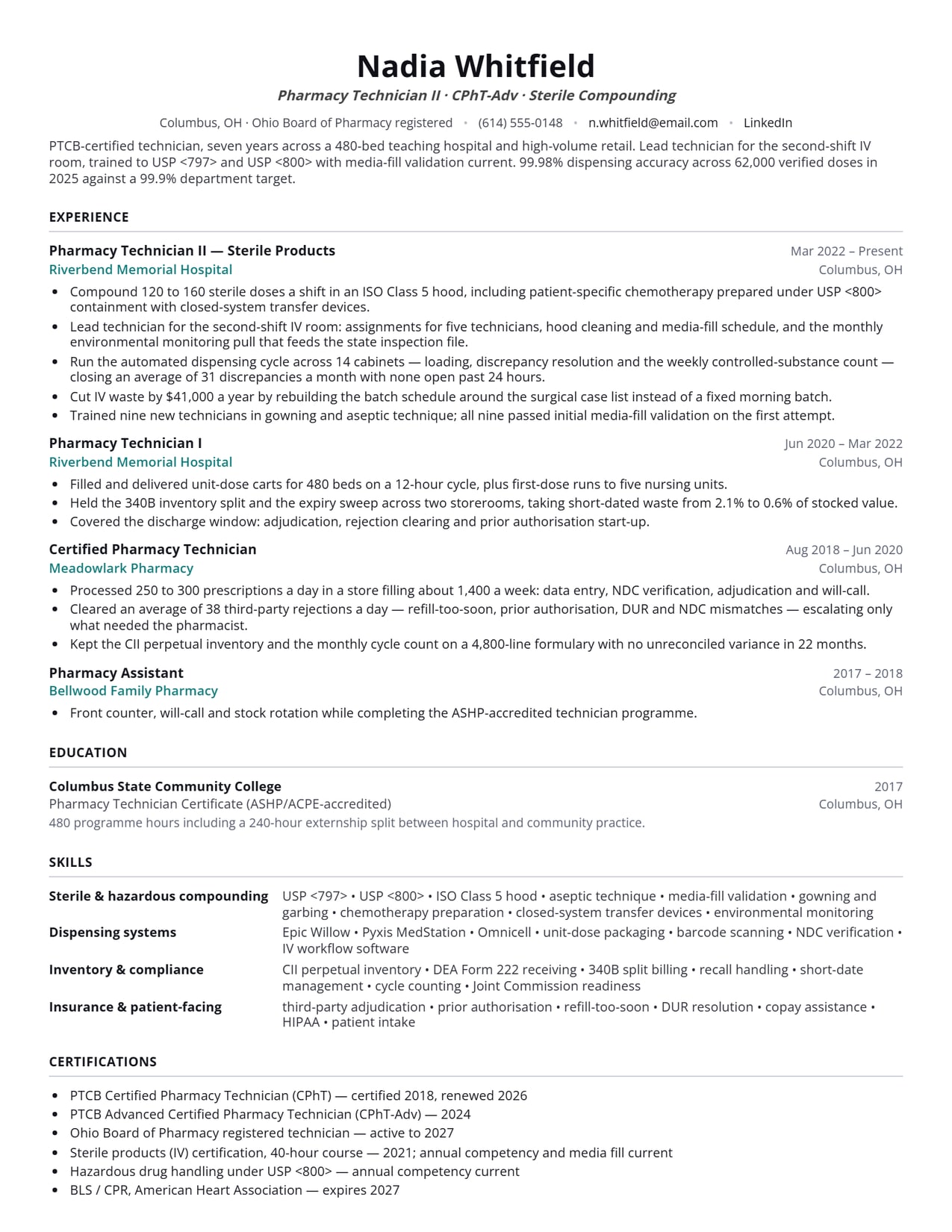
Put the credential in the title line, not at the bottom of the page. "Pharmacy Technician II · CPhT-Adv · Sterile Compounding" answers the two questions a pharmacy manager has before they read anything else. Then use the location line for the thing every pharmacy résumé leaves out: your state registration. "Columbus, OH · Ohio Board of Pharmacy registered" is eight words that clear a legal prerequisite.
Professional summary
Three lines, one of which is a number. Years, the settings you have worked in, the compounding standards you are trained to, and one accuracy or volume figure with the period attached. Skip the adjectives — every technician in the pile is careful and detail-oriented, and neither word is checkable.
Experience: the current role
Open with the compounding, the volume and the environment rather than with a verb. Doses per shift, the hood class, whether hazardous drugs are involved and whether you lead a shift tell a manager what level you operate at before any achievement lands. Then give the numbers: accuracy against the department's own target, discrepancy closure, waste reduction, and technicians trained.
The earlier years at the same employer
Split a promotion into two entries instead of collapsing it. It dates the sterile qualification, it shows progression inside one pharmacy, and it gives you somewhere to put the unglamorous work that hospital managers actually value: cart fill, first-dose runs, 340B splits and expiry sweeps.
The retail years, written for what they prove
Retail volume is the strongest thing on many hospital applications and the thing most technicians undersell. Prescriptions per day, rejections cleared per day, and a controlled-substance count with no unreconciled variance are all evidence of speed under interruption and of a clean compliance record. Write them as counts, not as duties.
The first job, kept to one line
Keep the pre-certification job and keep it short. It dates the start of your pharmacy experience and shows you were working the counter while you studied. What it must not do is take the space the certifications block needs.
Education and the training programme
Name the programme, its accreditation and its externship hours. For a technician résumé the ASHP/ACPE-accredited programme line matters more than any general education, because it is the thing a PTCB eligibility check and a hospital's own onboarding both map onto. Give the hours if you know them.
Skills, split four ways
Sterile and hazardous compounding, dispensing systems, inventory and compliance, insurance and patient-facing. Four labelled groups let a manager confirm four separate capabilities at a glance, and the split stops you writing "pharmacy software" where the posting says Epic Willow, Pyxis or Omnicell by name. Name the systems individually — that is what a search on an applicant pool actually looks for.
Certifications
Every line gets an issuing body and a date, and anything with a currency requirement gets its expiry or its last renewal. PTCB certification with the year, the advanced credential if you hold it, your state registration with its expiry, sterile products training with the course length, hazardous drug competency, and BLS. "Certified pharmacy technician" with no date and no issuer is a category rather than a record.
Pharmacy Technician resume sample, annotated
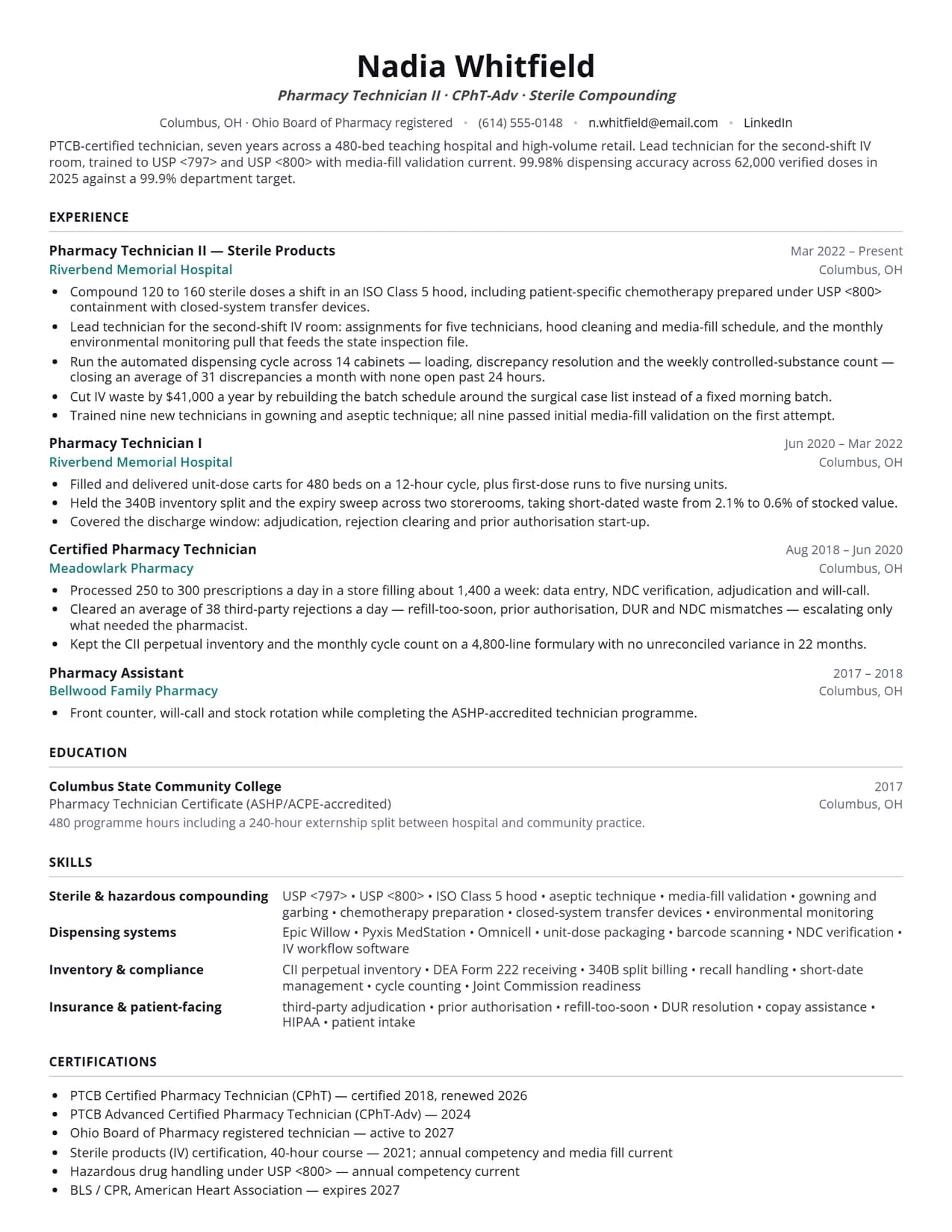
Nadia Whitfield, a lead IV-room pharmacy technician in Columbus, Ohio with seven years across a 480-bed teaching hospital and a high-volume chain pharmacy, certified by PTCB and trained to USP <797> and <800>
Seven years, four employers, four labelled skill groups and a six-line certifications block on one page. Read it as a structure to copy rather than wording to copy, and pay attention to where the annotations say it falls short, because a sample that only praises itself teaches nothing.
The annotations follow the page top to bottom, in the order a pharmacy manager reads it.
Header and title line
"Pharmacy Technician II · CPhT-Adv · Sterile Compounding" is the best decision on the page. Level, credential and capability arrive together before anything else is read, which is exactly the set a manager filling an IV room shift needs. Most technician résumés leave all three scattered between a summary paragraph and a certifications block at the bottom.
The location line
"Columbus, OH · Ohio Board of Pharmacy registered" does two jobs in six words. It says which market this application fits and it clears a legal prerequisite that otherwise sits unanswered until someone asks. Almost no technician résumé puts the registration up here, and it costs nothing.
Professional summary
Three lines carrying seven years, two settings, both compounding standards, current media-fill validation and an accuracy figure with its denominator. The strongest phrase is "against a 99.9% department target", because it turns a percentage into a comparison, and a comparison is what makes a number mean something.
First entry: the compounding line
"Compound 120 to 160 sterile doses a shift in an ISO Class 5 hood, including patient-specific chemotherapy prepared under USP <800> containment" names the volume, the environment and the risk class before describing a single duty. Compare it with the "prepared medications accurately" that opens most résumés in this field, which would equally describe a first-week trainee.
The lead technician bullet
Shift assignments, hood cleaning, the media-fill schedule and the environmental monitoring pull that feeds the state inspection file. The inspection clause is doing the quiet work: it says this technician is trusted with the evidence a regulator looks at, which is a different claim from being able to compound.
The discrepancy bullet
"31 discrepancies a month with none open past 24 hours" is the controlled-substance claim written properly. The count shows the scale of the cabinet estate, the closure window shows the discipline, and neither is an adjective. This is the line most technicians leave out entirely.
The waste reduction bullet
$41,000 a year, with the mechanism attached — rebuilding the batch schedule around the surgical case list instead of a fixed morning batch. A saving with no method behind it reads as a number someone was told to include; a saving with a method reads as something the applicant actually did.
Splitting the promotion into two entries
The same hospital appears twice, which dates the move into sterile products and gives the cart-fill years somewhere to live. The 340B and expiry-sweep bullet is the one that would be cut first by most people and it should not be: it is inventory accountability with a percentage attached.
The retail years
"250 to 300 prescriptions a day in a store filling about 1,400 a week" is the sentence that makes a hospital application from a retail background credible. The rejection-clearing count next to it proves the insurance half, and the CII line with no unreconciled variance in 22 months is the trust claim. Three bullets, three separate arguments.
The first job, kept to one line
Correctly sized. It dates the start of the pharmacy experience, shows the counter work happening alongside the training programme, and then gets out of the way. Two paragraphs on a job that ended in 2018 would have cost the certifications block its space.
Skills, split four ways
The first row is what makes this résumé surface when a hospital searches an applicant pool for USP <800> or media-fill validation. The weakness is the template's own heading: "Skills" undersells a block whose first row is a compounding qualification and whose third row is a compliance record.
Certifications at the bottom
Every line carries an issuing body and a date, and the currency-bearing ones carry an expiry. The placement works only because the title line already carried the credential; without that, this block belongs directly under the summary. Note that the sterile products entry gives the course length, which is the detail a hospital uses to judge whether your training maps onto theirs.
The honest gap
There is no immunisation line, and in states that authorise technicians to administer vaccines that is a real omission worth a row of its own. There is also no mention of the competency assessments behind the compounding claims. Bring those records to the interview; the résumé's job is to get you into the room.
What a pharmacy manager checks in the first few seconds
Technician hiring is a credential problem before it is a judgement problem. A pharmacy has a shift to cover, a set of tasks that some technicians are legally and practically able to do and others are not, and a stack of applications. The first pass is a short series of yes-or-no checks rather than a considered read, and a gap at any one of them ends it.
Five questions, roughly in this order.
Turn pharmacy duties into evidence: eight rewrites
Every line below is a real thing technicians write. The rewrite carries the same fact and adds the scale, the standard or the comparison that makes it worth reading.
Instead ofPrepared IV medications for patients.
WriteCompound 120 to 160 sterile doses a shift in an ISO Class 5 hood, including patient-specific chemotherapy prepared under USP <800> containment with closed-system transfer devices.
The first sentence describes every IV technician who has ever held the job. The second gives the volume, the environment, the risk class and the containment method, which is what a manager needs to place you.
Instead ofCertified pharmacy technician.
WritePTCB Certified Pharmacy Technician (CPhT) — certified 2018, renewed 2026; Ohio Board of Pharmacy registered technician, active to 2027.
The credential and the registration are two different things, and both are dated documents. Writing them as records rather than as a category is the difference between a claim and something verifiable.
Instead ofMaintained a high level of accuracy.
Write99.98% dispensing accuracy across 62,000 verified doses in 2025, against a 99.9% department target.
An accuracy claim is worth nothing without a denominator and a period, and worth a great deal with a comparison. All three are things your pharmacy already measures.
Instead ofHandled controlled substances.
WriteRan the weekly controlled-substance count across 14 automated cabinets, closing an average of 31 discrepancies a month with none open past 24 hours.
This is a trust claim, and trust claims need a mechanism and a closure window. The version with numbers is one of the strongest lines a technician can put on a page.
Instead ofManaged pharmacy inventory.
WriteHeld the 340B inventory split and the expiry sweep across two storerooms, taking short-dated waste from 2.1% to 0.6% of stocked value.
Inventory work is invisible until it is expressed as money or as a percentage of stocked value. The before-and-after is what makes it an achievement rather than a task list.
Instead ofWorked in a busy retail pharmacy.
WriteProcessed 250 to 300 prescriptions a day in a store filling about 1,400 a week: data entry, NDC verification, adjudication and will-call.
"Busy" is an adjective every applicant uses. The volume figure with the store's own weekly throughput next to it is the same claim, made checkable.
Instead ofDealt with insurance issues.
WriteCleared an average of 38 third-party rejections a day — refill-too-soon, prior authorisation, DUR and NDC mismatches — escalating only what needed the pharmacist.
Naming the rejection types shows you have actually worked the queue, and the escalation clause shows you know where your authority stops, which is what a pharmacist is really asking.
Instead ofHelped train new technicians.
WriteTrained nine new technicians in gowning and aseptic technique; all nine passed initial media-fill validation on the first attempt.
A pass rate is the only version of this claim that means anything, and it tells a manager you can be given a new hire in a clean room without supervision.
A first pharmacy technician application: what actually counts
Nobody starts certified and registered, and pharmacies hire trainees and newly qualified technicians constantly, so this is a normal application rather than a weak one. What changes is what the page leads with.
What to lead with, by kind of pharmacy
The same seven years should be arranged differently depending on where you are sending it. This is the edit most technicians never make, and it costs them interviews at the pharmacies they most want.
| Where you are applying | Lead with | Do not bury |
|---|---|---|
| Hospital inpatient / IV room | USP <797> and <800> training, hood class, doses per shift, competency currency | Automated cabinet work and discrepancy closure |
| Retail chain | Prescriptions per day, adjudication and rejection clearing, will-call flow | Controlled-substance counts and immunisation training |
| Independent community pharmacy | Breadth: ordering, compounding, counter work, delivery, patient relationships | Inventory accountability and short-date management |
| Long-term care / closed-door | Cart fill volume, cycle packaging, facility coordination, bulk order accuracy | Recall handling and expiry sweeps |
| Specialty and infusion | Sterile compounding, cold chain, prior authorisation and copay assistance | Payer-specific documentation and patient onboarding |
| Mail order and central fill | Throughput per hour, barcode verification, error rate at scale | Systems experience and any automation you have run |
Certifications, written so a manager can act on them
This block is short and it is the one most often written carelessly. Three rules cover it.
First, name the issuing body and date it. PTCB, which issues the CPhT and the advanced CPhT-Adv credential, states that certification is renewed every two years, so a credential with no year does not tell a reader whether it is current. Write the year you certified and the year you last renewed.
Second, separate the certification from the registration. Certification is a national credential you hold; registration is permission from a state board to work in that state, and it has its own expiry. A résumé that shows one and not the other leaves a manager with a question they have to ask before they can shortlist you.
Third, date the competencies, not just the training. Sterile products training with the course length, hazardous drug handling with the last annual competency, and media-fill validation with its date. Currency is the question the pharmacy is actually asking, and a training certificate from 2019 with no competency date does not answer it.
Outside the US: the same résumé, a different gate
The structure of this page travels unchanged. What changes is the credential that decides whether you can be employed at all, and naming it wrongly is the quickest way to look like an outsider to the profession.
In England the job is a registered profession rather than a certified one. The NHS's careers guidance states that you complete a two-year accredited pharmacy technician course involving a mix of practical work experience and study, and then register with the General Pharmaceutical Council and practise as a qualified pharmacy technician. So a UK CV leads with the accredited course and the GPhC registration, and a US certification is supporting evidence rather than the headline. The document is a CV rather than a résumé.
Wherever you are applying, write the credential exactly as it reads on the certificate and do not translate it into another country's vocabulary. A recruiter checking your file is looking for the words on the document.
The checks that come after the résumé
Pharmacy is one of the fields where the offer arrives wrapped in verification. Certification is confirmed against the certifying body's register, state registration against the board, and employment history and criminal record through a background screening company. None of that is unusual and none of it is a reason for anxiety, but it does change how you should write the page.
Write dates you can stand behind, name credentials exactly as they read, and do not round an accuracy figure upward. Everything on a technician's résumé that matters is checkable, which is precisely why the checkable version of each claim is also the persuasive one.
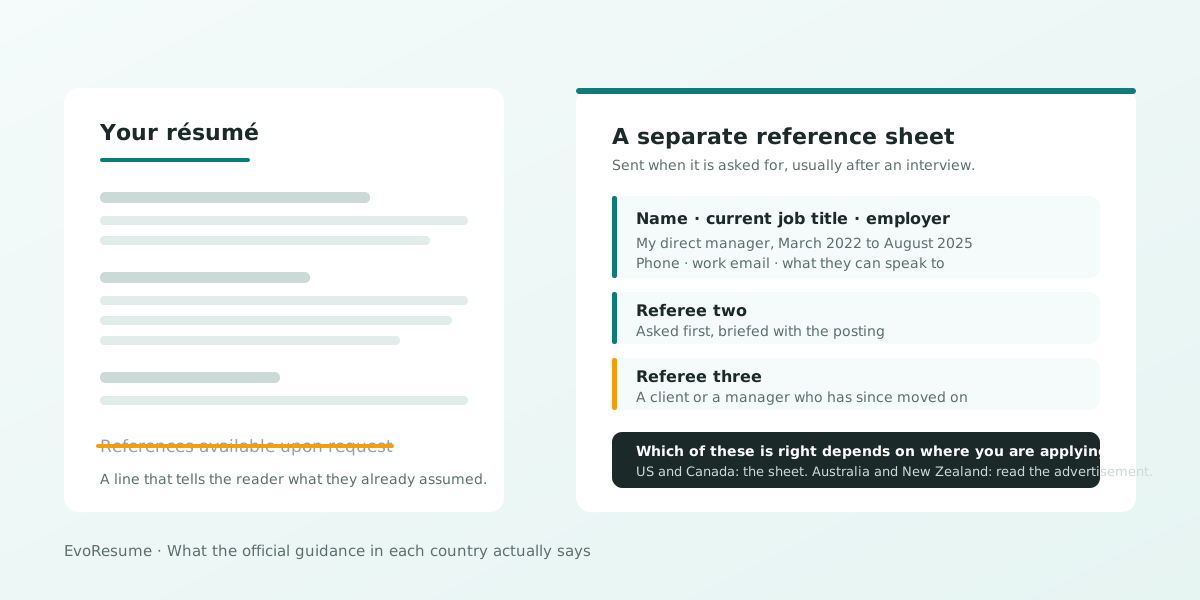
Line your referees up before you need them, and make sure the supervisor who signed off your sterile competency is one of them. Our guide to references on a résumé covers what a former employer is allowed to say, and what to do when the obvious referee has moved on.
Keywords ATS looks for
Weave these into your resume where they’re true to your experience, and always mirror the exact wording from the specific job post you’re applying to.
Common mistakes to avoid
Pharmacy Technician resume: FAQ
What should a pharmacy technician put on a resume?
Certification with its issuing body and date, state board registration with its expiry, the compounding standards you are trained to, and the systems you have actually used by name. Then two or three numbers a manager can check: prescriptions or doses per shift, accuracy against the department's own target, discrepancies closed, and short-dated waste as a share of stocked value. Patient-facing and insurance work comes after those, because the screening questions are about credential and capability first.
Do I need to be certified to work as a pharmacy technician?
It depends on the state and the employer, but certification is the thing that makes you portable. PTCB, which issues the CPhT credential, lists the requirements as residing in the United States or its territories, completing a PTCB-recognised education or training programme or the equivalent work experience, full disclosure of criminal and state board actions, compliance with its certification policies, and a passing score on the Pharmacy Technician Certification Exam. The work-experience route is set at a minimum of 500 hours. PTCB states that certification is renewed every two years.
What is the difference between CPhT and CPhT-Adv on a resume?
They are two separate PTCB credentials, and both are renewed on a two-year cycle. Write them as separate lines with their own dates rather than merging them, because a hospital hiring for a lead or specialist role is often screening for the advanced credential specifically. If you hold only the CPhT, do not write anything that implies otherwise — it is verifiable in seconds.
How do I write a pharmacy technician resume with no experience?
Lead with the things that can be checked rather than with enthusiasm. Your training programme and its accreditation, the externship hours and where they were served, your state registration or the fact that your application is filed, your certification or your exam date, and any BLS certification. Then evidence of the same behaviour elsewhere: a job with cash accountability, a job with a counting or checking procedure that had to be followed exactly, a job with interruptions and a queue. One line about a real procedure you followed beats a paragraph about wanting to help people.
How do I move from retail pharmacy to a hospital pharmacy?
Reframe the volume as evidence and add the one thing hospitals screen for that retail does not give you. Retail proves speed under interruption, third-party adjudication and a clean controlled-substance record, so write those as counts. What is usually missing is sterile compounding, so name any IV training you have, including a course you paid for yourself, and say plainly that you are trained to USP <797> and, if applicable, <800>. If you have none, apply anyway and say what you have done toward it — hospitals train technicians into IV rooms routinely, but they need to see you know the standard exists.
How long should a pharmacy technician resume be?
One page for anything under about ten years. Pharmacy hiring runs at volume, the screening is credential-first, and technician work compresses well because most of what matters is a certification, a training list, a systems list and a handful of numbers. The sample on this page is seven years and four employers on one page, which is what it looks like written tightly rather than cut.
What is a pharmacy technician called outside the US, and does the resume change?
The structure travels; the gate does not. In England the role is a registered profession: the NHS careers guidance states that you complete a two-year accredited pharmacy technician course combining practical work experience and study, then register with the General Pharmaceutical Council and practise as a qualified pharmacy technician. Lead a UK CV with that registration and the accredited course rather than with a US certification, and call the document a CV. In both markets, name the credential exactly as it reads on the certificate.
Should I put references on a pharmacy technician resume?
Not in the US or Canada — keep them on a separate sheet and send it when it is asked for. Pharmacy is one of the fields where the reference arrives bundled with licence verification and a background check, so line your referees up early and make sure the person who supervised your sterile competency is one of them. Our guide to references on a résumé covers what a former employer is allowed to say and what to do when the obvious referee is not available.