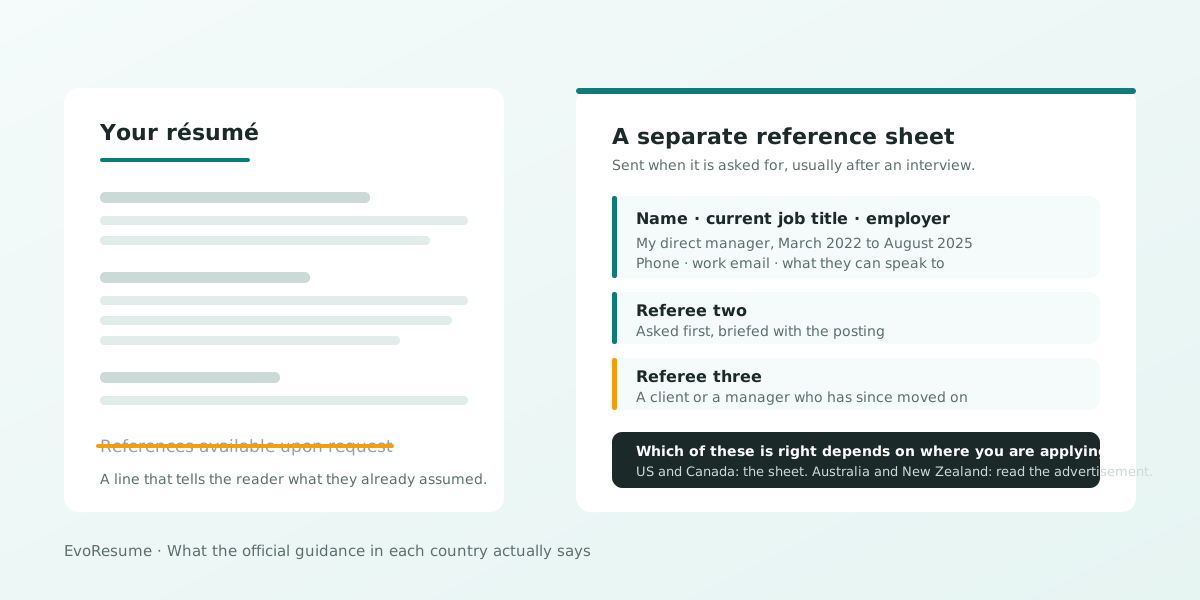
Type the question into a search box and you get one answer, stated with total confidence: never put references on a resume, and never write "references available upon request" either. It is the most repeated rule in résumé advice, and in the United States and Canada it is genuinely good advice.
It is also the reason a lot of applications in Britain, Australia and New Zealand arrive looking half-finished. In those markets the referee is often something the employer expects to see at the point you apply, and the New Zealand government's own careers service tells people to put referees in the CV when the advertisement asks for them. The confident global rule turns out to be a local convention that travelled.
So this piece answers the question properly. What each country's guidance actually says, what a reference sheet should contain when one is requested, how to brief the person giving it, what a former employer is and is not allowed to say about you, and what to do when the obvious referee is not available.
What each country's guidance actually says
This is the part almost nobody checks, so here it is from the source in each market.
- Canada. The Government of Canada's Job Bank guidance on writing a résumé is unambiguous: "An employer only requires references if they are seriously considering hiring you. Keep references on a separate sheet and provide them only when they are specifically requested."
- New Zealand. Tahatū, the New Zealand government's careers service, starts from the opposite default. Its guide to writing a CV says to include referees in your CV if the job ad asks for them, that you need contact details for at least two, and that one should be your current or former manager or supervisor. If the ad does not ask, it says to write "Referees available on request".
- Australia. SEEK, the country's largest job board, gives its candidates the same shape of answer in its guide to résumé references: "Unless you've been specifically asked to include references on your resumé, there's usually no need to list them", with "References available on request" as the line to use instead, and three to five referees lined up behind it.
- United Kingdom. There is no official line on where referees go, because the British convention moved the question off the CV entirely: most employers collect referee details on the application form, and the reference itself is usually taken after an offer. What GOV.UK does define is the reference, which is covered further down.
- United States. No government guidance and no ambiguity in practice: a separate reference sheet, produced when asked, usually after a first or second interview.

"References available upon request" — dead weight, with two exceptions
In a US or Canadian résumé the phrase is a line of text telling the reader something they already assumed. Everyone has references. Nobody has ever refused to supply them. It occupies a line that could carry a certification or a number, and it makes the page read as though it came off a template from 2004.
Two exceptions, and they are real ones rather than hedging.
- You are applying in Australia or New Zealand and the ad did not ask. Both sets of guidance above name that phrase as the correct thing to write. Using it there is convention, not staleness.
- The referee is the argument. If your reference is a named authority in a small field and saying so would carry weight, then the vague version is the wrong version anyway. Name them, with their permission, in the covering note where it can do some work.
One thing worth knowing if you are still building the document rather than deciding what to call the last line: everything on the page competes for space with the parts a screening system actually reads. Our note on pulling keywords out of the job description is a better use of a spare line, and the free ATS score check will show you which of the posting's terms your résumé is missing.
The reference sheet: what actually goes on it
When it is requested, send a separate one-page document carrying the same header as your résumé — same name, same phone number, same typeface. It should look like page two of the same application rather than something typed in a hurry.
Each entry needs six things, in this order.
- Full name, with the title they use professionally.
- Current job title and employer, not the title they held when you worked together. The person calling wants to know who is vouching for you now.
- Relationship, and the period it covers. "My direct manager at Halloway Logistics, March 2022 to August 2025." This is the line most reference sheets leave out and the one that makes the rest usable.
- Phone number, direct where possible.
- Email address, the work one.
- What they are best placed to speak to. One clause: "can speak to the warehouse system migration and to how the peak season staffing gap was handled".
Sarah Whitcombe — former manager. [email protected]
Sarah Whitcombe, Operations Director, Halloway Logistics. My direct manager, March 2022 to August 2025. (614) 555-0143 · [email protected]. Best placed to speak to the WMS migration and the 2024 peak season staffing plan.
Three referees is the working number for most applications, and two is enough early in a career. Order them deliberately, strongest and most senior first, because the first call is often the only call.
Choosing referees, and the one people forget
The instinct is to pick whoever liked you most. The better instinct is to pick whoever's account is hardest to wave away, which is usually someone who supervised your work directly and can describe a specific thing you did.
- A direct manager beats a senior name. A vice-president who barely worked with you gives a warm, vague reference that sounds exactly like a warm, vague reference.
- A client or a customer counts, particularly for contract, agency and freelance work where there may be no single employer to point at. If your history is fragmented, our guide to listing contract and temp work covers the same problem on the résumé itself.
- A colleague at your own level is a fallback, not a choice. Use one when the manager is genuinely unavailable, and say on the sheet why they are there.
- The one people forget: a former manager who has since moved on. They often make the best referee you have. They know your work, they no longer have a stake in your current employer's view of you, and they are usually pleased to be asked.
- Not a family member, and not a friend with no working relationship. It is checkable, and it reads as a hole where a professional referee should be.
How to brief a referee so the call goes well
Most references are mediocre for a dull reason: the person giving it does not know which job you are going for, so they improvise. Five lines of email fixes that, and it is the highest-return ten minutes in a job search.
- The role and the employer, with a link to the posting.
- Two or three things the job needs most, lifted out of the posting in its own words.
- One specific thing you worked on together that demonstrates one of them, with enough detail that they could tell the story.
- When to expect contact, and by what method.
- A line giving them permission to decline. A lukewarm referee who felt trapped into agreeing is worse than no referee at all.
Send it as soon as you know a reference is coming rather than after the request lands. Then tell them how it ended, either way. The person who took a call for you is the person you will need again in three years.
What a former employer is allowed to say
This is the anxious half of the subject, and the country that has written it down most plainly is the UK. GOV.UK's guidance on employment references sets out three things.
- An employer "does not usually have to give a work reference", so silence is a legitimate answer rather than a sign that something went wrong.
- "If they give a reference it must be fair and accurate." That is the standard: a lower bar than positive, a much higher one than whatever they feel like saying.
- A reference "can be brief – such as job title, salary and when you were employed", and it "can include details about your performance and if you were sacked".
GOV.UK also names the exception. Employers must give a reference if there is a written agreement to do so, or if "they're in a regulated industry, like financial services". If you are moving between regulated firms, the reference is neither optional nor brief.
Elsewhere the position is looser and the practical outcome converges anyway. Large employers in the US, Canada and Australia commonly run a policy of confirming job title and dates and declining to characterise anything else, because saying more creates exposure for them. Assume that is what your former employer will do, and build your list from people who will answer as themselves rather than from an HR line that will confirm you existed.
When a screening company makes the call, you get rights
There is a distinction almost nobody draws, and in the United States it changes what you are owed. A hiring manager ringing your old boss is one thing. An employer paying a background screening company to verify your history is a different thing legally, because the report that company produces is a consumer report and the Fair Credit Reporting Act attaches to it.
The Federal Trade Commission and the Equal Employment Opportunity Commission set out the employer's obligations in their joint guidance on background checks. Before the check, the employer must "tell the applicant or employee you might use the information for decisions about his or her employment" — a notice that must be "in writing and in a stand-alone format" — and must "get the applicant's or employee's written permission to do the background check".
What matters more is what happens if the report sinks you. The guidance requires the employer to tell you that you were rejected because of information in the report, to give you "the name, address, and phone number of the company that sold the report", to explain that the company selling the report "didn't make the hiring decision, and can't give specific reasons for it", and to tell you that you have "a right to dispute the accuracy or completeness of the report, and to get an additional free report from the reporting company within 60 days".
When you do not have a good reference
Four situations cover nearly every version of this, and none of them is fatal.
- You cannot ask your current employer. Normal, and universally understood. Write "current employer, by arrangement after an offer" on the sheet and give two others. Nobody expects you to announce your resignation in order to apply.
- The relationship ended badly. Do not list them, and do not hide the job either. Choose a colleague, a client or a second-line manager from the same period so those dates are still covered by somebody.
- The company no longer exists. Find the person, not the business. A former manager's personal email is a perfectly good referee contact, and a payslip, contract or P45 covers the fact of employment if the fact is what is in question.
- It is your first job. A tutor, a placement supervisor, a volunteer coordinator or a coach are all real referees. Tahatū's guidance names exactly that kind of person — a teacher, a sports coach — as an acceptable second referee alongside a manager.
A hole in your history is a different problem from a hole in your reference list, and the two get confused. If the underlying worry is a period you are not sure how to present, explaining an employment gap deals with that half.
Get the résumé right before the references matter
Paste the job posting and see which of its terms your résumé is missing. The score check is free to run.
The whole thing, in seven lines
- In the US and Canada, references go on a separate sheet and are sent when they are asked for.
- In Australia and New Zealand, "referees available on request" is still the normal line, and referees go in the document when the advertisement asks for them.
- The advertisement outranks every convention above it.
- A reference sheet entry names the referee's current title, the relationship, the exact period and one thing they can speak to.
- Ask before you list anyone, and brief them with the role, the posting and one story.
- In the UK a reference is usually optional but must be fair and accurate, and it can be as short as title, salary and dates.
- If a screening company produced the report that cost you the job, you are owed its source and a free copy within 60 days.
One field where all of this lands at once is regulated healthcare, where the reference, the licence check and the certification dates are handled as a single pre-employment package. The pharmacy technician résumé sample shows what the written half looks like when the credential and the verification trail are treated as part of the document rather than as an afterthought.
Frequently asked questions
Should you put references on a resume?
In the United States and Canada, no. The Government of Canada's Job Bank guidance says an employer only requires references if they are seriously considering hiring you, and to keep them on a separate sheet provided only when specifically requested. In New Zealand and Australia the default is different: Tahatū, the New Zealand government careers service, tells people to include referees in the CV if the job ad asks for them and to write "Referees available on request" if it does not. Whichever country you are in, the advertisement's own instruction comes first.
Is "references available upon request" outdated?
In an American or Canadian résumé, yes — it spends a line telling the reader something they already assume. In Australia and New Zealand it is still the conventional line to use when the advertisement has not asked for referees, which is why the same phrase gets called dated by one guide and recommended by another. Check which market you are writing for before you delete it.
How many references should I have?
Three is the working number for most applications, and two is enough early in a career. SEEK suggests between three and five for Australian candidates to give a rounded impression, and Tahatū tells New Zealanders to have contact details for at least two, one of whom should be a current or former manager or supervisor. Line up more than you expect to need, because the first person called may be on holiday.
What should a reference sheet include?
One page with the same header as your résumé, then each referee's full name, their current job title and employer, your relationship to them with the exact dates it covered, a direct phone number, a work email address, and one clause saying what they are best placed to speak to. The relationship line is the one most people leave out, and it is what turns a list of names into something a hiring manager can use.
What can a former employer legally say about you?
In the UK, GOV.UK states that an employer does not usually have to give a work reference, but if they do it must be fair and accurate. It can be brief — job title, salary and when you were employed — and it can include details about your performance and whether you were sacked. Employers must give one where there is a written agreement, or where they are in a regulated industry such as financial services. Elsewhere the position varies, and many large employers voluntarily limit references to title and dates because saying more creates exposure for them.
Can a former employer refuse to give a reference?
In most cases yes, and it is not a sign that something went wrong. GOV.UK is explicit that an employer does not usually have to give one. The exceptions are a written agreement to provide one and regulated sectors such as financial services. If you expect a former employer to decline, do not leave that period uncovered — find a manager, colleague or client from the same job who will speak as an individual.
When in the hiring process are references checked?
Usually late: after a first or second interview, and often after a verbal offer stated as subject to satisfactory references. That timing is why the reference sheet is a separate document rather than part of the résumé, and it is why you have time to brief your referees once an offer is close. Regulated sectors and roles working with children run the checks earlier and more formally.
What if a background check company gets my employment history wrong?
You have a right to correct it. The FTC and EEOC's joint guidance for employers requires that when someone is rejected because of information in a background report, they are told the name, address and phone number of the company that sold the report, that the company selling it did not make the hiring decision and cannot give specific reasons for it, and that they have a right to dispute the accuracy or completeness of the report and to get an additional free report from the reporting company within 60 days. Dates and job titles are the fields that most often come back wrong.