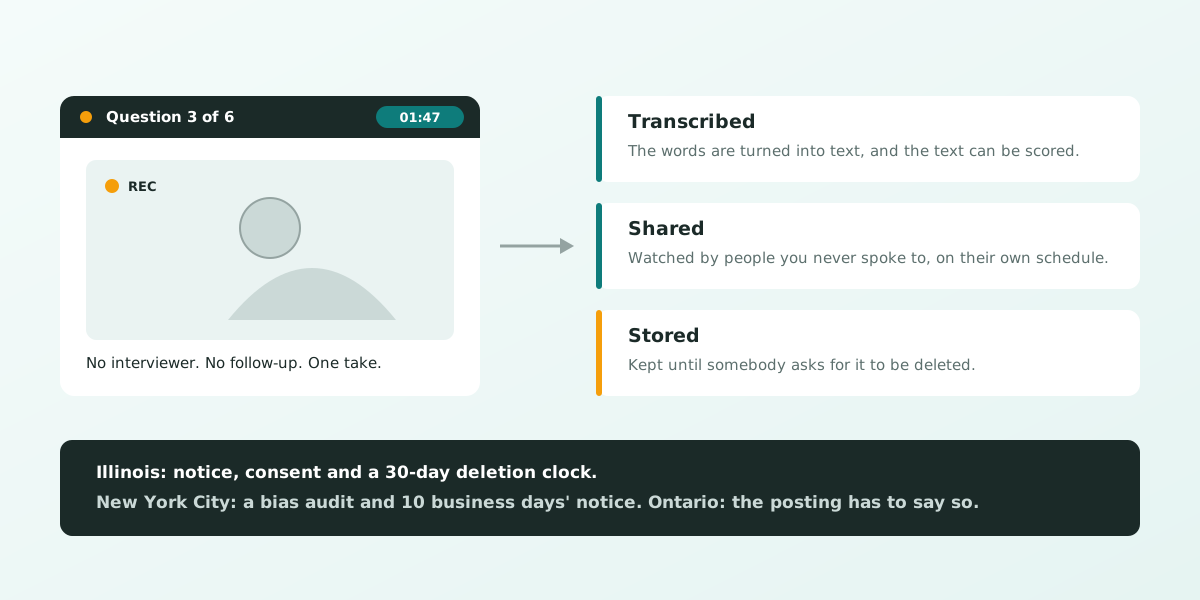
A link arrives, usually with a deadline of two or three days. You click it, a browser tab asks for your camera and microphone, and a question appears on screen with a countdown next to it. There is no interviewer. There is no way to ask what they meant. You speak into a lens for two minutes, the timer runs out, and the next question loads.
Almost everything written about this format is advice on how to perform in it: look at the lens, tidy the background, smile. That advice is fine and it is not the interesting part. The interesting part is what happens after you press submit, because a one-way video interview is the only stage of a job application that produces a permanent recording of your face and voice, held by a company you have no relationship with, for a length of time nobody told you.
This piece is about that half. What the systems do with the file, what a data protection regulator found when it actually audited the vendors, where the law gives you a right to notice or deletion, and how any of it should change the way you record.
What a one-way video interview is, mechanically
The format goes by several names. One-way, asynchronous, on-demand, pre-recorded, or the vendor's product name. They all describe the same thing: a screening round in which you record answers to fixed questions, alone, before a deadline, and a recruiter watches them later or never watches them at all.
Three settings are chosen by the employer before you ever see the link, and they change the experience completely.
- Preparation time. Anything from zero to a minute between the question appearing and the recording starting. Zero is common and is the setting most likely to catch out someone who has not done one before.
- Retakes. None, a fixed number per question, or unlimited. If the platform does not say, assume none.
- Answer length. A hard cap, usually between 60 seconds and three minutes, and the recording stops when it stops. An answer that is still building at the cutoff is submitted unfinished.
The reason employers use it is volume. One recruiter can work through forty recorded answers in the time two live phone screens would take, and the candidate does the scheduling. That is a real efficiency and it is why the format keeps spreading. It is also why the recording exists at all, and the recording is where everything else in this article comes from.

Is a machine scoring you? Usually the transcript, sometimes nothing
This is the question everyone asks and the one the industry has been least clear about, partly because the honest answer changed a few years ago.
The early promise of these products was that software could read your face. Micro-expressions, eye movement, how animated you were, all scored against a model of what a good hire looks like. That is the version that lodged in the public imagination, and it is largely gone.
HireVue, the best-known vendor in the category, dropped facial analysis from its assessments and said so publicly in January 2021. Fortune's report at the time quotes the company's chief data scientist saying that in most cases nonverbal data "contributed about 0.25% to a model's predictive power", rising to roughly 4% for customer-facing roles, and the chief executive saying that set against the concerns people were having, "it wasn't worth the incremental value". The company had commissioned an audit from O'Neil Risk Consulting and Algorithmic Auditing, the firm founded by the mathematician Cathy O'Neil.
Two findings from that audit are worth carrying with you into any recorded interview, because they are about the parts that did not get removed. The auditors recommended investigating whether candidates with different accents were assessed differently, and they noted that candidates from minority groups were disproportionately flagged for human review when they gave short answers.
What replaced facial scoring is language. Your answers are transcribed, and the transcript is treated much the way an applicant tracking system treats your résumé: as text to be searched, matched and ranked. The UK Information Commissioner's Office, describing the category it audited, lists selection tools that score "candidate competencies and skills from written responses to interview questions and text transcriptions of in-person or video interviews".
That single sentence is the most useful thing in this article. If the scoring happens on a transcript, then a one-way video interview is a spoken keyword problem as much as a performance problem, and it rewards the same discipline that a résumé does: name the tool, name the standard, name the number, out loud, in a full sentence. "I used the CRM" and "I worked the queue in Salesforce Service Cloud, about sixty tickets a day" transcribe very differently.
And sometimes nothing is scoring you. Plenty of employers use these platforms purely as a recording tool, watch every submission themselves, and run no analysis at all. You are rarely told which situation you are in, which is exactly the problem the rules below are trying to fix.
What a regulator found when it audited the vendors
In November 2024 the UK's Information Commissioner's Office published AI tools in recruitment: audit outcomes report, the results of consensual audits of companies that build and supply AI sourcing, screening and selection tools. It is the only document of its kind in this market: a regulator with statutory powers looking inside the products rather than reading their marketing.
The ICO made "almost 300 recommendations to improve compliance", and reports that all of them were accepted. Four findings are worth quoting, because they describe things being done to candidates who were not told.
- Some tools "estimated or inferred people's gender, ethnicity, and other characteristics from their job application or even just their name, rather than asking candidates directly". The ICO adds that this inferred information "is not accurate enough to monitor bias effectively" and "was often processed without a lawful basis and without the candidate's knowledge".
- Some search features "could lead to discrimination by having a search functionality that allowed recruiters to filter out candidates with certain protected characteristics".
- The regulator was "concerned to find tools that collected far more personal information than was needed", and in some cases information "was scraped and combined with other information from millions of peoples' profiles on job networking sites and social media" to build databases recruiters could market vacancies into. "Recruiters and candidates were rarely aware that information was being repurposed in this way."
- Several AI providers "incorrectly defined themselves as processors rather than controllers", with contracts that "appeared to be deliberately broad or left recruiters in the dark" about who was responsible for what.
The report also notes what it deliberately left out, and that gap matters here: the audits did not cover AI used to process biometric data, "such as emotion detection in video interviews", because the ICO was producing separate guidance on biometrics. So the most alarming category is not covered by these findings in either direction.
The report is not all criticism. It records providers who gave recruiters clear configuration choices that avoided collecting unnecessary information, and others who published detailed explanations of how their models worked. The point of reading it as a candidate is narrower: it tells you the practices are uneven, and that the difference between a careful vendor and a careless one is invisible from where you sit.
Where the law actually gives you something
There is no single rule covering recorded interviews, and most of the world has nothing specific at all. What exists is a short list of jurisdictions with real, checkable requirements. Knowing which one you are in tells you what to ask for.
Illinois: notice, consent, and a 30-day deletion clock
Illinois has had the most direct rule in the world on this since the start of 2020. The Artificial Intelligence Video Interview Act (820 ILCS 42) applies to an employer that asks applicants to record video interviews and uses an AI analysis of them for positions based in Illinois. Before asking for the video, the employer must do three things: section 42/5 requires it to notify you that AI may be used to analyse the interview, to give you "information before the interview explaining how the artificial intelligence works and what general types of characteristics it uses to evaluate applicants", and to obtain your consent. An employer "may not use artificial intelligence to evaluate applicants who have not consented".
Two more provisions are worth knowing. The employer may not share your video "except with persons whose expertise or technology is necessary in order to evaluate an applicant's fitness for a position". And section 42/15 gives you a deletion right with teeth: on your request, employers "within 30 days after receipt of the request, must delete an applicant's interviews and instruct any other persons who received copies of the applicant video interviews to also delete the videos, including all electronically generated backup copies".
New York City: a bias audit, and 10 business days' notice
New York City's Local Law 144 of 2021 works from the other end. It does not care whether the tool is a video platform or a résumé screener. It prohibits employers and employment agencies from using an automated employment decision tool "unless the tool has been subject to a bias audit within one year of the use of the tool", and unless notice has been given to candidates, which the rule sets at 10 business days before the tool is used. The city's Department of Consumer and Worker Protection began enforcing it on 5 July 2023.
For a candidate the practical value is the audit. The city's guidance lists making "information about the bias audit" publicly available among the conditions an employer has to meet, which means there is sometimes a document you can read about the thing scoring you. That is more than any other jurisdiction offers.
Ontario: the posting has to say so
Ontario took the simplest possible approach and put the disclosure where you will actually see it. Under the Employment Standards Act, for publicly advertised job postings made on or after 1 January 2026 by employers with 25 or more employees, Ontario's guide states: "If an employer uses artificial intelligence to screen, assess or select applicants for a publicly advertised job posting, the employer must disclose the use of the artificial intelligence in the posting."
The definition used is broad enough to catch transcript scoring: "a machine-based system that, for explicit or implicit objectives, infers from the input it receives in order to generate outputs such as predictions, content, recommendations or decisions that can influence physical or virtual environments". The guidance also says an employer does not have to describe the system in detail, so expect a single sentence rather than an explanation. It is still the only place where reading the advert tells you.
The UK, Australia, Canada outside Ontario, New Zealand
None of these has an interview-specific statute. What they have instead is general data protection law, and the recording is unambiguously your personal data, which gives you an access right and usually a route to complain.
In Australia that is Australian Privacy Principle 12, which the Office of the Australian Information Commissioner states plainly: "An APP entity that holds personal information about an individual must, on request, give that individual access to the information." The OAIC's guidelines say an organisation must respond within a reasonable period and that, as a general guide, "a reasonable period should not exceed 30 calendar days". In the UK the equivalent is a subject access request. The mechanism differs; the practical effect is the same, which is that you can make someone tell you what they hold.
What to ask for, and when to bother
Most of the time you should record the interview and get on with your life. There are three situations where a question is worth the two minutes it costs, and asking them politely at the right moment does not read as difficult.
- Before you record, if the invitation says nothing. One line in reply to the invitation email: "Before I record, could you confirm whether the interview will be reviewed by a person or assessed by software, and how long the recording is kept?" A recruiter who cannot answer that will forward it to someone who can, and the answer tells you whether you are writing for a transcript or performing for a human.
- After a rejection you want to understand. Ask what stage it was decided at. If an automated tool was involved and you are somewhere the rules bite, that is the point to say so.
- When the process is finished, either way. Ask for the recording to be deleted. In Illinois this is a statutory right with a 30-day deadline that reaches the vendor's backups. Elsewhere it is a request rather than a demand, and a lot of employers will simply do it.
Recording one that survives both readers
Everything above leads to one conclusion about technique. You are writing for two readers at once: a transcript that gets searched, and a person who may watch on 1.5x speed with the sound low. Almost all the standard advice serves the second reader and ignores the first.
Write for the transcript
- Say the noun. "The system", "the tool", "that framework" all transcribe as nothing. Name it: Epic, Salesforce, ASME Section IX, Xero, ISO 9001, the Fair Work Act. Nouns are what a text search matches.
- Say the number as a number. "A lot of tickets" is unsearchable. "About sixty tickets a day" is a fact, and it survives transcription unchanged.
- Answer the question in the first sentence. Both readers benefit. A transcript scored for relevance and a recruiter skipping ahead are looking at the same first ten seconds.
- Use the words in the job posting. Not as a trick, and not by reciting them. If the posting says "stakeholder management" and you say "keeping people in the loop", you have described the same work in vocabulary the scoring will not connect to the role.
- Finish the sentence you start. Trailing off is invisible on camera and obvious in a transcript, where an unfinished clause reads as an unanswered question.
So yeah, in my last role I basically handled a lot of the customer stuff, and I think I was pretty good at dealing with difficult situations and using the systems we had.
In my last role I handled about sixty support tickets a day in Zendesk, with a 4.6 out of 5 satisfaction score. The hardest part was billing disputes, so I built a three-step check that cut escalations to my manager by roughly half.
The second version is the same length spoken. It contains four nouns and three numbers, and it works whether it is read as text or watched as a person talking.
The performance half, briefly
- Look at the lens, not at your own face in the preview window. Covering your self-view with a sticky note fixes this in about a second.
- Put the light in front of you and the window behind the camera. A bright window behind you turns you into a silhouette, and no amount of good content fixes that.
- Raise the laptop until the camera is at eye level. A stack of books is the standard solution and it changes the shot completely.
- Use a plain wall or a tidy corner. Virtual backgrounds glitch around hands and hair on cheap encoders.
- Wired headphones with a microphone beat laptop audio and beat most Bluetooth, which compresses your voice hard and makes the transcript worse.
- Test the whole thing on the actual platform first. Almost all of them provide a practice question, and it is the only reliable way to find out that your microphone is set to the wrong device.
The setup, in the order it goes wrong
- Open the link on a laptop, not a phone, and in the browser the platform names. Recording in an unsupported browser is the single most common failure.
- Do the equipment check and the practice question. Watch the practice answer back with sound.
- Close everything that can produce a notification sound, including the phone in the room.
- Check the light and the eye line on the practice recording rather than in a mirror.
- Have water within reach and out of shot.
- Read the retake rules on the first screen and write down the number. It changes how hard you can push on the first attempt.
- Do not leave it to the last hour of the deadline. Uploads fail, and a re-record needs time you will not have.
What this changes about the rest of your application
If the recorded interview is scored on a transcript, then it is the same machine-reading problem as your résumé, one stage later and in your own voice. That is genuinely useful, because it means the preparation transfers. The nouns and numbers that get a résumé through a keyword match are the nouns and numbers to have ready to say out loud.
The practical move is to work out the vocabulary once, from the posting, and use it in both places. Our guide to pulling keywords out of a job description is the method; what ATS résumé checkers actually check covers what the earlier stage does with them. If the posting is vague enough that you cannot tell what the role wants, that is worth a second look before you record anything, and how to spot a ghost job covers the version of that problem where the vacancy is not real.
Find the words before you say them
Paste the job posting and see which of its terms your résumé is missing. Free to run, no account needed to see your score.
The whole thing, in seven lines
- Assume you are transcribed, and write your answers with nouns and numbers a text search can find.
- Assume the file is kept until somebody asks for it to go.
- Facial expression scoring is largely gone at the biggest vendor, and language scoring replaced it.
- Short answers can route you differently, so prepare enough material to fill the time you are given.
- In Illinois you must be told, asked for consent, and have a deletion request honoured within 30 days.
- In New York City the tool needs a bias audit and you get 10 business days' notice; in Ontario the posting has to disclose AI use from January 2026.
- Everywhere else, general data protection law still lets you ask what is held about you.
One last thing that is easy to miss. Airlines, hospitality groups and large retailers run more one-way interviews than almost anyone, because they hire in cohorts and the format is built for volume. If that is the kind of job you are going for, the flight attendant résumé sample shows what the written half of a cohort application looks like when it is done properly, and the same nouns carry straight into the recording.
Frequently asked questions
What is a one-way video interview?
A screening round where you record answers to fixed questions on your own, before a deadline, with no interviewer present. The employer sets the preparation time, the number of retakes and the maximum answer length before you get the link, and a recruiter reviews the submissions later. It is also called an asynchronous, on-demand or pre-recorded interview. Employers use it because one person can review dozens of recorded answers in the time a handful of live phone screens would take.
Does AI score a one-way video interview?
Sometimes, and when it does the scoring usually happens on a transcript of what you said rather than on your face. The UK Information Commissioner's Office, describing the tools it audited, lists selection products that score candidate competencies from "text transcriptions of in-person or video interviews". Many employers run no analysis at all and simply watch the recordings. You are rarely told which you are in, which is why the notice rules in Illinois, New York City and Ontario exist.
Do video interview systems still analyse your face?
The largest vendor stopped. HireVue removed facial analysis from its assessments and confirmed it publicly in January 2021. Fortune reported its chief data scientist saying nonverbal data "contributed about 0.25% to a model's predictive power" in most cases, around 4% for customer-facing roles, and its chief executive saying that against the concerns being raised, "it wasn't worth the incremental value". That is one company rather than the whole market, but it is the company the format is named after in most people's minds.
How long is my video interview recording kept?
There is no general rule, and in most places nobody has to tell you. Illinois is the exception for roles based there: on request, the employer must delete the interviews within 30 days and instruct anyone else holding copies to delete them too, including all electronically generated backup copies. Elsewhere you can ask, and under general data protection law in the UK, Australia and the EU you can make an access request to find out what is held about you.
Can I ask for my video interview to be deleted?
Yes, and it is worth doing once the process is over. In Illinois it is a statutory right under 820 ILCS 42/15 with a 30-day deadline that also reaches copies held by third parties. Everywhere else it is a request rather than an entitlement, but many employers will act on it, and asking costs one short email. Send it to the recruiter you dealt with rather than to the video platform, since the employer is usually the one who decides.
Do humans actually watch one-way video interviews?
Often, but not always all of them. The economics of the format is that a shortlist gets watched properly and the rest may be reviewed briefly or filtered by a score first. The safest assumption is that the first thirty seconds of each answer will be watched by someone skipping ahead, and that the full transcript will be read by software. Answering the question in your first sentence serves both.
How long should my answers be?
Use most of the time you are given, and stop when you have finished the point. A very short answer is a risk beyond simply saying less: the audit HireVue commissioned from O'Neil Risk Consulting and Algorithmic Auditing found that candidates from minority groups were disproportionately flagged for human review when they gave brief responses. Prepare enough material that a two-minute limit does not leave you with forty seconds of silence to fill.
Can I use notes in a one-way video interview?
Yes, and you should, as long as you are not reading. Put four or five words per answer on a card beside the camera lens so your eyes stay near the shot. A full script is obvious to a viewer and reads badly in a transcript, where sentences written to be read sit oddly against spoken ones.