Flight Attendant Resume Sample (USA): Cabin Crew Resume Example for 2026
Complete guide · 12 min read · Updated 2026
Airline cabin crew hiring is a cohort process, not a vacancy. A carrier opens a class, takes tens of thousands of applications for a few hundred seats, and screens them in stages that mostly do not involve a person reading your resume closely. So the resume has one job: get you out of the pile and into the recorded interview, on the strength of four things a recruiter can check in about eight seconds.
Below is a complete flight attendant resume sample for a US narrowbody career, annotated section by section, plus what changes for a first application with no flying experience, for a regional-to-mainline move, and for Gulf and European carriers where the qualification is named differently. The sample is a lead flight attendant with six years across a regional carrier and a US major, based at Chicago O'Hare.
How does your flight attendant resume score?
Upload your resume and get its ATS score out of 100, with each finding quoting the line it is about. Free, no account, and the file never leaves your browser — it is read locally and scanned on the results page.
Choosing your template
A cabin crew resume is a qualification and availability record wrapped around a service history, and both halves break in a two-column layout. Single column keeps the certificate attached to its date, the fleet attached to the role that qualified you on it, and the base attached to the employer. Split those into a sidebar and an applicant tracking system can lift them apart, so "lead qualified on the 737-800 and A320 family since 2023" reaches a recruiter as three unconnected fragments. Airlines screen at volume on exactly those fields, so the layout that keeps them together is the one that gets read.
Browse all 20 templates →Section-by-section: what to write
Header and title line
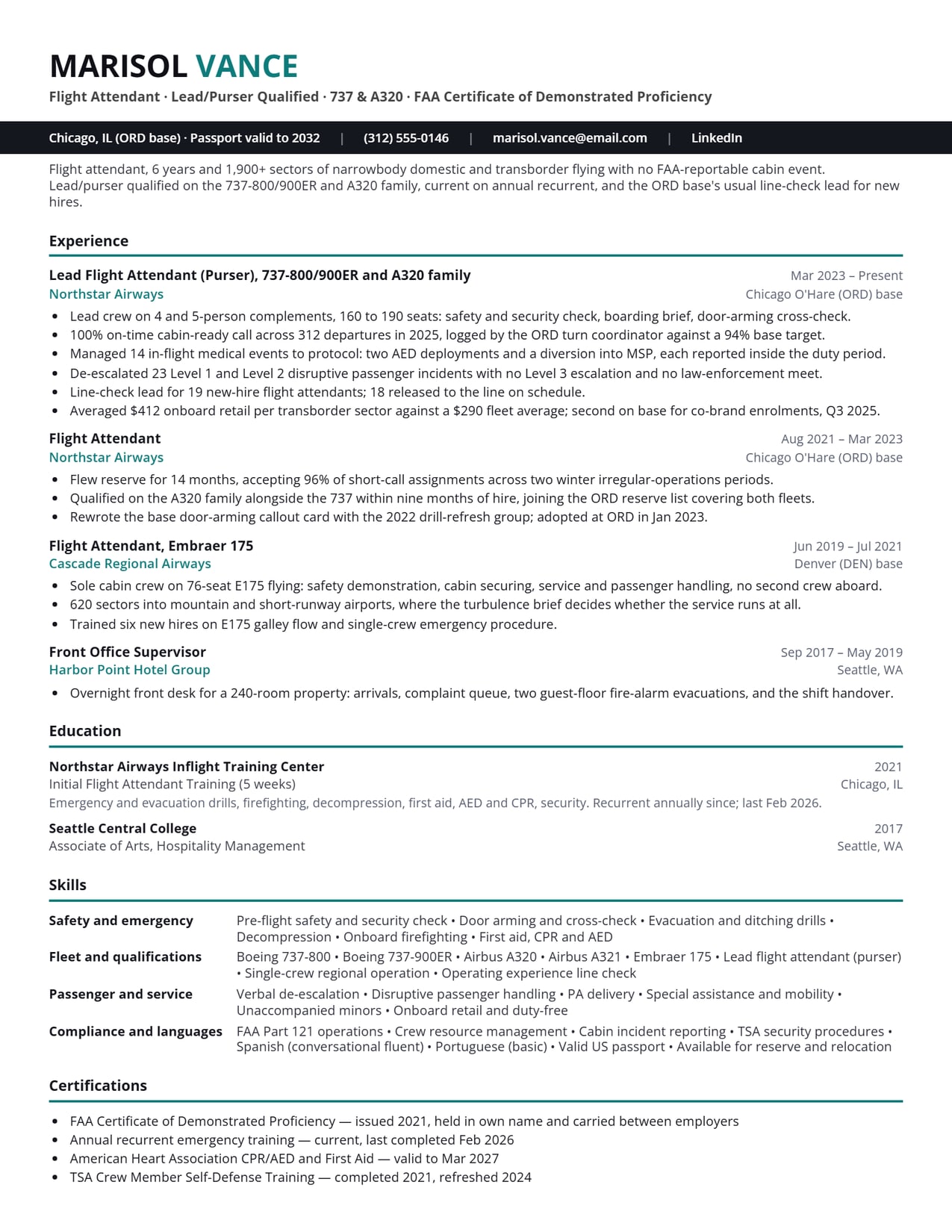
Put the qualification in the title line rather than saving it for the bottom of the page. "Flight Attendant · Lead/Purser Qualified · 737 & A320 · FAA Certificate of Demonstrated Proficiency" answers the rostering question in the first inch. Add your base or nearest airport and your passport validity: crew hiring is base-by-base, and a recruiter filling an ORD class needs to know whether you are already there.
Professional summary
Three lines, one of which is a safety fact. Years, sector count, fleet, lead qualification, recurrent currency and a language if you have one. "Passionate about delivering exceptional customer service" is true of every applicant in the pile and checkable in none of them.
Experience: the current role
Open with the crew complement and the aircraft, not with a verb. Cabin size, crew size, sector volume and the checks you are responsible for tell a recruiter what level you operate at before any achievement lands. Then give the numbers: cabin-ready performance, medical events handled, de-escalations, and where each figure was recorded.
The earlier years at the same airline
Split a promotion into two entries rather than collapsing it into one. It shows the progression, it dates the lead qualification, and it gives you somewhere to put the unglamorous things that recruiters actually value: reserve reliability, short-call acceptance, and getting through two winters of irregular operations without an attendance problem.
The regional years, written for what they prove
Single-crew regional flying is the strongest thing on many mainline applications and the thing most applicants undersell. Say it plainly: sole cabin crew member, full safety demonstration, cabin securing and passenger handling with nobody else aboard. That is a judgement claim a major cannot get from a first-time applicant.
The job before aviation, kept to one line
Keep pre-aviation work and keep it short. Hospitality, retail and healthcare all carry across, and one line is enough to show the shift pattern and the public-facing pressure. What it must not do is take the space the fleet and certificate block needs.
Education and initial training
Initial cabin crew training goes here, with the operator, the length and what it covered, and the date of your last recurrent. Academic education sits below it and gets one line. For a US resume the training entry matters more than the degree, because it is the thing that maps onto the carrier's own course.
Skills, split four ways
Safety and emergency, fleet and qualifications, passenger and service, compliance and languages. Splitting them lets a recruiter confirm four separate capabilities at a glance, and it forces you to list aircraft types individually instead of writing "narrowbody experience", which matches nothing a recruiter searches and tells a crew planner nothing they can roster around.
Certifications
Every line gets the issuing body and a date, and anything with a currency requirement gets the date it was last renewed. The FAA Certificate of Demonstrated Proficiency, your last annual recurrent, CPR and AED validity, and any self-defence training. "FAA certified" on its own is a category rather than a record.
Flight Attendant resume sample, annotated
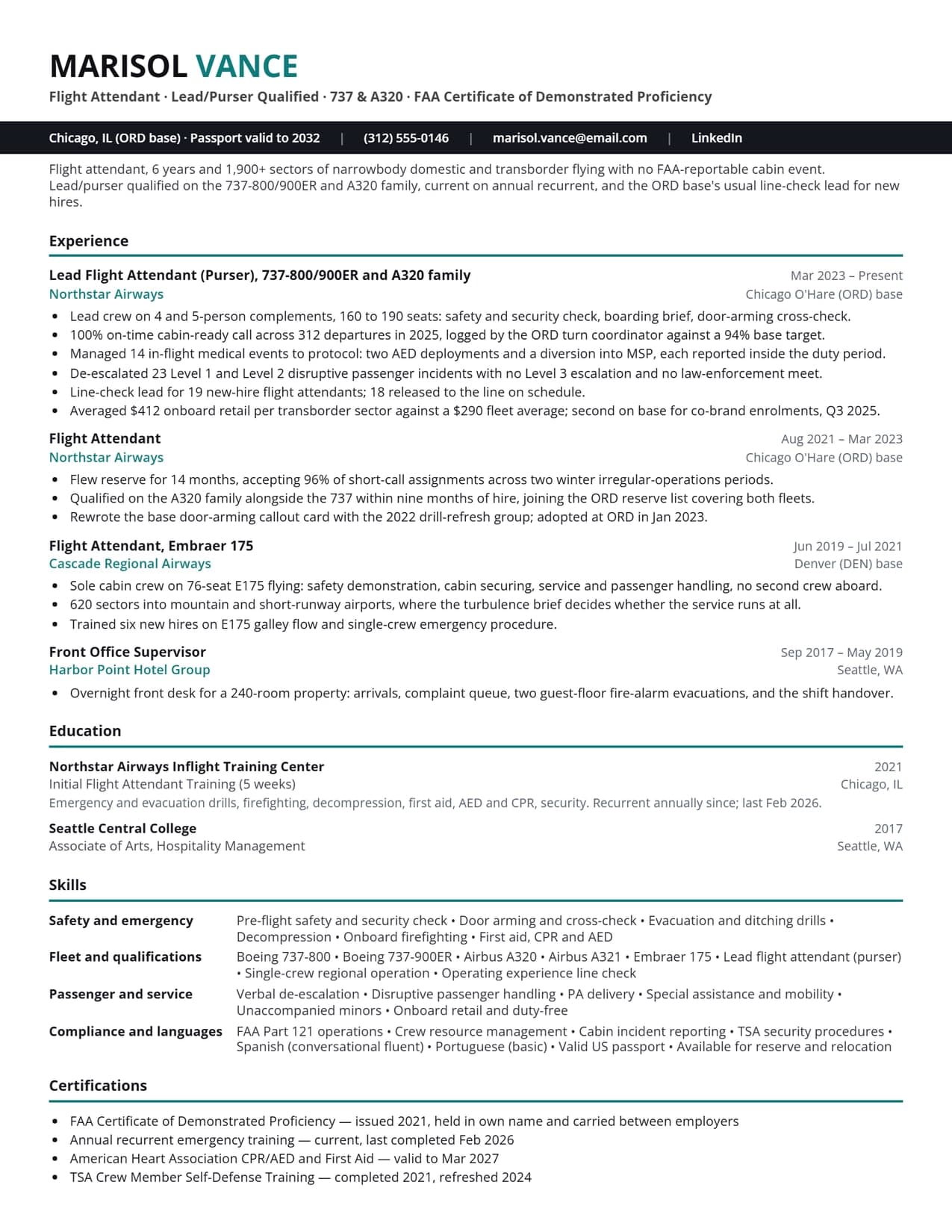
Marisol Vance, a lead flight attendant based at Chicago O'Hare with six years across a regional carrier and a US major, qualified on the 737-800/900ER and the A320 family
Six years, four employers, a fleet list and a certificate block on one page. Read it as a structure to copy rather than wording to copy, and pay attention to where the annotations say it falls short, because a sample that only praises itself teaches nothing.
The annotations follow the page top to bottom, in the order an airline recruiter reads it.
Header and title line
"Flight Attendant · Lead/Purser Qualified · 737 & A320 · FAA Certificate of Demonstrated Proficiency" is the best decision on the page. Role, seniority, fleet and credential arrive together before anything else is read, which is exactly the set of facts a recruiter filling a class needs. Most cabin crew resumes leave all four scattered between a summary paragraph and a certifications block at the bottom.
The contact line
"Chicago, IL (ORD base) · Passport valid to 2032" does two jobs in eight words. It says which class this application fits without anyone having to work it out, and it clears the passport question that otherwise sits unanswered until an interview. Both are screening fields.
Professional summary
Three lines carrying six years, a sector count, the fleet, the lead qualification, recurrent currency and a language. The strongest phrase is "no FAA-reportable cabin event", because it is a safety claim stated in the terms the industry actually records, and it is checkable.
First entry: complement before verbs
"Lead crew on 4 and 5-person complements, 160 to 190 seats" names the operating level before describing a single duty. Compare that with the "provided excellent customer service to passengers" that opens most resumes in this field, which would equally describe a first-week trainee.
The cabin-ready bullet
"100% on-time cabin-ready call across 312 departures in 2025, logged by the ORD turn coordinator against a 94% base target" is the strongest line here. It gives the measure, the volume, the period, the comparison and where the number lives. On-time departure is what a station is judged on, so this reframes a flight attendant as someone who protects the operation.
The medical events bullet
Fourteen events, two AED deployments and one diversion, each reported inside the duty period. The reporting clause is doing the quiet work: it says the paperwork was done, which is the difference between a crew member who handles an emergency and one who handles an emergency and then creates a compliance problem.
The de-escalation bullet
"23 Level 1 and Level 2 disruptive passenger incidents with no Level 3 escalation and no law-enforcement meet" uses the carrier's own severity language. That is the right instinct: writing in the terms the industry logs events in tells a recruiter you have actually filed these reports rather than read about them.
Splitting the promotion into two entries
The same airline appears twice, which dates the lead qualification and gives the reserve years somewhere to live. The reserve bullet is the one most applicants leave out and the one crew scheduling cares most about: 96% short-call acceptance across two winters is a reliability claim in a job where reliability is the whole product.
The regional years
"Sole cabin crew on 76-seat E175 flying" is the sentence that would get this application read at a major. Single-crew operation means every decision on the aircraft was made without a colleague to check it against, and that is a judgement claim a candidate cannot manufacture.
The hotel job, kept to one line
Correctly sized. It shows the shift work and the public-facing pressure that made the transition plausible, and then it gets out of the way. Two paragraphs on a job that ended in 2019 would have cost the fleet list its space.
Skills, split four ways
The fleet row is what makes this resume surface when a crew planner searches an applicant pool for A321 or E175 qualification. The weakness is the template's own heading: "Skills" undersells a block whose second row is a rostering answer and whose fourth row settles passport, languages and relocation.
Certifications at the bottom
Every line carries an issuing body and a date, and the certificate line says it is held in the applicant's own name and carried between employers, which is both true and something most applicants do not realise. The placement works only because the title line already carried the credential; without that, this block belongs directly under the summary.
The honest gap
There is no reference to the cabin reports behind those numbers, and no seniority number, which at a US major decides your bidding position and is not something a resume can carry. Bring your training records and recurrent dates to the interview. The resume's job is to get you into the room and into the recorded interview that usually follows it.
What an airline recruiter checks in the first few seconds
Cabin crew recruiting is a cohort problem. A carrier opens a class with a start date, a base and a headcount, and the screening exists to reduce a very large pile to a shortlist for a recorded interview. The first pass is a short series of yes-or-no checks rather than a considered read, and a gap at any one of them ends it.
Five questions, roughly in this order.
Turn cabin crew duties into evidence: eight rewrites
Every line below is a real thing cabin crew write. The rewrite carries the same fact and adds the scale, the outcome or the comparison that makes it worth reading.
Instead ofProvided excellent customer service to passengers on domestic flights.
WriteLead crew on 4 and 5-person complements, 160 to 190 seats: pre-flight safety and security check, boarding brief, door-arming cross-check, 90 to 110 sectors a quarter.
The first sentence describes every cabin crew member who has ever held the job. The second gives the crew size, the cabin size, the checks you own and the volume, which is what a recruiter needs to place you.
Instead ofFAA certified flight attendant.
WriteFAA Certificate of Demonstrated Proficiency — issued 2021, held in own name and carried between employers.
The certificate is a real document with an issue date, and it belongs to you rather than to the airline that trained you. Writing it as a record rather than a category is the difference between a claim and something verifiable.
Instead ofEnsured passenger safety and comfort at all times.
WriteManaged 14 in-flight medical events to protocol: two AED deployments and a diversion into MSP, each reported inside the duty period.
Safety claims are only worth anything with a count and an outcome. The reporting clause is what turns it from an anecdote into evidence that the compliance half of the job was done too.
Instead ofDealt with difficult passengers.
WriteDe-escalated 23 Level 1 and Level 2 disruptive passenger incidents with no Level 3 escalation and no law-enforcement meet.
Using the severity language the industry logs events in signals that you have filed these reports. The negative outcome, no escalation and no meet, is the achievement.
Instead ofAlways on time and reliable.
WriteFlew reserve for 14 months, accepting 96% of short-call assignments across two winter irregular-operations periods.
Reliability is unprovable as an adjective and easy as a number. Short-call acceptance is exactly the figure crew scheduling would ask about, and almost nobody volunteers it.
Instead ofWorked on regional aircraft.
WriteSole cabin crew on 76-seat E175 flying: safety demonstration, cabin securing, service and passenger handling, no second crew aboard.
Single-crew operation is the strongest thing on a regional resume and the thing most applicants throw away. It says every decision was made without a colleague to check it against.
Instead ofHelped train new crew members.
WriteLine-check lead for 19 new-hire flight attendants; 18 released to the line on schedule.
A release rate is the only version of this claim that means anything, and it tells a base manager you can be given a new hire on a real flight without supervision.
Instead ofSold duty-free items on board.
WriteAveraged $412 onboard retail per transborder sector against a $290 fleet average; second on base for co-brand enrolments, Q3 2025.
Onboard revenue is measured per sector and ranked, so the comparison is available and the raw figure without it means nothing. Put the benchmark in.
A first cabin crew application: what actually counts
Nobody starts qualified, and airlines hire large numbers of people with no flying experience every year, so this is a normal application rather than a weak one. What changes is what the page leads with.
What to lead with, by kind of carrier
The same six years should be arranged differently depending on where you are sending it. This is the edit most cabin crew never make, and it costs them interviews at the airlines they most want.
| Where you are applying | Lead with | Do not bury |
|---|---|---|
| US major, narrowbody domestic | Certificate and issue date, fleet list, base, lead qualification, sector volume | Reserve reliability and short-call acceptance |
| US regional | Single-crew capability, availability to relocate, willingness to commute | First aid and AED currency, and any second language |
| Low-cost and high-frequency short haul | Turn times, cabin-ready performance, onboard sales per sector | Attendance across an irregular-operations period |
| Long haul and widebody | Rest and duty familiarity, service flow across a long cabin, languages | Medical event handling and diversion experience |
| Gulf carriers | Languages, relocation readiness, service standards and grooming compliance | Emergency training currency and the exact name of your initial course |
| Corporate and private aviation | Discretion, catering and single-crew autonomy, flexibility at short notice | Food safety training and any specific type experience |
Certifications, written so a recruiter can act on them
This block is short and it is the one most often written carelessly. Three rules cover it.
First, name the document and date it. The FAA states in its guidance to operators that after 11 December 2004, no person may serve as a flight attendant on an air carrier aircraft with 20 or more seats unless they hold a Certificate of Demonstrated Proficiency issued by the FAA to that individual, and that the certificate is the property of the individual rather than of the air carrier that employs or trains them. Write it as a dated record, and say it is held in your own name.
Second, say what keeps you current. Annual recurrent emergency training with the month it was last completed, and CPR and AED validity with an expiry. Currency is the question a crew planner is actually asking, and a certificate with no recurrent date does not answer it.
Third, separate the qualification from the airline's internal endorsement. A lead or purser qualification belongs to the carrier that gave it, so name the carrier and the year. A new employer will retrain you and will still want to know you have done the role.
Outside the US: the same resume, a different gate
The structure of this page travels unchanged. What changes is the credential that decides whether you can be employed at all, and naming it wrongly is the quickest way to look like an outsider to the industry.
In the UK the gate is the Cabin Crew Attestation. The UK Civil Aviation Authority states that to be eligible for one you must be at least 18 years of age and must have successfully completed the required initial training course and the associated examination in accordance with the Basic Regulations, and that the training is delivered and the attestation issued by companies the CAA has approved to do so. Lead with your attestation and its issue date, name the approved organisation that issued it, and add the medical assessment your regulator requires. The document is a CV rather than a resume, and the role is cabin crew rather than flight attendant.
For carriers elsewhere, including the Gulf and Asia-Pacific, the qualification generally comes through the operator's own approved initial course rather than through a certificate you hold independently. Write the operator, the course name and length, and the date of your last recurrent, exactly as the certificate reads. Do not translate it into US terminology, because a recruiter checking your file is looking for the words on the document.
The stage that usually comes after the resume
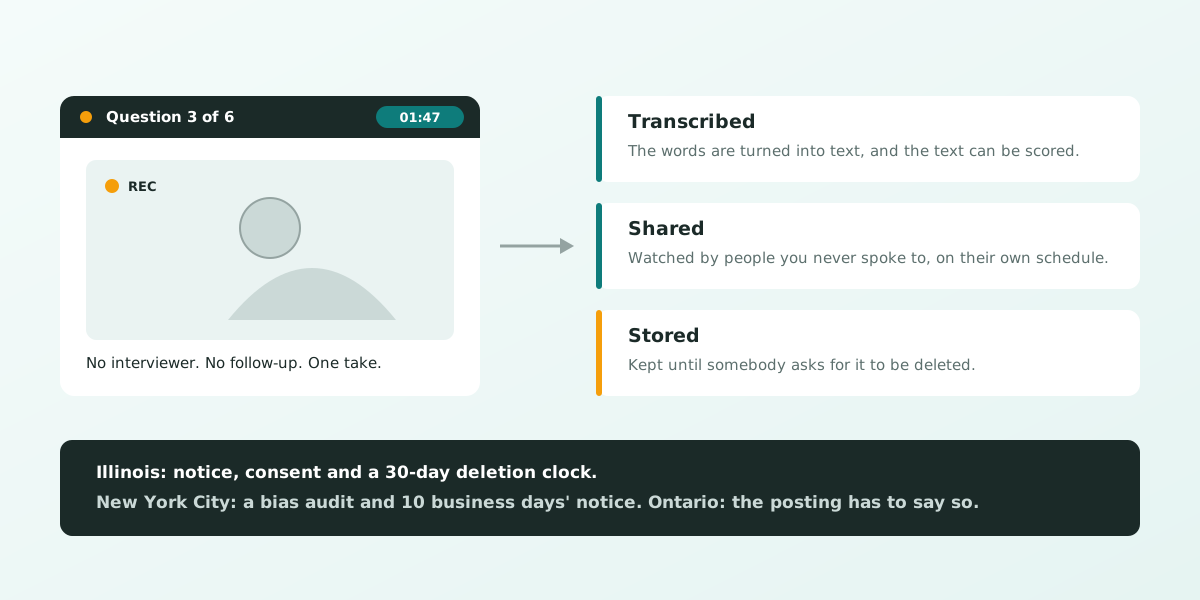
Cabin crew hiring at volume rarely goes from resume to interview room. The step in between is normally a recorded, one-way video interview: fixed questions, a countdown, no interviewer, and a deadline a couple of days out.
That matters for how you write this page, because the vocabulary carries over. The nouns on your resume are the nouns to say out loud, since these recordings are commonly transcribed and the transcript is what gets searched and scored. Saying "the system" where your resume says "door arming and cross-check" throws away the work you already did.
Prepare the numbers the same way. Sector counts, medical events, de-escalations and cabin-ready performance should all be sayable in a full sentence with the period and the source attached, because that is what survives both a transcript and a recruiter watching at speed.
Keywords ATS looks for
Weave these into your resume where they’re true to your experience, and always mirror the exact wording from the specific job post you’re applying to.
Common mistakes to avoid
Flight Attendant resume: FAQ
What should a flight attendant put on a resume?
The certificate and the date it was issued, every aircraft type you are qualified on, whether you are lead or purser qualified, your sector volume, your base and your availability. Then two or three safety facts a recruiter can check: medical events handled to protocol, de-escalations that stayed below a law-enforcement meet, cabin-ready performance against the station's target. Service and sales numbers come after those, because the job is a safety job first.
Do I need a licence to be a flight attendant in the US?
You need an FAA Certificate of Demonstrated Proficiency, and it is worth understanding what it is because most applicants describe it wrongly. The FAA's own guidance to operators states that after 11 December 2004, no person may serve as a flight attendant on an air carrier aircraft with 20 or more seats "unless that person holds a Certificate of Demonstrated Proficiency issued by the FAA to that individual", and that the certificate "is the property of the individual, not the air carrier that employs or trains the individual". You earn it through an airline's initial training, and it goes with you when you leave, so it belongs on your resume with its issue date.
How do I write a flight attendant resume with no experience?
Lead with the things the job is actually screened on rather than with enthusiasm. Reach and height requirements you meet, a valid passport with no travel restrictions, availability to relocate to any base, ability to work rotating shifts and holidays, swim requirement if the carrier states one, and any first aid or CPR certification you already hold. Then evidence of the same behaviour in another setting: a job with shift work, a job with hostile members of the public, a job where a written procedure had to be followed exactly. One line about a real safety-critical procedure you followed beats a paragraph about loving travel.
How long should a flight attendant resume be?
One page for anything under about ten years. Airline recruiting runs at a volume where a second page is usually not opened at the first screen, and cabin crew work compresses well because most of what matters is a qualification, a fleet list and a handful of numbers. The sample on this page is six years and four employers on one page, which is what it looks like written tightly rather than trimmed.
What is the difference between a flight attendant and cabin crew on a resume?
They are the same job with different regional vocabulary, and you should use the one the airline uses. US carriers say flight attendant. UK, European, Gulf and Asia-Pacific carriers usually say cabin crew, and the document is a CV rather than a resume. Match the posting, because a keyword search is run on the airline's own term and "air hostess" in particular reads as dated to most recruiters now.
How do I list cabin crew qualifications outside the US?
Name the awarding framework, because the letters do not travel. In the UK, cabin crew hold a Cabin Crew Attestation. The UK Civil Aviation Authority states that to be eligible you must be "at least 18 years of age" and have "successfully completed the required initial training course and the associated examination in accordance with the Basic Regulations", with training conducted and the attestation issued by companies the CAA has approved for it. Write your attestation number and issue date, and add the medical assessment your regulator requires. For carriers in the Gulf and Asia-Pacific, name the operator's approved initial course, its length and the date of your last recurrent exactly as the certificate reads.
What numbers should go on a cabin crew resume?
Sector count over a stated period, crew complement and cabin size, cabin-ready or on-time departure performance against the station's target, medical events handled and how many involved an AED or a diversion, de-escalations that did not escalate further, new hires you line-checked and how many were released on schedule, and onboard sales against a fleet average if your carrier tracks it. Give the period and where the number was logged. A figure with a source survives a follow-up question and a figure without one does not.
Do airlines use automated screening for cabin crew applications?
Large carriers hire in cohorts and screen in stages, and the early stages are usually a form and a recorded interview rather than a person reading your resume. That is why the fleet, the certificate, the base and the availability need to be written as plain searchable text rather than implied. Our guide to one-way video interviews covers the stage that usually comes next and what the recording is used for.