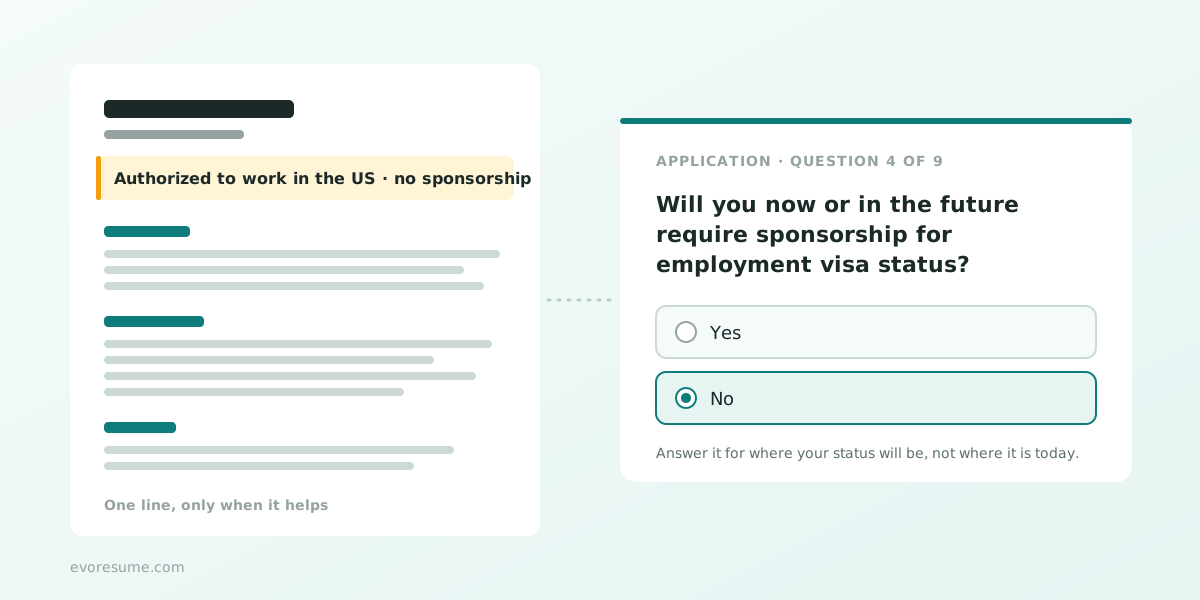
Your degree is from Lagos, your first two jobs were in Manila, and you have held a green card for four years. None of that is visible on the page. What is visible is a foreign university and an overseas employer, and a recruiter with two hundred applications to clear draws the obvious conclusion: this one will need a visa. They are wrong, and nobody tells you, because you are simply not called.
The opposite case is just as common. A graduate on a student visa puts “F-1 OPT, STEM eligible, H-1B required” in the header, answers the application's sponsorship question in the same breath, and gives the screener two chances to stop reading before they reach the work. Both people have the same problem: they are not sure what belongs on the résumé, and what belongs on the form. This guide separates the two, using what the immigration authorities and regulators in five countries actually say rather than the folklore that fills most careers forums.
Two different questions that get treated as one
Almost all the confusion here comes from mixing up two separate moments in an application.
- The résumé. A document you control completely. Nothing on it is required, so a work authorization line is a choice about what the reader will assume. The only question is whether stating your status removes a wrong assumption or creates a new objection.
- The application form. A set of questions the employer wrote. The sponsorship question is usually one of them, often a required yes-or-no that can screen you out automatically. You do not get to choose whether to answer it, only whether to answer it accurately.
Once you see them as separate, most of the advice falls into place. The résumé is for heading off a guess. The form is for the truth, stated once, in the place the employer asked for it.
When a right-to-work line helps, and when it costs you
Include it when
- Your history looks international but your status is settled. A foreign degree, overseas employers, a recent move, or a name a screener might wrongly read as a visa signal. If you are a citizen, a permanent resident or otherwise free to work for any employer, one line removes the guess before it costs you the call.
- The posting asks for it. Some adverts say “must have the right to work in the UK” or “Australian work rights required”. Mirroring the requirement in your header tells the screener, and any keyword search, that you meet it.
- You are applying across a border you are already allowed to work in. An Irish citizen applying in London, for instance. Recruiters outside immigration specialisms do not always know who has automatic rights, so say it.
- You are applying through an agency. Recruiters submitting you to a client are asked about eligibility before anything else, and a clear line saves a round of emails.
Leave it off when
- You will need sponsorship and the posting does not mention it. Stating it on the résumé does not make you more honest than answering the form does; it just moves the objection to the first line a person reads. Let the work make its case, and answer the form's question accurately when it comes.
- Your status is complicated. A pending application, a visa tied to a partner's, a permit with an end date. None of that fits on a résumé line without inviting a wrong conclusion. Explain it where there is room for a sentence: the form, a cover letter, or a conversation.
- It would mean adding nationality, date of birth or a photo. None of those prove a right to work, and in most of these five countries they are exactly the details you are advised to leave off. Our guide to photos and personal details on a résumé covers the country-by-country conventions.
Nationality: Nigerian · DOB 14/03/1994 · Passport no. A01234567 · Visa: Subclass 190 · Status: PR
Sydney, NSW · Full working rights in Australia (permanent resident)
The second version says everything the employer needs at the screening stage and nothing they do not. It also says it in the location line, which is where a recruiter's eye goes when they are wondering whether you are local, and where an applicant tracking system usually parses the header from.
How employers check, country by country
The reason a résumé line is optional is that the real check happens later, in a formal step every employer in these countries has to run. Knowing what that step is tells you what to write, and what you can safely leave for it.

United States
Every new hire completes Form I-9. USCIS guidance on completing Section 2 says the employer must do it “within 3 business days of the date of hire”, defined as the first day of work for pay, and that the employee chooses which acceptable documents to present: one from List A, or one from List B with one from List C. So your status is verified after the offer, from documents you pick. A résumé line is only ever a courtesy to the screener.
A line that works: Authorized to work in the US for any employer. It is accurate for citizens, green card holders and anyone else with unrestricted authorization, and it avoids naming a category that some readers will misunderstand.
United Kingdom
Employers carry out a right to work check before you start. GOV.UK's page on proving your right to work says British and Irish citizens can use a British passport or an Irish passport or passport card, while anyone who is not a British or Irish citizen can use a share code. When you generate a share code, the employer sees the types of job you are allowed to do in the UK and how long you can work there for. The stakes explain why employers take this seriously: GOV.UK sets the civil penalty at “up to £60,000 for each illegal worker”, avoided only by showing the correct checks were made.
A line that works: Full right to work in the UK, no sponsorship needed. If you hold settled or pre-settled status, a Graduate visa or another time-limited permission, be careful with “full”: say what is true, or say nothing and let the share code do it.
Australia
The Department of Home Affairs runs VEVO, which it describes as letting visa holders, employers and other organisations check visa conditions. Registered organisations can see the conditions of visa holders who have given them permission, and you can use VEVO to send proof of your own visa conditions to an employer. Australian citizens cannot use it; the department says to provide an Australian passport or citizenship certificate instead.
A line that works: Full working rights in Australia, with “(permanent resident)” or “(citizen)” where that helps. If your visa carries work conditions, the VEVO record states them precisely, so there is no need to paraphrase them on the page.
Canada
The check in Canada runs through the Social Insurance Number, and the timing matters. Employment and Social Development Canada's SIN Code of Practice tells employers directly: “Don't ask for the SIN on a job application or during an interview.” It is requested after hiring, and the same guidance says employers must ensure that employees with a SIN beginning with 9, which is issued to temporary residents, are authorized to work in Canada.
Two things follow for your résumé. Your SIN never goes on it, under any circumstances. And if you are a permanent resident or citizen with overseas experience, Eligible to work in Canada (permanent resident) saves a screener from guessing.
New Zealand
Immigration New Zealand is unambiguous that the check is the employer's job: “Before someone from overseas can begin working for you, you must check that their visa gives them the right to work in New Zealand.” Its VisaView service lets any New Zealand employer, once registered, check whether a prospective or current employee has a valid visa, its conditions, and the date it expires.
A line that works: Entitled to work in New Zealand, adding “(resident visa)” or “(citizen)” where that helps. A temporary visa with conditions is better left to the VisaView check, which shows the employer the conditions and the expiry date exactly.
“Will you now or in the future require sponsorship?”
This is the question people search for more than any other part of this topic, usually with the application open in another tab. The words that cause the trouble are in the future.
Sponsorship means the employer has to act so that you can keep working for them: file a petition, obtain a licence, assign a certificate. In the US, the H-1B specialty occupation route is the common example. The employer files the petition, and the programme has an annual limit of 65,000 new statuses or visas plus 20,000 more for people with a US master's degree or higher, allocated through an electronic registration. In the UK, a Skilled Worker needs to work for a UK employer that has been approved by the Home Office and hold a certificate of sponsorship from them.
“In the future” exists to catch people who can work today on permission that will end. The most common case is a US graduate on optional practical training. USCIS says certain STEM graduates can get a 24-month extension of post-completion OPT, and the employer has to be enrolled in E-Verify and complete a Form I-983 training plan. That is years of lawful work. But if you want to stay in the job after it ends, someone will have to sponsor you, so the honest answer to the question as written is usually yes.
How the answer usually works out
- Citizen or permanent resident: no, now or in the future.
- Unrestricted authorization with no end date you are relying on an employer to fix: no.
- Student or graduate work permission that ends, such as OPT or STEM OPT in the US: typically yes, because of the “future” half.
- Already on an employer-sponsored visa and moving jobs: typically yes, because the new employer has to take over or file afresh.
- A pending application or a status you are not sure about: answer the question as it applies to your status on the day you would start, and check with your university's international office or an immigration adviser before you guess. The question is short; the rules behind it are not.
What employers are and are not allowed to ask
Candidates often assume the sponsorship question is illegal. In the US, it generally is not. The Department of Justice's Immigrant and Employee Rights Section says in its employer fact sheet, Information for Employers About Citizenship Status Discrimination (updated April 2024): “Generally, an employer may ask job applicants if they have the legal right to work in the United States and if they will need sponsorship for an employment visa.” The same page calls it best practice to avoid asking for applicants' citizenship or immigration status itself.
What an employer usually cannot do is restrict the job. The fact sheet says the Immigration and Nationality Act protects US citizens, US nationals, recent lawful permanent residents, and people granted asylum or refugee status from citizenship status discrimination in hiring, and it lists posting language that risks violating the law:
- “Only U.S. Citizens”
- “Only U.S. Citizens or Green Card Holders”
- “Must present U.S. birth certificate”
- “H-1Bs or OPT Candidates Preferred”
The exception is narrow: IER's frequently asked questions say employers cannot limit applicants or hires to US citizens unless a federal, state or local law or a federal contract requires it, and the fact sheet adds that export control rules such as ITAR and EAR do not themselves require citizens-only hiring. If you are a green card holder or a refugee and a posting says “citizens only” with no stated legal reason, that is worth knowing. It also helps to know that USCIS's own Form I-9 instructions say employees may choose which acceptable documents to present, so a request for one specific document at the hiring stage is worth questioning politely.
The other four countries approach it differently. In the UK, the employer's legal duty is the right to work check itself, and sponsorship depends on whether the employer holds a sponsor licence at all. In Canada, the SIN must not be requested on an application or at interview. In Australia and New Zealand, the employer's obligation is to verify before work begins, and questions about work rights at application stage are routine.
If you need sponsorship: aim before you apply
If your honest answer to the question is yes, the most useful work happens before you write anything. Some employers sponsor routinely and many never do, and the difference is public in two of these countries.
- United States. USCIS publishes the H-1B Employer Data Hub, covering employers who have submitted H-1B petitions from fiscal year 2009 onward, searchable by employer name, city, state, ZIP code and industry code. An employer with years of approvals in your field is a far better use of an application than one with none.
- United Kingdom. The Home Office publishes the register of licensed sponsors, a list of organisations licensed to sponsor workers on the Worker and Temporary Worker routes. If an employer is not on it, they cannot sponsor you for a Skilled Worker visa today, however much they like your CV.
- Everywhere. Read the posting for the sponsorship line before tailoring anything. “Unable to sponsor” is common, it is usually final, and an application against it costs you the time you could have spent on one that was not.
Once you have a shortlist, the application itself becomes a normal one. Tailor the résumé to the posting's language, and run it through the free ATS score check to see which of the posting's terms are missing before you submit. If you are browsing roles by country, the EvoResume jobs board groups verified vacancies by country, and it is worth reading what employers actually verify before an offer, because the right to work check tends to arrive alongside the rest of the background screening.
What never belongs on the page
- Identity numbers. Passport, visa grant, alien registration, Social Security or Social Insurance numbers. A résumé travels through inboxes, agencies and databases you will never see, and none of these numbers is needed until you are hired.
- Documents. A scan of a visa, a permit or a card, attached “to save time”. The formal check uses its own process in every one of these countries, and an attached copy just creates another place your documents are stored.
- Expiry dates you have not been asked for. “Work permit valid until March 2027” invites the reader to count the months. If the date matters to the employer, the form or the check will surface it.
- Visa jargon a generalist will misread. Subclass numbers, category codes and abbreviations mean something to an immigration lawyer and very little to a hiring manager. Translate them into what they let you do.
Make the work the first thing they read
Paste a posting and see which of its terms your résumé is missing. Free to run.
Frequently asked questions
Should I put work authorization on my resume?
Only when it removes a wrong assumption or the posting asks for it. If your education or work history is international but you are free to work for any employer, one line such as “Authorized to work in the US for any employer” or “Full working rights in Australia” stops a screener guessing that you need a visa. If you do need sponsorship and the posting does not mention it, leave it off the résumé and answer the application form's question accurately instead.
How do I answer “Will you now or in the future require sponsorship?”
Answer it for the whole time you would want the job, not just today. Citizens and permanent residents answer no. People working on permission that ends, such as OPT or STEM OPT in the US, usually answer yes, because an employer would have to sponsor them to keep them on. Anyone already on an employer-sponsored visa who is changing jobs usually answers yes as well. If your status is unusual, check with an immigration adviser or your university's international office, and explain in a free-text field if the yes-or-no does not fit.
Is it legal for employers to ask if I need visa sponsorship?
In the US, generally yes. The Department of Justice's Immigrant and Employee Rights Section says an employer may generally ask applicants whether they have the legal right to work in the United States and whether they will need sponsorship for an employment visa. What an employer usually cannot do is limit a job to US citizens unless a law, regulation or government contract requires it. Posting language such as “Only U.S. Citizens” or “H-1Bs or OPT Candidates Preferred” is listed by IER as risking a violation.
Should I answer no to sponsorship to get past the screening?
No. Your status is verified anyway: in the US on Form I-9 within three business days of your first day of work, and in the UK through a right to work check before you start. A wrong answer surfaces after an offer, when the employer has the least room to help and good reason to doubt the rest of the application. Answer accurately and aim your applications at employers that sponsor.
How do I write right to work on a UK CV?
In one line near your contact details, and only if it helps. “Full right to work in the UK, no sponsorship needed” suits British and Irish citizens and people with settled status. If your permission is time-limited, describe it accurately or leave it for the right to work check, where you will prove it with a share code. Do not add nationality, date of birth or a passport number; none of them proves your right to work, and UK CV conventions leave them off.
Can an employer ask for my SIN before hiring me in Canada?
Employment and Social Development Canada's SIN Code of Practice tells employers not to ask for the SIN on a job application or during an interview. It is requested after you are hired. The same guidance says employers must make sure that employees with a SIN beginning with 9, which is issued to temporary residents, are authorized to work in Canada.
How can I find companies that sponsor visas?
In the US, USCIS publishes the H-1B Employer Data Hub, which lists employers who have filed H-1B petitions from fiscal year 2009 onward and can be searched by employer name, location and industry. In the UK, the Home Office publishes the register of licensed sponsors for the Worker and Temporary Worker routes; an employer that is not on it cannot currently sponsor a Skilled Worker. Beyond that, read each posting for a sponsorship statement before you tailor anything.
Do I need to put my visa type on my resume?
Rarely. A visa category or subclass number means little to most hiring managers and can invite a wrong conclusion. Where you want to say something, translate the visa into what it lets you do, such as “Authorized to work in the US for any employer” or “Entitled to work in New Zealand”. The employer's formal check will confirm the details later.